Skip to main contentEngineering Courses, Mentoring & Jobs | EveryEng
Pressure Vessel Design & Engineering using PV Elite banner
Live Online Class Advanced

Pressure Vessel Design & Engineering using PV Elite

3(70)
1316 views
COMPLETED

Tell us and we’ll notify you when the next batch is scheduled.

20 hrs
Jun 15, 2025 · 3:00 PM
English
1316 views

Shanmugam V
Shanmugam VLead / Senior Mechanical Engineer/Static Equipment Engineer
  • 7-day money-back guarantee
  • Session recordings included
  • Anytime Learning
  • Learn from Industry Expert

Is this course for you?

You should take this if

  • You work in Oil & Gas Upstream or Pharmaceutical & Healthcare
  • You're a Mechanical Engineering / Piping & Layout Engineering professional
  • You have 3+ years of hands-on experience in this field
  • You prefer live, instructor-led training with Q&A

You should skip if

  • You're new to this field with no prior experience
  • You need a different specialisation outside Mechanical Engineering
  • You need fully self-paced, on-demand content

Course details

  • Are you looking to make a Career in Pressure Vessel Engineering?

  • Are you already working as a Mechanical Static Engineer and wish to clarify your doubts from an expert?

  • Are you a beginner and wish to excel in pressure vessel engineering?

  • Do you have a plan to excel in PVelite software?

  • Are you preparing for a job interview and want to refresh your learning?

If your answer to any of the above questions is yes, then the following online course is perfectly designed for you. In the approximate 20 hours of course, the mentor will guide you in-person to understand all the crucks of pressure vessel design using ASME BPVC code.

The course will be conducted live at 8:30 PM IST from Monday to Friday (Each day 2 hours)

Special Note About the Software: Everyeng Training Team will not provide the software; The participant has to arrange for it in case he wishes to practice.

Course suitable for

Key topics covered

This course gives you a complete understanding & fundamentals of Pressure vessel Design & Engineering. Following topics are covered in this course

1. Overview Equipment in Energy Sector

a. Oil and gas Industry process equipment

b. Refinery and Petro-Chemical process equipment

2. Pressure vessel Engineering

a. Engineering Organization

b. Static Equipment discipline particular about pressure vessel team

c. Various Disciplines & stakeholders

d. How Static Equipment Department Works

e. Pressure vessel for Beginners

3. Components of Pressure vessel

a. Orientation of vessel

b. Different type of supports

c. Types of Flanges

d. Types of Nozzles

e. Types of Dish-end

4. Design of Pressure vessel

a. Understanding design parameters

b. Thickness Calculation for Internal and External pressure

c. Nozzle Reinforcement calculation

d. Local Load Analysis WRC 537 & WRC 297

e. Flange rating

f. Stiffiner ring design

g. Saddle design

5. Load Cases

a. Different types of internal and external loads & combinations

b. Wind loads

c. Seismic loads

d. Snow loads

e. Impact Loads

f. Transportation loads

g. Erection loads

6. Codes & Standards

a. Introduction to ASME Section VIII DIV 1 / 2 / 3 Standards

b. Dimensional Standards

c. Material Standards

d. Pipe thickness

e. Flange Standards

f. Fitting Standards

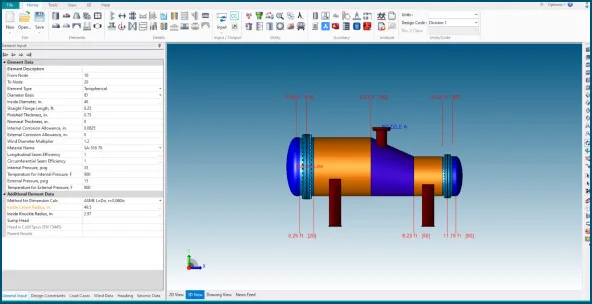
7. PV-ELITE Software Features

8. Modeling and Analysis of DIV 1 and DIV 2 Vessels

9. Codecalc 26 Component Analysis

10. Common Errors & resolving strategies

Opportunities that await you!

Skills & tools you'll gain

Career opportunities

Training details

This is a live course that has a scheduled start date.

Live session

Started

Sun, Jun 15, 2025 Ended

3:00 PM UTC· your timezone

Duration

2 hours per day

10 days total

Why people choose EveryEng

Industry-aligned courses, expert training, hands-on learning, recognized certifications, and job opportunities-all in a flexible and supportive environment.

COMPLETED

Jun 15, 2025 · 3:00 PM

Questions and Answers

A: Governing principle: MAWP sensitivity in Div 1 is dominated by joint efficiency when thickness and material are unchanged. Here, the shell calcs align with GA and inspection data, but PV Elite will silently penalize E when RT isn’t declared. Option C tempts engineers who’ve been burned by code-year shifts, yet the allowable stress delta isn’t large enough to explain a 15% MAWP drop on its own.

A: Governing principle: external pressure failure is controlled by rate and availability of make‑up gas, not PSV settings. With the PSV blinded, purge flow can outpace in‑leak and exceed external pressure limits. Option D traps engineers who assume vacuum capacity by default, ignoring that Div 1 requires explicit external pressure checks.

A: Governing principle: horizontal vessels rely on saddles to manage bending while controlling local shell stress and corrosion. Sleepers with wear plates address CUI and distribute load. Option B sounds inspection-friendly but ignores shell damage risk from steel‑to‑steel contact under thermal movement.

A: Governing principle: Div 1 external pressure uses chart‑based A and B factors tied to D/t and L/D. Running the numbers lands near half a bar for this geometry. Option D catches those who know the theory but skip the mandatory chart method required by code.