
Preview this course
Self-paced Advanced
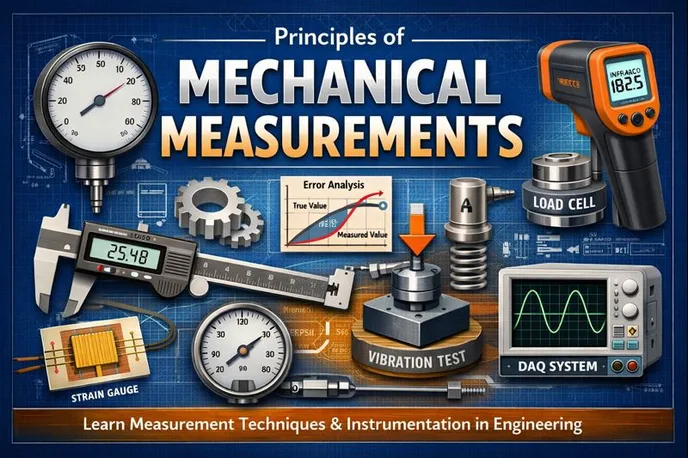
Principles of mechanical measurements
4(117)
239 views
FREE
1975 min
Anytime
English
239 views
Engineering AcademyLearn Without Limits: Free Engineering Courses
- Lifetime access
- Anytime Learning
- Learn from Industry Expert
- Career Option Guideline
Why enroll
Is this course for you?
You should take this if
- You work in Manufacturing & Industrial
- You're a Mechanical Engineering / Instrumentation Engineering professional
- You have 3+ years of hands-on experience in this field
- You prefer self-paced learning you can revisit
You should skip if
- You're new to this field with no prior experience
- You need a different specialisation outside Mechanical Engineering
- You need live interaction with an instructor
Course details
Course suitable for
Key topics covered
Course content
The course is readily available, allowing learners to start and complete it at their own pace.
34 lectures32 hr 55 min
- Principles of Mechanical Measurement [Intro video]11 min
- Introduction to measurement72 min
- Generalized measurement system & static characteristics61 min
- Uncertainties in measurement58 min
- Statistical treatment of random errors63 min
- System response to periodic inputs68 min
- Zeroth & first order systems67 min
- First & second order systems58 min
- Basics of digitization & number systems69 min
- Binary logic gates & binary codes65 min
- Analog-to-digital conversion61 min
- Digital-to-analog conversion58 min
- Electromagnetic indicators65 min
- Electronic amplifiers & filters60 min
- Resistive devices68 min
- Inductive, capacitive & optical devices57 min
- Piezoelectric & nozzle-flapper transducers45 min
- Resistive strain gages & associated circuitry63 min
- Strain gage rosettes & gage orientation57 min
- Elastic & strain gage load cells47 min
- Various load cells & dynamometers60 min
- Principles of manometry74 min
- Piezometer & elastic pressure transducer57 min
- Electric pressure transducer and high & low pressure measurement51 min
- Bernoulli's equation in obstruction meters64 min
- Obstruction meters & volume flowmeters60 min
- Mass flowmeters & velocity probes68 min
- Expansion-based devices70 min
- RTD, Thermistor & Thermocouple72 min
- Introduction to pyrometers64 min
- Basic seismic transducer36 min
- Vibro-, velo- & accelerometer44 min
- Introduction to acoustic measurement44 min
- Radioactivity & its biological effects38 min
Opportunities that await you!
Career opportunities
Why people choose EveryEng
Industry-aligned courses, expert training, hands-on learning, recognized certifications, and job opportunities-all in a flexible and supportive environment.