<link href="https://fonts.googleapis.com/css2?family=Caveat:wght@500;700&family=JetBrains+Mono:wght@400;500;600&display=swap" rel="stylesheet" /> Skip to main contentEngineering Courses, Mentoring & Jobs | EveryEng
Principles of Metal Forming Technology banner
Preview this course

Principles of Metal Forming Technology

Principles of Metal Forming Technology banner
Preview this course
Self-paced Advanced

Principles of Metal Forming Technology

3(115)
241 views
FREE
1221 min
Anytime
English
Engineering Academy
Engineering AcademyLearn Without Limits: Free Engineering Courses
  • Lifetime access
  • Certificate of completion
  • Anytime Learning
  • Learn from Industry Expert
Volume pricing for groups of 5+

Why enroll

Participants join this course to gain a clear understanding of how metals are shaped through plastic deformation and how forming processes are applied in modern manufacturing. The course builds strong fundamentals in material behavior, metal flow, and formability, enabling learners to analyze and understand the mechanics behind various metal forming operations.

The program is highly beneficial for students and professionals aiming to work in manufacturing, production, automotive, aerospace, and heavy engineering industries. It enhances the ability to select appropriate forming processes, materials, and process parameters while addressing common forming defects and quality issues. Exposure to both conventional and modern forming techniques strengthens practical and analytical skills relevant to industrial applications.

By joining this course, participants develop a solid foundation for advanced studies in manufacturing technology and gain industry-relevant knowledge that supports careers in process design, tooling, production planning, and manufacturing optimization.

Is this course for you?

You should take this if

  • You work in Mechanics & Turbomachinery
  • You're a Mechanical Engineering / Production Engineering professional
  • You have 3+ years of hands-on experience in this field
  • You prefer self-paced learning you can revisit

You should skip if

  • You're new to this field with no prior experience
  • You need a different specialisation outside Mechanical Engineering
  • You need live interaction with an instructor

Course details

Principles of Metal Forming Technology is a core manufacturing engineering course that focuses on the science and engineering principles involved in shaping metals through plastic deformation. The course provides a comprehensive understanding of how metals behave under applied stresses beyond their elastic limit and how this behavior is utilized in industrial forming processes to produce components with desired shapes, dimensions, and mechanical properties.

The course begins with an introduction to the fundamentals of plastic deformation, including stress–strain behavior, yield criteria, flow rules, strain hardening, and the effects of temperature and strain rate on metal flow. Concepts of metal flow, formability, and workability are explained to help students understand the limits and capabilities of different materials during forming operations.

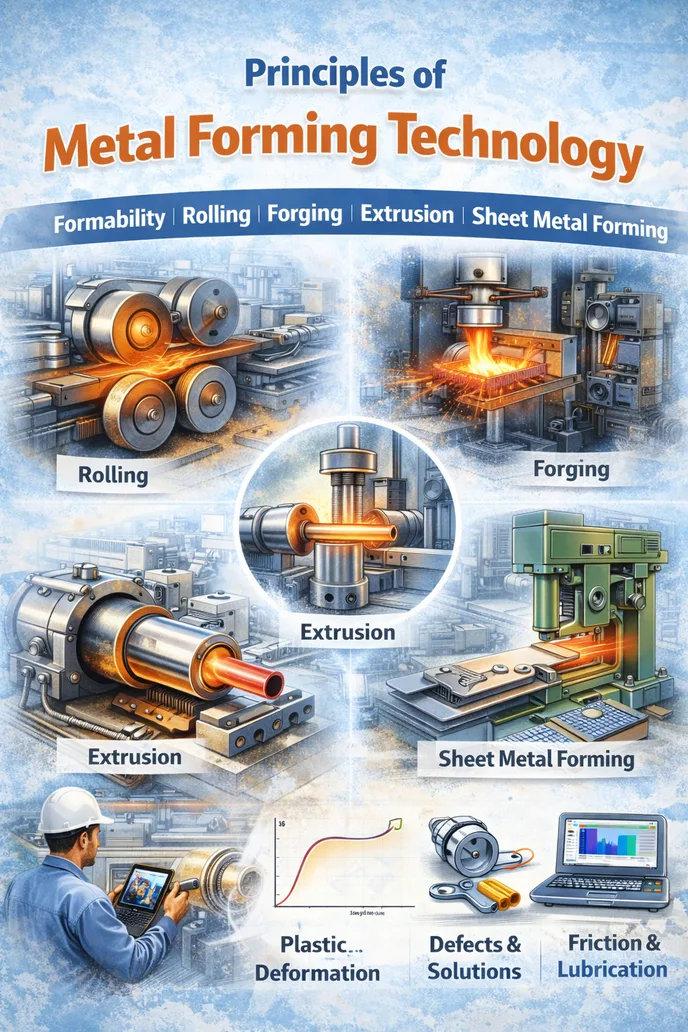
Various metal forming processes are studied in detail, including rolling, forging, extrusion, drawing, and sheet metal forming operations such as bending, deep drawing, and stretch forming. The working principles, process parameters, tooling, and equipment used in each process are discussed along with advantages, limitations, and typical industrial applications. The course also introduces defects in metal forming, such as cracking, wrinkling, and residual stresses, and methods for their prevention and control.

In addition, the course covers analytical and empirical approaches to metal forming analysis, including force and power requirements, friction and lubrication, and basic process modeling. Modern developments such as computer-aided metal forming, finite element analysis, and advanced forming techniques are introduced to provide exposure to current industrial practices.

By the end of the course, learners gain a strong theoretical foundation and practical insight into metal forming technologies, enabling them to analyze forming processes, select appropriate methods and materials, and contribute effectively to manufacturing process design, optimization, and quality improvement in metalworking industries.

source : NPTEL[youtube]

Course suitable for

Key topics covered

  • introduction to principles of metal forming technology

  • concept of stress & strain

  • state of stress in three dimension

  • introduction to theory of plasticity and flow curve

  • instability in tension

  • classification of metal working processes

Course content

The course is readily available, allowing learners to start and complete it at their own pace.

39 lectures20 hr 21 min

Opportunities that await you!

Career opportunities

FREE

Access anytime

Questions and Answers

A: Principle: Plastic deformation localizes where stress state and material strength interact unfavorably. Here the edge sees higher tensile stress from crown mismatch, and work hardening accelerates cracking as reduction increases. Backing off reduction lowers edge strain and arrests it. B catches engineers who know inclusions cause cracks, but those wouldn't turn off just by easing reduction per pass.

A: Principle: Presence-sensing safeguards stop motion but don't remove stored mechanical energy. A flywheel clutch failure can still transmit energy regardless of light curtain state, leading to uncontrolled motion. The other options are exactly what the curtain is meant to interrupt. C trips up people who assume control faults bypass presence sensing, but the safeguard still inhibits motion on detection.

A: Principle: Material flow must be restrained without over-constraining it. Excessive holder force starves the wall of material, raising tensile strain and causing tears. Using draw beads restores control while lowering global restraint. D tempts engineers who know lubrication helps, but it doesn't fix the over-restraining stress state.

A: Principle: Formability predictions hinge on accurate material flow stress and hardening behavior. A chemistry change can drop n-value, making localized necking happen earlier than the model shows. That's consistent with cracks despite 'green' results. B catches people focused on modeling practice, but coarse mesh wouldn't suddenly break correlation only after a material rev change.