<link href="https://fonts.googleapis.com/css2?family=Caveat:wght@500;700&family=JetBrains+Mono:wght@400;500;600&family=Plus+Jakarta+Sans:wght@600;700;800&display=swap" rel="stylesheet" /> Skip to main contentEngineering Courses, Mentoring & Jobs | EveryEng
Process Equipment sizing & selection banner

Process Equipment sizing & selection

Process Equipment sizing & selection banner
Live online Intermediate

Process Equipment sizing & selection

4(14)
71 views
₹ 14000
30 hrs
Next month
English
71 views
Enggenious (SAN Techno Mentors)
  • 7-day money-back guarantee
  • Session recordings included
  • Certificate of completion
Volume pricing for groups of 5+

Why enroll

Understand basic process engineering concepts behind equipment selection

Learn about fundamental design & sizing principles

Learn about various types & categories of equipments available

Learn about technical specifications & selection aspects

Understand how to select the right equipments for a particular process, from amongst various options available

Learn how to maintain a healthy balance between technically suitable & economically attractive systems

Learn about methods for optimizing the output obtained from an equipment

Learn about optimizing the process control instrumentation & automation commonly deployed with the equipment

Is this course for you?

You should take this if

  • You work in Industrial Automation or Manufacturing & Industrial
  • You're a Chemical & Process / Instrumentation Engineering professional
  • You have some foundational knowledge in the subject
  • You want to build skills in Control Systems, Electrical Maintenance

You should skip if

  • You're looking for an introductory overview course
  • You need a different specialisation outside Chemical & Process
  • You need fully self-paced, on-demand content

Course details

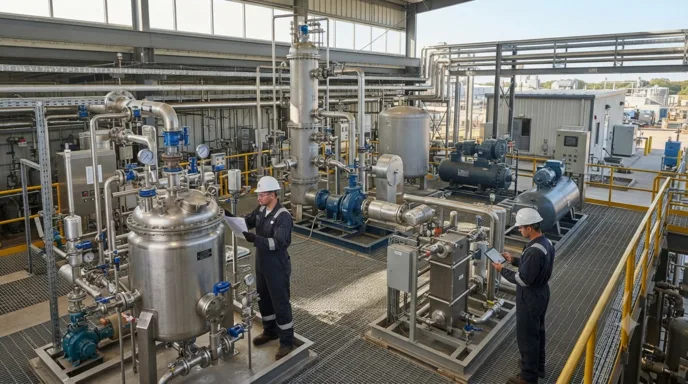
A wide variety of process equipments are used in the Chemical Process Industries (CPI) including Chemicals, Petrochemicals, Oil & Gas, & Allied Industries. Some of these equipments are used in other industries also, such as Power, Iron & Steel, & Cement. Examples of such widely used process equipments are tanks, reactors, agitators, pumps, compressors, boilers, chillers, heat exchangers, filters, columns, etc.

Proper selection, sizing & design of the process equipment(s) used is of paramount importance in the success of a chemical process plant. Suitability of the equipment for the location, process, personnel, technology & budget needs to be examined minutely. Various aspects that need to be considered while deploying particular equipment include material of construction, accessories, operating procedures, training, inspection, technical specifications, etc.

A wide choice of process equipments being available, it is of utmost importance to know which equipment should be used for what process. In addition to the above, compatibility of the various equipments in the plant, their interdependence, balancing equipments, & utilities required need to be evaluated with great care.

The course covers most of the above considerations while sizing & selection of these equipments. It will include theory in brief, design aspects, process & service specifications, selection, & application aspects of these equipments in a practical manner. Special emphasis will be given on the requirement & selection of instrumentation & control for these process equipments.

The course will be useful for process engineers & supervisors who will find it helpful in refreshing their knowledge, in addition to gaining valuable information concerning the practical aspects of these equipments. The course will also be useful for engineers having electrical, mechanical & instrumentation background, & working in maintenance, projects, design, site installation & commissioning.

Course suitable for

Key topics covered

Module 1 Introduction to chemical process engineering Evolution of chemical process engineering Introduction to unit operations Chemical process equipments Need for equipment sizing & selection

Module 2 Constraints involved in equipment selection Evaluation of equipments for suitability Technical specifications Interdependence & compatibility of equipments Accessories, balancing equipments & utilities Operating procedures & training requirements

Module 3 Pumps, piping, fittings, tanks, reactors, agitators, filters, centrifuges Types, processes, sizing & selection Instrumentation & control schemes

Module 4 Heat exchangers, evaporators, distillation columns, dryers, extractors, absorption columns, crystallizers Types, processes, sizing & selection Instrumentation & control schemes

Module 5 Boilers, chillers, compressors, vacuum pumps, thermic fluid heaters, brine units, cooling towers Types, processes, sizing & selection Instrumentation & control schemes

Opportunities that await you!

Skills & tools you'll gain

Control SystemsElectrical MaintenanceEngineering & DesignLean ManufacturingPreventive maintenance

Career opportunities

Training details

This is a live course that has a scheduled start date.

₹14000

₹0 Early bird

Coming in Next Month

Questions and Answers

A: A feels tempting because stress models drive real steel, but it ignores liquid carryover risk if the process intent was a downward inlet. B is the classic process-first instinct, yet it skips the need for a formal MOC and evidence of physical configuration. C borrows rules of thumb from slug catchers and applies them blindly to a specific vendor design. D is the trap: treating a geometry change as an operations tweak bypasses MOC, hydraulic checks, and warranty exposure when the vendor claims off-design inlet momentum.

A: A looks reasonable because any H2S raises flags, but ppmv levels at this temperature don’t drive SSC. C misreads pressure as temperature; 45°C is nowhere near HTHA onset. D confuses local damage mechanisms with the dominant, system-wide threat. B lines up with free water, CO2 partial pressure, and carbon steel, which sets corrosion allowance and inhibitor strategy.

A: A skips the entire basis change from standard to actual. B fixes pressure but quietly holds temperature constant, a common spreadsheet slip. D does the math loudly but drops Z, overstating volume at pressure. C carries all three corrections, landing where API 12J intent sits for capacity checks.

A: A assumes drawings never lie, despite last-minute safety studies. B imports a design philosophy that ignores alarm-only SIFs. D underestimates how often FAT follows the wrong basis. C forces reconciliation of LOPA, cause & effect, and hardware before commissioning risk locks in.