<link href="https://fonts.googleapis.com/css2?family=Caveat:wght@500;700&family=JetBrains+Mono:wght@400;500;600&family=Plus+Jakarta+Sans:wght@600;700;800&display=swap" rel="stylesheet" /> Skip to main contentEngineering Courses, Mentoring & Jobs | EveryEng
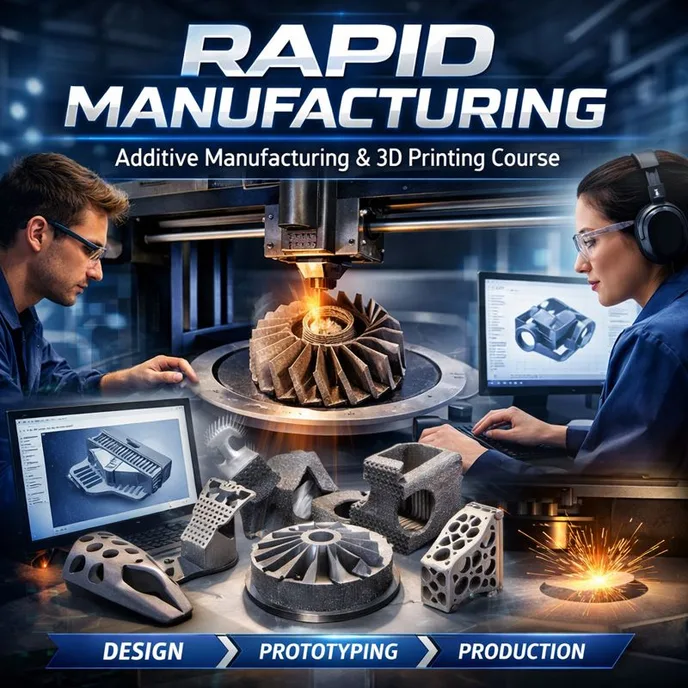
Rapid manufacturing banner
Preview this course

Rapid manufacturing

Rapid manufacturing banner
Preview this course
Self-paced Advanced

Rapid manufacturing

3(115)
175 views
FREE
1664 min
Anytime
English
175 views
Engineering Academy
Engineering AcademyLearn Without Limits: Free Engineering Courses
  • Lifetime access
  • Certificate of completion
  • Anytime Learning
  • Learn from Industry Expert
Volume pricing for groups of 5+

Why enroll

Why Participants Join

Participants join Rapid Manufacturing programs to gain practical and industry-relevant knowledge of modern digital manufacturing technologies that are transforming conventional production systems. The course equips learners with a strong understanding of additive manufacturing processes, digital design integration, and rapid production workflows, which are increasingly demanded across advanced engineering industries.

By joining, participants develop the ability to design and manufacture complex, high-performance components with reduced lead times and minimal tooling. The program enhances skills in CAD-driven manufacturing, material selection for additive processes, and optimization of designs for functionality, cost, and sustainability. Exposure to real-world industrial applications helps participants bridge the gap between theoretical concepts and practical implementation.

Additionally, participants benefit from learning how rapid manufacturing enables mass customization, agile supply chains, and faster time-to-market. This knowledge strengthens career prospects in sectors such as aerospace, automotive, biomedical, and product development, while also supporting innovation, entrepreneurship, and research-oriented roles in advanced manufacturing.

Is this course for you?

You should take this if

  • You work in Mechanics & Turbomachinery
  • You're a Mechanical Engineering / Production Engineering professional
  • You have 3+ years of hands-on experience in this field
  • You prefer self-paced learning you can revisit

You should skip if

  • You're new to this field with no prior experience
  • You need a different specialisation outside Mechanical Engineering
  • You need live interaction with an instructor

Course details

Rapid Manufacturing is an advanced and digitally driven production methodology that utilizes additive manufacturing and related rapid fabrication technologies to produce functional, end-use components directly from three-dimensional CAD models. Unlike conventional manufacturing processes that rely heavily on tooling, molds, and complex setup procedures, rapid manufacturing enables the direct transformation of digital designs into physical products with minimal human intervention, significantly reducing lead time and production complexity.

At the core of rapid manufacturing is the integration of computer-aided design (CAD), computer-aided manufacturing (CAM), and additive manufacturing techniques such as selective laser sintering (SLS), fused deposition modeling (FDM), stereolithography (SLA), electron beam melting (EBM), and direct metal laser sintering (DMLS). These technologies allow the layer-by-layer fabrication of components with intricate geometries, internal features, and lightweight structures that are difficult or impossible to achieve using traditional subtractive or formative processes.

Rapid manufacturing supports low-volume to medium-volume production, mass customization, and design iteration without the cost penalties associated with tooling changes. This makes it particularly valuable for industries with short product life cycles or high customization requirements, such as aerospace, automotive, medical devices, electronics, and consumer products. In biomedical applications, for example, rapid manufacturing enables patient-specific implants and prosthetics, while in aerospace it supports the production of lightweight, high-performance components with optimized material usage.

In addition to reducing time-to-market, rapid manufacturing improves supply chain agility by enabling decentralized and on-demand production. Digital inventories can replace physical stock, reducing storage costs and material waste. Furthermore, the ability to quickly modify designs based on testing and feedback enhances product innovation and performance optimization.

Overall, rapid manufacturing represents a paradigm shift in modern production systems, combining digital design, advanced materials, and automated fabrication to achieve faster development cycles, greater design freedom, and more sustainable manufacturing practices.

source: NPTEL[youtube]

Course suitable for

Key topics covered

  • introduction to rapid manufacturing

  • production development process

  • design for modularity

  • reverse engineering

  • laboratory demonstration

  • powder based process

Course content

The course is readily available, allowing learners to start and complete it at their own pace.

40 lectures27 hr 44 min
  1. Rapid Manufacturing-Introduction
    4 min
  2. Introduction to Rapid Manufacturing -I
    48 min
  3. Introduction to Rapid Manufacturing-II
    54 min
  4. Introduction to Rapid Manufacturing-III
    41 min
  5. Production development Process-I
    52 min
  6. Production development Process-II
    49 min
  7. Production development Process-III
    51 min
  8. Design for Modularity(Part-1 of 4 Design for Manufacturing)
    35 min
  9. Design for Modularity(Part-2 of 4 Design for Assembly)
    53 min
  10. Design for Modularity(Part-3 of 4 Design for Assembly)
    43 min
  11. Design for Modularity(Part-4 of 4)
    33 min
  12. Subtractive versus Rapid Manufacturing
    59 min
  13. Reverse Engineering -I
    53 min
  14. Reverse Engineering-II
    54 min
  15. Laboratory Demonstration, Co-ordinate Measuring Machine-I
    23 min
  16. Laboratory Demonstration, Co-ordinate Measuring Machine-II
    41 min
  17. Laboratory Demonstration, 3D scanners-I
    36 min
  18. Laboratory Demonstration, 3D scanners-II
    39 min
  19. Polymerization Processes -I
    52 min
  20. Polymerization Processes-II
    64 min
  21. Powder based processes-I
    37 min
  22. Powder based processes -II
    37 min
  23. Powder based processes -III
    39 min
  24. Extrusion based processes
    54 min
  25. Extrusion based processes-II
    35 min
  26. Sheet Stacking processes
    42 min
  27. printing processes
    49 min
  28. Laboratory Demonstration-I
    40 min
  29. Laboratory Demonstration-II
    31 min
  30. Laboratory Demonstration
    38 min
  31. Beam Deposition processes
    56 min
  32. Materials in Rapid Manufacturing-I
    59 min
  33. Materials in Rapid Manufacturing
    28 min
  34. Post-processing concerns-I
    29 min
  35. Post-processing concerns
    30 min
  36. Product costing for Rapid Manufacturing-I
    31 min
  37. Product costing for Rapid Manufacturing-II
    25 min
  38. Rapid Product Development, CAD/CAM -I
    53 min
  39. Rapid Product Development, CAD-II
    41 min
  40. Rapid Product Development, CAD-III
    26 min

Opportunities that await you!

Career opportunities

FREE

Access anytime

Questions and Answers

A: This choice explains a gradual trend while still passing spec and why tool alarms compress over successive runs. Offset habits would create step changes, not a smooth slide. Hardness shifts usually show up immediately on the first lot from that heat. Coolant issues accelerate wear but don't bias size in one direction unless paired with thermal drift.

A: One fixture per printer per day matches the 20 hr build constraint and sets the pace before assembly ever feels it. Assembly takt only matters once printed inventory exists. Parallelization is already baked in and can't beat printer hours. Post-processing is real, but not an order-of-magnitude limiter here.

A: This option balances speed, stiffness after post-machining, and chemical resistance within the 48-hour window. Machined aluminum meets tolerance but blows the schedule. Welded steel adds distortion risk and time. Modular systems are fast but struggle to reliably hold ±0.05 mm in high-mix setups.

A: Growing changeovers inflate lead time and WIP without moving OEE much because availability absorbs it. A quality hold would spike WIP abruptly, not trend. Data smoothing affects visibility, not physical WIP. Staffing issues usually hit performance first.