<link href="https://fonts.googleapis.com/css2?family=Caveat:wght@500;700&family=JetBrains+Mono:wght@400;500;600&family=Plus+Jakarta+Sans:wght@600;700;800&display=swap" rel="stylesheet" /> Skip to main contentEngineering Courses, Mentoring & Jobs | EveryEng
Selection of Nanomaterials for Energy Harvesting and Storage Application banner
Preview this course

Selection of Nanomaterials for Energy Harvesting and Storage Application

Selection of Nanomaterials for Energy Harvesting and Storage Application banner
Preview this course
Self-paced Advanced

Selection of Nanomaterials for Energy Harvesting and Storage Application

3(115)
143 views
FREE
661 min
Anytime
English
143 views
Engineering Academy
Engineering AcademyLearn Without Limits: Free Engineering Courses
  • Lifetime access
  • Certificate of completion
  • Anytime Learning
  • Learn from Industry Expert
Volume pricing for groups of 5+

Why enroll

Participants need to join the Selection of Nanomaterials for Energy Harvesting and Storage Applications program to gain a clear, application-oriented understanding of how advanced nanomaterials are identified, evaluated, and optimized for modern energy technologies. The course bridges fundamental material properties with real-world performance requirements in areas such as batteries, supercapacitors, fuel cells, and energy harvesting devices, enabling participants to make informed material selection decisions rather than relying on trial-and-error approaches. By focusing on structure–property–performance relationships, scalability, cost, and sustainability considerations, the program equips students, researchers, and industry professionals with practical insights that are directly relevant to current research challenges and industrial needs.

Is this course for you?

You should take this if

  • You work in Mechanics & Turbomachinery
  • You're a Mechanical Engineering / Production Engineering professional
  • You have 3+ years of hands-on experience in this field
  • You prefer self-paced learning you can revisit

You should skip if

  • You're new to this field with no prior experience
  • You need a different specialisation outside Mechanical Engineering
  • You need live interaction with an instructor

Course details

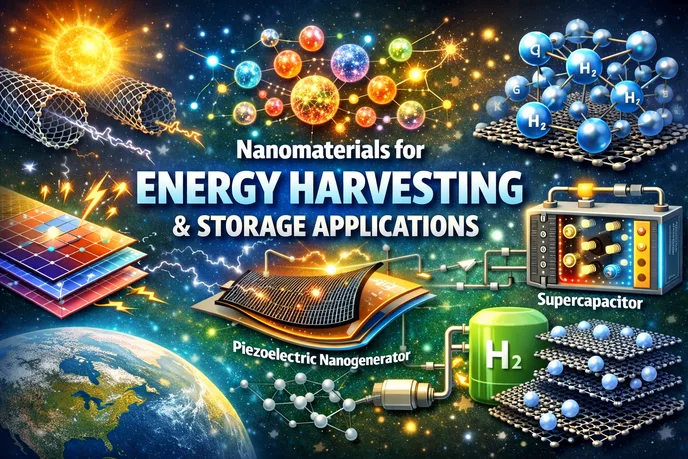
Nanomaterials play a crucial role in energy harvesting and storage applications due to their high surface area, tunable electrical and optical properties, and enhanced charge transport behavior. By carefully selecting nanomaterials—such as graphene, quantum dots, metal oxides, perovskites, and nanocomposites—engineers can significantly improve energy conversion efficiency, storage capacity, and device durability. The selection process focuses on matching material properties with application requirements, including conductivity, stability, scalability, and environmental compatibility, enabling the development of high-performance and sustainable energy systems.

Source: IIT Roorkee July 2018 [NPTEL Youtube]

Course suitable for

Key topics covered

  • Fundamentals of nanomaterials and nanoscale effects

  • Classification of nanomaterials for energy applications

  • Nanomaterials for energy harvesting (solar, mechanical, thermal)

  • Selection criteria for photovoltaic, piezoelectric, and thermoelectric materials

  • Nanomaterials for energy storage: batteries and supercapacitors

  • Role of graphene, carbon nanotubes, metal oxides, and perovskites

  • Performance metrics: energy density, power density, efficiency, and stability

  • Challenges in scalability, cost, and environmental impact

  • Emerging trends and future prospects in nanomaterial-based energy systems

Course content

The course is readily available, allowing learners to start and complete it at their own pace.

20 lectures11 hr 1 min
  1. Introduction
    46 min
  2. Solar Energy Harvesting
    46 min
  3. Perovskite Solar Cells
    30 min
  4. Solar Thermal Energy
    32 min
  5. Heat Transfer Fluids
    38 min
  6. Hydrogen Energy: Introduction & Hydrogen Production from Fossil Fuels and Biomass
    30 min
  7. Hydrogen Production from Thermochemical Process
    27 min
  8. Hydrogen Production from Electrolysis
    22 min
  9. Photo-electrochemical Production of Hydrogen Using solar energy
    22 min
  10. Hydrogen Production from Biological Process
    26 min
  11. Nanogenerators: Introduction & Piezoelectric Nanogenerators
    65 min
  12. Triboelectric Nanogenerators
    33 min
  13. Pyroelectric Nanogenerators IIT Roorkee July 2018
    32 min
  14. Thermoelectric Nanogenerators & Electromagnetic generators
    31 min
  15. Other Energy Resources
    38 min
  16. Energy Storage
    27 min
  17. Electrochemical Energy Storage (Batteries)
    28 min
  18. Supercapacitors
    24 min
  19. Hydrogen Storage
    33 min
  20. Thermal Energy Storage
    31 min

Opportunities that await you!

Career opportunities

FREE

Access anytime

Questions and Answers

A: Option A would require harvesting more energy than the vibration field can deliver locally, Option B imports bulk ceramic assumptions that don't hold for nanowire packing density, Option C ignores how quickly losses eat power at low strain amplitudes, Option D follows the acceleration-to-force estimate and applies a realistic efficiency ceiling.

A: Option A ignores documented capacitance fade at high cycle counts, Option B confuses mechanical strength with electrochemical stability, Option C risks dead surface area that never participates, Option D ties the material swap to measurable performance drivers that protect throughput.

A: Option A misses the surface-area-driven side reactions, Option B drops the geometric effect that dominates SEI formation, Option C jumps to a safety outcome not tied to particle size alone, Option D links the size change to SEI kinetics and a practical countermeasure.

A: Option A ignores every real loss term, Option B quietly drops non-sulfur mass that dominates in practice, Option C over-trusts early lab data, Option D walks through each derating step to land in a defendable band.