Skip to main contentEngineering Courses, Mentoring & Jobs | EveryEng
Shaft Alignment of Rotating Machines banner
Live Online Class Beginner

Shaft Alignment of Rotating Machines

4(14)
206 views
Trainers Rating
4(14)
Course type
Instructor led live training
Duration
18 hrs
Start
Next month
Language
English
Views
206
  • 7-day money-back guarantee
  • Session recordings included
  • Foundational Learning
  • Access to Study Materials
$ 150
Enggenious (SAN Techno Mentors)

Why enroll

• Types of Bearings

• The functions of a bearing in rotating machines

• The factors effecting the performance of rolling element bearings

• Bearing mounting and dismantling procedures

• Shaft alignment and how to correct for misalignment

• Bearing Inspection methods

• Causes of bearing failure

• Identify the symptoms of bearing trouble and describe how to remedy each situation.

• Shaft alignment, compensation for misalignment

• Root cause and Failure analysis

• Installation care and precaution

• Selection of lubricants

• Replacement procedures

• Tools for servicing

Course details

The overall course objective is to provide pertinent information and practical insight to improve the performance of rolling element bearings, which enhances the reliability of rotating equipment.

The course is designed for participants to understand the functions of bearings in relation to rotating equipment, its installation, its performance and to know the major signals/symptoms of Bearing failure. A basic understanding of the principles and practices of predictive maintenance is also covered.

Participants can use the skills and knowledge gained in this course to: Minimize bearing failures in equipment thus reducing downtime and cost; Perform regular preventive maintenance on equipments; and Quickly respond to bearing-related equipment and system failures.

The course discusses the modes of failure of bearings in equipments, how to check root cause and what methods available to eliminate them for the future.

Course suitable for

Is this course for you?

Perfect for

  • You work in Manufacturing & Industrial or Energy & Utilities
  • You're a Mechanical Engineering professional
  • You want to build skills in Drawing, GD&T
  • You prefer live, instructor-led training with Q&A

Before you enrol

  • No prior experience needed for this course
  • Live online sessions — join on the scheduled dates

Key topics covered

Bearings Basics Fundamentals of friction, frictional power loss Reduction of friction Basics of bearing technology Types of bearings, (journal and thrust) Merits demerits, bearing components, Bearing loads Construction of Bearing, Components Materials of Construction Single row and multiple row Bearings, NRBs

Bearing Installation Inspection of bearings before fitment Knowledge of tools and equipments

Bearing Operation

Maintenance practices Mounting and dismounting Causes of Failure of Bearings Types of Wear Failure Analysis Improving Reliability of bearings Specifications and Selection of Bearings for various applications

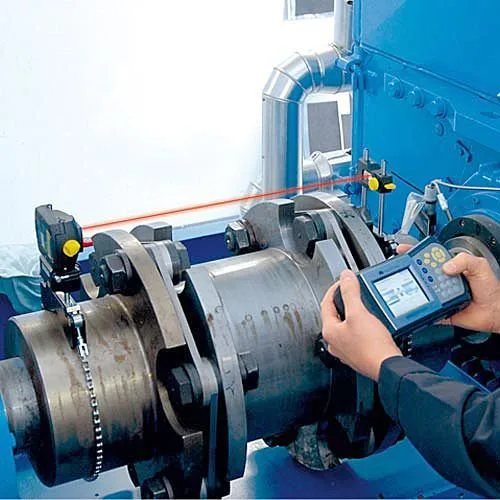
Alignment of Rotating Machines Bearing Performance monitoring and management Tools and Service Equipments for bearings Alignment process of rotating machines Theory behind alignment Detailed discussions on alignment

Training details

This is a live course that has a scheduled start date.

Opportunities that await you!

Career opportunities

Frequently asked questions

A: That's the most common mistake — assuming a flexible coupling forgives predictable thermal movement. It doesn't. Here you've got measured vertical growth at the pump casing, not angular distortion, so the cold alignment target has to preload the motor low by the same amount. Anything else pushes steady-state misalignment straight into the bearings.

A: That's the trap — looking at temperature alone and blaming bearings. Horizontal angular misalignment creates an axial force component at the coupling that lands on the pump thrust bearing, not the motor. The 1× signature lines up with that load path, and the cool motor bearings tell you the force isn't originating there.

A: That's the usual slip — using the coupling span instead of projecting to the feet. The slope is 0.20 over 500, so when you extend that to 750 mm you get 0.30 mm. And because the laser shows the motor low at the coupling, the inboard feet need lift, not removal.

A: That's where people underestimate scrutiny. At 1500 rpm with a spacer coupling, you need angular resolution and a data trail. Laser systems give both, plus repeatability. The others can work in a workshop, but they don't survive a COMAH audit when something trips later.

$150

Coming in Next Month

What learners say about this course

Industry-aligned courses, expert training, hands-on learning, recognized certifications, and job opportunities-all in a flexible and supportive environment.

Put no limit on your engineering passion.

We would love to hear from you.

Engineers collaborating around a laptop