Skip to main contentEngineering Courses, Mentoring & Jobs | EveryEng
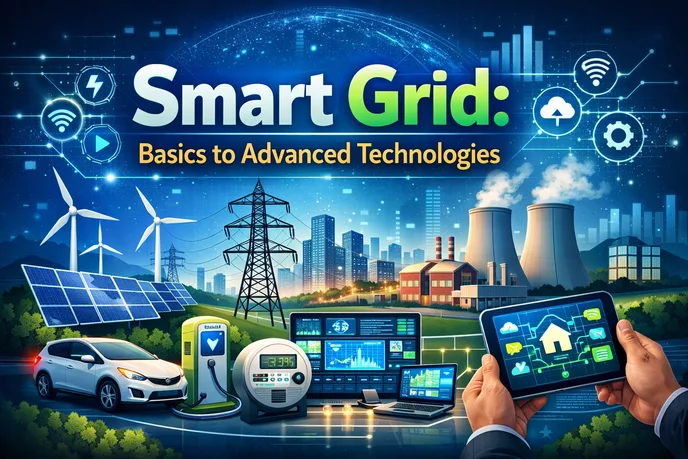
Smart Grid: Basics to Advanced Technologies banner
Preview this course

Smart Grid: Basics to Advanced Technologies

Smart Grid: Basics to Advanced Technologies banner
Preview this course
Self-paced Advanced

Smart Grid: Basics to Advanced Technologies

3(115)
1 enrolled
170 views
FREE
1019 min
Anytime
English
170 views
Engineering Academy
Engineering AcademyLearn Without Limits: Free Engineering Courses
  • Lifetime access
  • Certificate of completion
  • Anytime Learning
  • Learn from Industry Expert

Why enroll

Participants join this course to understand how modern smart grids work, learn about renewable energy and microgrids, gain knowledge of latest technologies like EVs and energy storage, improve practical and industry-relevant skills, and prepare for careers or higher studies in power and energy systems.

Is this course for you?

You should take this if

  • You work in Energy & Utilities
  • You're a Electrical Engineering / Information Technology professional
  • You have 3+ years of hands-on experience in this field
  • You want to build skills in Engineering & Design, Project Management

You should skip if

  • You're new to this field with no prior experience
  • You need a different specialisation outside Electrical Engineering
  • You need live interaction with an instructor

Course details

This course explains the basics of the smart grid and how it works with today’s power system. It introduces modern technologies such as electric vehicles, energy storage systems, microgrids (AC, DC, and hybrid), phasor measurement units (PMUs), and cyber security. The course also covers how energy storage systems are modeled, planned, operated, and controlled. It explains how AC, DC, and hybrid microgrids are designed and managed. Special focus is given to integrating renewable energy sources into the main grid and microgrids, along with their operation, control, protection, and monitoring. Some concepts are also demonstrated using laboratory-scale experiments for better understanding.

Source:
IIT Roorkee, July 2018 [Youtube Channel]

Course suitable for

Key topics covered

  • Introduction to Smart Grid — what it is and why it matters

  • Smart grid architecture and system standards

  • Core elements and technologies of a smart grid

  • Distributed generation resources (solar, wind, etc.)

  • Wide-area monitoring systems (WAMS) and phasor measurements

  • Phasor estimation methods

  • Digital relays and protection basics

  • Islanding detection techniques (detecting when a microgrid separates from the main grid)

  • Smart grid protection concepts (several parts)

  • Modeling of energy storage devices

  • Modeling DC smart grid components

  • Operation & control of AC microgrids

  • Operation & control of DC microgrids

  • Operation & control of hybrid AC–DC microgrids

  • Case studies and simulation examples (AC, DC, hybrid)

Course content

The course is readily available, allowing learners to start and complete it at their own pace.

30 lectures16 hr 59 min
  1. Smart Grid: Basics to Advanced Technologies
    4 min
  2. Introduction to Smart Grid-I.
    39 min
  3. Architecture of Smart Grid system
    47 min
  4. Standards for Smart Grid system
    58 min
  5. Elements and Technologies of Smart Grid System-I
    35 min
  6. Introduction to Smart Grid-II.
    40 min
  7. Elements and Technologies of Smart Grid System-II
    32 min
  8. Distributed Generation Resources-I
    34 min
  9. Distributed Generation Resources- II
    47 min
  10. Distributed Generation Resources- III
    35 min
  11. Distributed Generation Resources- IV
    40 min
  12. Introduction to energy storage devices
    27 min
  13. Different types of energy storage technologies
    20 min
  14. Analytical modelling of energy storage devices
    14 min
  15. Optimal sizing and siting of storages
    22 min
  16. Battery management system (BMS)
    35 min
  17. Wide area Monitoring Systems-I
    35 min
  18. Wide area Monitoring Systems-II
    46 min
  19. Phasor Estimation-I
    50 min
  20. Phasor Estimation-II
    39 min
  21. Digital Relays for Smart Grid Protection
    43 min
  22. Islanding Detection Techniques –II
    33 min
  23. Islanding Detection Techniques –III
    42 min
  24. Smart Grid Protection-I
    24 min
  25. Smart Grid Protection-III
    34 min
  26. Smart Grid Protection-IV
    32 min
  27. Modelling of storage devices
    31 min
  28. Modelling of DC smart grid components
    23 min
  29. Operation and control of AC Microgrid-I
    32 min
  30. Operation and control of AC Microgrid -II
    26 min

Opportunities that await you!

Skills & tools you'll gain

Engineering & DesignProject ManagementResearch & Developmnet

Career opportunities

Why people choose EveryEng

Industry-aligned courses, expert training, hands-on learning, recognized certifications, and job opportunities-all in a flexible and supportive environment.

What learners say about this course

Bhavani S
Bhavani S Student
Feb 22, 2026

Nice

Mohit Navelkar
Mohit Navelkar Mechanical Engineer
May 3, 2026

Grabbed this to tighten up system design thinking, not to chase math proofs, and it mostly fit that lane for a beginner course. The chapter that stuck was the self‑attention walkthrough where they freeze on a 4‑token sentence and sketch Q/K/V shapes on screen, then show how a tiny change in softmax temperature flips the output; that’s now a note in our repo next to an old PR. Framing transformers as an arch choice with tradeoffs helped when we talked about prod inference paths and why RPS falls off under longer contexts. it's light on infra realities, though. I wasn’t sold on the quick pass over scaling; a bit more on k8s placement, CI checks for model drift, or basic obs would’ve helped teams shipping this stuff. Still, it nudged us to clean up assumptions, and we’re already tweaking on‑call docs to match how attention actually behaves.

Avatar icon
Davey Enyia
May 3, 2026

The ramp from symbols to actual circuits didn't whiplash; concepts stacked in a way a beginner can keep in cache. Chapter 3’s Ohm’s Law bench demo stuck, especially the moment the instructor calls out the 9.6V sag on the multimeter after adding a second resistor, not just the formula. Framing labs like small PRs helped: wire it, test, note failure modes, then iterate, which maps to how things break in prod even if the domain’s different. Some bits were mostly fine but rushed; the AC section and power ratings felt thin, and I wasn't sold on skipping breaker safety beyond a slide. It's clean enough to run between meetings, though I've seen clearer obs on why mistakes happen when RPS goes up—one aside tying heat to failure would’ve helped. next pass, I’ll probably be sharper about gaps because this set a baseline.

Balaji Paskanti
Balaji Paskanti mechanical engineer
May 3, 2026

After weeks of arch debates on the team, this beginner pass on electricity helped ground the conversations. The moment in Chapter 2 where they derive Ohm’s Law using the LED + resistor calc and actually show why 330Ω works stuck with me. I wasn't sold on the AC section pace; wished there was a quick oscilloscope aside. I've already caught myself sanity-checking current limits before wiring, which might save a couple rough late nights later.

FREE

Access anytime

Questions and Answers

A: Governing principle: IEC 61850 protection messaging assumes deterministic delivery under worst-case load, not just good averages. Applied here: Shared VLANs create queueing delay during bursts; priority and traffic shaping preserve bounded latency without redesigning protection logic. Distractor trap: Option B appeals to engineers who know GOOSE retransmits, but retransmission doesn't cap delay once queues saturate.

A: Governing principle: IEEE 1547 aims to keep DER online during grid disturbances that are not faults. Applied here: Motor-start sags are brief and expected; adjusting LVRT avoids unnecessary disconnection while staying compliant. Distractor trap: Option D sounds grid-friendly, but fixed power factor doesn't address transient sags and can worsen recovery.

A: Governing principle: Energy equals voltage times amp-hours, then divide by load power. Applied here: 48 V × 100 Ah ≈ 4.8 kWh; at 0.12 kW the order-of-magnitude runtime is tens of hours. Distractor trap: Option D mixes up Peukert effects, which help at low currents but not by a factor of two.

A: Governing principle: PLC noise characteristics depend on network impedance and background interference, not just traffic volume. Applied here: Lightly loaded lines can worsen coupling and noise floor, so tuning PLC parameters is the right lever. Distractor trap: Option C feels logical to IT-minded engineers but ignores physical layer behavior.