
Preview this course
Self-paced Advanced
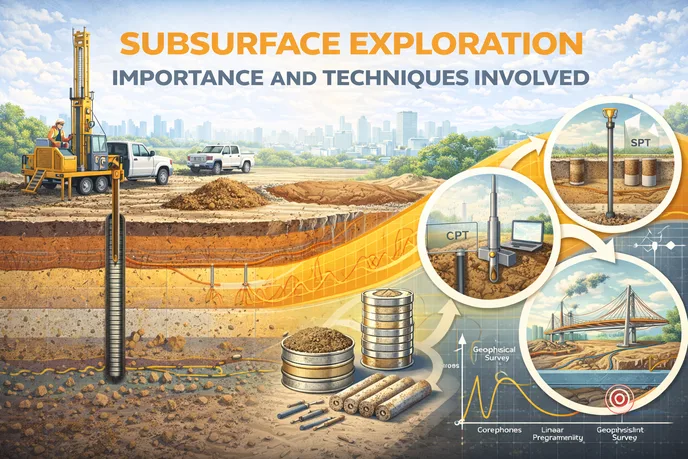
Subsurface Exploration :Importance And Techniques Involved
4(117)
246 views
FREE
1206 min
Anytime
English
246 views

Engineering AcademyLearn Without Limits: Free Engineering Courses
- Lifetime access
- Anytime Learning
- Learn from Industry Expert
- Career Option Guideline
Why enroll
Is this course for you?
You should take this if
- You work in Oil & Gas Upstream or Agriculture
- You're a Civil & Structural / Chemical & Process professional
- You have 3+ years of hands-on experience in this field
- You prefer self-paced learning you can revisit
You should skip if
- You're new to this field with no prior experience
- You need a different specialisation outside Civil & Structural
- You need live interaction with an instructor
Course details
Course suitable for
Key topics covered
Course content
The course is readily available, allowing learners to start and complete it at their own pace.
21 lectures20 hr 6 min
- Introduction43 min
- Phases and classification of subsurface Investigation60 min
- Test Pits+ Borings59 min
- Ground water table and rock drilling57 min
- Standard Penetration Test52 min
- Cone Penetration Test58 min
- Dilatometer Test63 min
- Pressuremeter Test62 min
- Seismic reflection method60 min
- Seismic refraction method57 min
- Electrical Resistivity Survey59 min
- Magnetic Survey66 min
- Surface wave method66 min
- Gravity Survey59 min
- Offshore Investigation49 min
- Geophysical Investigation in Offshore Environment44 min
- Sampling and Geotechnical Investigations in Offshore Environment68 min
- Important Terminologies in Offshore Environment70 min
- Dynamic Testing in Pile Driving54 min
- Dynamic Testing in Pile ( Low Strain)66 min
- Conclusion34 min
Opportunities that await you!
Career opportunities
Why people choose EveryEng
Industry-aligned courses, expert training, hands-on learning, recognized certifications, and job opportunities-all in a flexible and supportive environment.