<link href="https://fonts.googleapis.com/css2?family=Caveat:wght@500;700&family=JetBrains+Mono:wght@400;500;600&display=swap" rel="stylesheet" /> Skip to main contentEngineering Courses, Mentoring & Jobs | EveryEng
Fundamentals of welding science and technology banner
Preview this course

Fundamentals of welding science and technology

Fundamentals of welding science and technology banner
Preview this course
Self-paced Advanced

Fundamentals of welding science and technology

3(115)
141 views
FREE
1231 min
Anytime
English
141 views

Engineering Academy
Engineering AcademyLearn Without Limits: Free Engineering Courses
  • Lifetime access
  • Certificate of completion
  • Anytime Learning
  • Learn from Industry Expert
Volume pricing for groups of 5+

Why enroll

Participants join Fundamentals of Welding Science and Technology to build a strong conceptual and practical foundation in welding principles that are essential across manufacturing, fabrication, and structural industries. The course helps learners understand how welding parameters influence heat flow, microstructure, mechanical properties, and overall joint integrity, enabling more informed decision-making in design and production.

This course is particularly valuable for engineering students, early-career professionals, and researchers who want to strengthen their knowledge of welding metallurgy, process selection, and defect prevention. By developing a clear understanding of welding science and technology, participants enhance their technical competence, improve employability, and gain confidence in applying welding concepts to real-world engineering challenges.

Is this course for you?

You should take this if

  • You work in Mechanics & Turbomachinery
  • You're a Mechanical Engineering / Production Engineering professional
  • You have 3+ years of hands-on experience in this field
  • You prefer self-paced learning you can revisit

You should skip if

  • You're new to this field with no prior experience
  • You need a different specialisation outside Mechanical Engineering
  • You need live interaction with an instructor

Course details

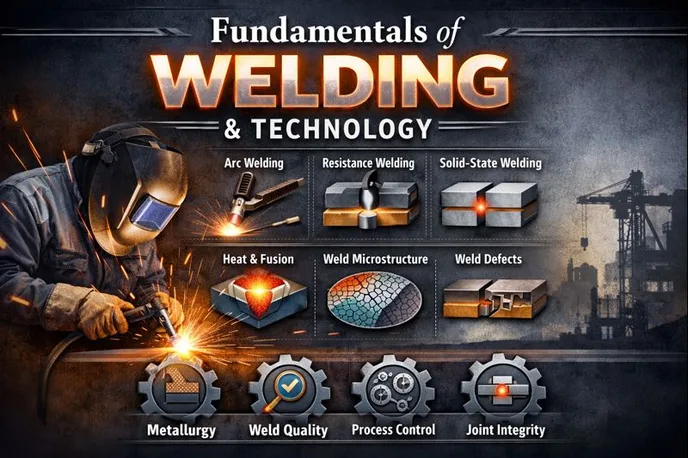
Fundamentals of Welding Science and Technology is a foundational course that introduces the scientific principles and technological practices governing modern welding processes. The course explains the physics of heat generation and transfer, melting and solidification behavior, and metallurgical transformations that occur during welding. Emphasis is placed on understanding weld pool dynamics, microstructural evolution, and the relationship between welding parameters and joint performance.

Participants gain exposure to major welding processes such as arc welding, resistance welding, and solid-state welding, along with the role of consumables, shielding methods, and power sources. The course also covers weld defects, residual stresses, distortion, and basic weld quality control techniques. By integrating materials science with process technology, this course builds a strong conceptual base for selecting, designing, and optimizing welding procedures in industrial and research applications.

source: NPTELIIT Guwahati

Course suitable for

Key topics covered

  • introduction of welding

  • classification of welding and joints

  • welding power sources

  • physics of welding

  • oxy-fuel gas welding

  • submerged arc welding

  • welding defects and inspection

Course content

The course is readily available, allowing learners to start and complete it at their own pace.

24 lectures20 hr 31 min

Opportunities that await you!

Career opportunities

FREE

Access anytime

Questions and Answers

A: At 0.1 kJ/mm you'd predict almost no HAZ width, which contradicts observed bead profiles at these currents. At 0.5 kJ/mm the implied travel speed would be unrealistically high for SMAW. At 5 kJ/mm you'd expect excessive penetration and burn-through on typical plate thicknesses. Using P=VI, applying efficiency, and dividing by a plausible 3–4 mm/s travel speed lands near 1–2 kJ/mm.

A: Starting with continuity logs can let an unqualified procedure slip through if the paperwork looks clean. Jumping to visual acceptance ignores whether the procedure itself is permitted. Reviewing NDT first risks validating welds made to an invalid process window. Ensuring the WPS is backed by a compliant PQR gates all downstream checks and prevents rework.

A: Excessive dilution mainly shifts chemistry but doesn't explain delayed cracking at the toe. Solidification cracking appears along the weld centerline during freezing, not after cooldown. Lamellar tearing tracks through-thickness inclusions and shows a different crack path. Hydrogen trapped by high restraint and rapid cooling produces delayed toe cracks hours after welding.

A: Arc eye to bystanders is mitigated by correctly placed screens. UV exposure drops sharply with opaque barriers. Visible glare is also blocked when screens are intact. Metal fumes travel over and around screens and still require ventilation and respiratory controls.