<link href="https://fonts.googleapis.com/css2?family=Caveat:wght@500;700&family=JetBrains+Mono:wght@400;500;600&display=swap" rel="stylesheet" /> Skip to main contentEngineering Courses, Mentoring & Jobs | EveryEng
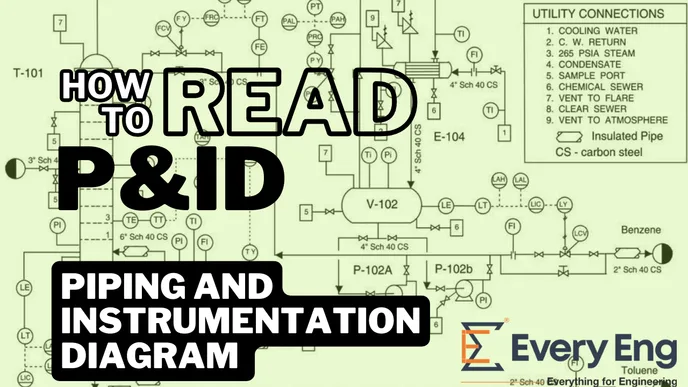
How to read Piping and Instrumentation Diagrams (P&IDs) ? banner
Preview this course

How to read Piping and Instrumentation Diagrams (P&IDs) ?

How to read Piping and Instrumentation Diagrams (P&IDs) ? banner
Preview this course
Self-paced Beginner

How to read Piping and Instrumentation Diagrams (P&IDs) ?

4(400)
10 enrolled
3108 views
₹ 89
81 min
Anytime
English
3108 views

Process Engineering World
  • 7-day money-back guarantee
  • Lifetime access
  • Certificate of completion
Volume pricing for groups of 5+

Is this course for you?

You should take this if

  • You work in Oil & Gas Upstream or Pharmaceutical & Healthcare
  • You're a Chemical & Process professional
  • You prefer self-paced learning you can revisit

You should skip if

  • You need a different specialisation outside Chemical & Process
  • You need live interaction with an instructor

Course details

Piping and Instrumentation Diagrams (P&IDs) are crucial in representing the intricacies of process systems in various industries. Accurately reading and understanding P&IDs is essential for efficient design, operation, and maintenance. This course teaches you how to decipher P&IDs, unlocking the secrets to effective process and system management.

Course suitable for

Key topics covered

Understanding P&ID’s. Reading P&ID’s, Key ideas and tips to understand hidden points in P&ID’s.

Course content

The course is readily available, allowing learners to start and complete it at their own pace.

3 lectures1 hr 21 min

Opportunities that await you!

Career opportunities

₹89

Access anytime

Questions and Answers

A: The hard boundary here is the 1.5 bar allowable ΔP called out on the P&ID. Steam sizing under IEC 60534 with expansion factor gives a Cv just under 100 for 5,000 kg/h at 10 barg. Treating it as liquid or taking full line pressure drop pushes Cv high, while ignoring downstream pressure depresses it unrealistically.

A: The key marker is the FC notation. Loss of air drives the valve open. On a separator this drains liquid inventory, exposing internals and pushing gas into liquid outlets. The P&ID intent is upstream flow reduction, not emergency blowdown.

A: The number that matters is the 90 barg HH relative to MAWP and control logic. A wider sensor span dulls resolution but doesn't change protection if scaling is right. Under audit, undocumented re-ranging or silent acceptance fails immediately.

A: The threshold is simply the presence of free water and CO₂ at modest temperature. That points straight to sweet corrosion. The other mechanisms need conditions that aren’t on the P&ID.