Skip to main contentEngineering Courses, Mentoring & Jobs | EveryEng
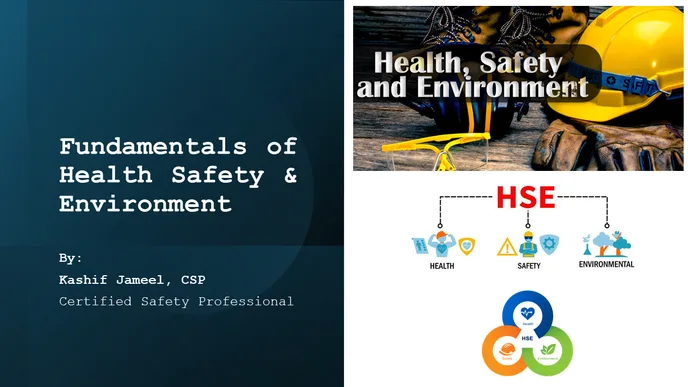
HSE Fundamentals: Workplace Health, Safety & Environment banner
Live Online Class Advanced

HSE Fundamentals: Workplace Health, Safety & Environment

4(8)
760 views
COMPLETED

Tell us and we’ll notify you when the next batch is scheduled.

6 hrs
Next month
English
760 views

kashif jameel
kashif jameelHSE / Process Safety Expert
  • 7-day money-back guarantee
  • Session recordings included
  • Anytime Learning
  • Learn from Industry Expert

Why enroll

✔ Career Advancement – Enhance your qualifications for HSE roles such as HSE Officer, HSE Manager, and Safety Engineer.
✔ Practical Learning – Learn through real-world case studies, risk assessment techniques, and incident analysis.
✔ Expert-Led Training – Get insights from an experienced CSP®-certified safety professional.
✔ Industry-Relevant Knowledge – Gain essential HSE skills aligned with global standards and best practices.
✔ Networking Opportunities – Connect with like-minded professionals and expand your HSE

Is this course for you?

You should take this if

  • You work in Oil & Gas Upstream or Energy & Utilities
  • You're a Health, Safety & Environmental professional
  • You have 3+ years of hands-on experience in this field
  • You prefer live, instructor-led training with Q&A

You should skip if

  • You're new to this field with no prior experience
  • You need a different specialisation outside Health, Safety & Environmental
  • You need fully self-paced, on-demand content

Course details

To provide aspiring HSE professionals, officers, and managers with essential knowledge and practical insights into health, safety, and environmental management, enabling them to build a strong foundation for a successful career in HSE.

Course suitable for

Opportunities that await you!

Career opportunities

Training details

This is a live course that has a scheduled start date.

Why people choose EveryEng

Industry-aligned courses, expert training, hands-on learning, recognized certifications, and job opportunities-all in a flexible and supportive environment.

COMPLETED

Coming in Next Month

Questions and Answers

A: This choice explains why carryover appears only at turndown by tying momentum criteria to the superseded standard and inlet hydraulics. The demister deadband would cause carryover across the load range, not only at low liquid rates. Nozzle elevation errors are flow‑independent once level is controlled. Foaming would show pressure drop increase and unstable levels, which aren't observed.

A: This mechanism fits CO₂ presence with intermittent oxygen, explaining rapid localized attack in wet service. SSC needs tensile stress and H₂S activity that isn't stated. Erosion‑corrosion would align with velocity hot spots and wall thinning rather than pits. Graphitization is a cast iron issue, not carbon steel spools.

A: Lengthening the cycle compensates for reduced driving force without stressing the bed. Pushing more flow shortens contact time and worsens breakthrough. Cutting purge raises impurity loading in the bed over successive cycles. A bed swap doesn't address the pressure‑dependent equilibrium.

A: This flow rate clears the stated volume within minutes when you back‑calculate from Bernoulli with typical loss factors. The smaller rates underestimate velocity for a short, flooded drain. The largest value ignores head limitation and friction. The lowest figure assumes restrictive valves that aren't in the scenario.