Skip to main contentEngineering Courses, Mentoring & Jobs | EveryEng
Basic Fundamentals of HVAC banner

Basic Fundamentals of HVAC

+1 enrollmentsin the last 30 days
-44.4% vs prior 150-day average

Cohort starts 21 Mar 9 enrolled

Basic Fundamentals of HVAC banner
Live online Beginner

Basic Fundamentals of HVAC

4(24)
9 enrolled
1190 views
COMPLETED
1 hrs
Mar 21, 2026
English
Yogesh Kulkarni
Yogesh Kulkarni
  • Session recordings included
  • Certificate of completion
  • Foundational Learning
  • Access to Study Materials
Volume pricing for groups of 5+

Why enroll

Mastering the Basic Fundamentals of HVAC is a crucial step towards a rewarding career in the heating, ventilation, and air conditioning industry. With this foundational knowledge, you'll be well-positioned to advance into roles such as HVAC Technician, Installation Specialist, or Maintenance Supervisor. As you progress, you can move into senior positions like Service Manager, Operations Manager, or even start your own HVAC business. Moreover, HVAC constitutes around 70% of overall building MEP (Mechanical Electrical Plumbing) services and hence understanding the basics of HVAC systems can also lead to opportunities in related fields like energy auditing, building management, and sustainability. By learning the fundamentals of HVAC, you'll unlock a world of possibilities for career growth and advancement in this in-demand industry.


Is this course for you?

You should take this if

  • You work in Aerospace or Automotive
  • You're a Chemical & Process / Mechanical professional
  • You prefer live, instructor-led training with Q&A

You should skip if

  • You need a different specialisation outside Chemical & Process
  • You need fully self-paced, on-demand content

Course details

This introductory course covers the essential principles and concepts of Heating, Ventilation, and Air Conditioning (HVAC) systems. Students will learn the basic fundamentals of HVAC, including:

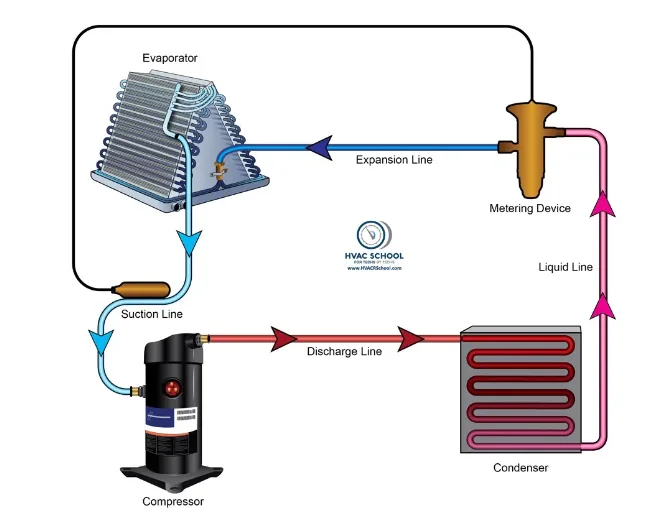
- Understanding the basics of refrigeration

- Identifying components and functions of HVAC systems

- Exploring types of HVAC systems and their applications

- Understanding airflow, ductwork, and ventilation principles

- Familiarizing with HVAC Maintenance and Energy saving

Course suitable for

Key topics covered

- Sensible Heat
- Latent Heat
- Dry Bulb Temperature
- Wet Bulb Temperature
- Dew Point Temperature
- Definition of Ton Enthalpy
- Relative Humidity
- Refrigeration Cycles
- Vapour Compression Cycle
- Vapour Absorption cycle

Opportunities that await you!

Career opportunities

Training details

This is a live course that has a scheduled start date.

Live session

Starts

Sat, Mar 21, 2026

12:00 AM UTC· your timezone

Duration

1 hour per day

+1 enrollmentsin the last 30 days
-44.4% vs prior 150-day average

Our Alumni Work At

Why people choose EveryEng

Industry-aligned courses, expert training, hands-on learning, recognized certifications, and job opportunities-all in a flexible and supportive environment.

What learners say about this course

Engineering Academy
Engineering Academy Engineer
Feb 25, 2026

This course turned out to be more technical than I anticipated. Coming from a general facilities background, the breakdown of the refrigeration cycle and basic load calculations helped fill a gap that usually gets glossed over on job sites. The sections on heat pumps and airflow fundamentals were especially useful, since those come up constantly during equipment selection meetings.One challenge was getting comfortable with the terminology early on. Psychrometrics, sensible vs. latent loads, and how they tie back to real comfort issues took a bit of rewatching before it clicked. That said, the beginner pacing made it manageable without feeling watered down.What stood out was the practical framing. Understanding how ventilation requirements relate to indoor air quality, rather than just code compliance, changed how current retrofit projects are being reviewed. A clear takeaway was being able to look at a basic HVAC schematic and follow refrigerant flow and air paths without guessing.

Trinergy Engineering
Trinergy Engineering DIRECTOR
Feb 25, 2026

Coming into this course, I had some prior exposure to the subject, mostly from field coordination and reviewing HVAC submittals rather than formal training. The course does a decent job laying out the basics of the refrigeration cycle and air distribution, and it introduces psychrometrics in a way that beginners can at least follow, even if mastery takes more time. The section on heat pumps versus conventional split systems was especially relevant given where the industry is heading. One challenge was that some concepts, like load calculations and airflow balancing, were presented at a high level without many real-world edge cases. In practice, odd building envelopes, part-load conditions, and poor duct layouts drive most problems, and that nuance only came through indirectly. Compared to how things are handled on actual projects, the course leans more idealized than messy. A practical takeaway was the emphasis on proper sizing and understanding system interactions before selecting equipment. Too often in industry, oversizing is still treated as a safety net, and this course at least pushes back on that habit. The content felt aligned with practical engineering demands.

sunil singhal
sunil singhal Manager
Feb 25, 2026

Coming into this course, I had some prior exposure to the subject, mostly from field coordination and reviewing HVAC submittals rather than formal training. The course does a decent job laying out the basics of the refrigeration cycle and air distribution, and it introduces psychrometrics in a way that beginners can at least follow, even if mastery takes more time. The section on heat pumps versus conventional split systems was especially relevant given where the industry is heading. One challenge was that some concepts, like load calculations and airflow balancing, were presented at a high level without many real-world edge cases. In practice, odd building envelopes, part-load conditions, and poor duct layouts drive most problems, and that nuance only came through indirectly. Compared to how things are handled on actual projects, the course leans more idealized than messy. A practical takeaway was the emphasis on proper sizing and understanding system interactions before selecting equipment. Too often in industry, oversizing is still treated as a safety net, and this course at least pushes back on that habit. The content felt aligned with practical engineering demands.

Vicko Peović
Vicko Peović Engineer
Feb 25, 2026

This course turned out to be more technical than I anticipated. For a beginner track, it went beyond buzzwords and actually touched on load calculations and basic psychrometrics, which is where a lot of entry-level HVAC folks usually get tripped up. The overview of the vapor-compression refrigerant cycle was solid, especially the explanation of superheat and subcooling, though it stayed conceptual rather than diagnostic, which makes sense at this level. One challenge was the pacing around ventilation standards. ASHRAE 62.1 was mentioned, but the edge cases—like mixed-use spaces or high-occupancy scenarios—were glossed over. In industry, those exceptions drive a lot of redesign and rework, so even a brief nod to them would help set expectations. Compared to how we train junior engineers in-house, this course is lighter on controls integration and system-level interactions, such as how HVAC sizing impacts energy modeling and commissioning outcomes. A practical takeaway was a simple framework for thinking through system selection: start with load, then airflow, then equipment type, rather than jumping straight to tonnage. That mindset alone can prevent common mistakes seen on early projects. The content felt aligned with practical engineering demands.

COMPLETED

Mar 21, 2026

Questions and Answers

Q: You're checking an air handling unit nameplate during design review and search "ISO ventilation air temperature sensor placement accuracy HVAC". The supply air temperature sensor is installed immediately downstream of the cooling coil. Why does ISO guidance push that location rather than inside the supply duct several meters away?

A: This placement preserves control accuracy by measuring the variable the coil actually controls. B sounds plausible but EMI isn't the limiting error source for temperature sensors here. C is convenient but doesn't justify the standard’s intent. D mixes up airflow measurement practice with temperature sensing.