<link href="https://fonts.googleapis.com/css2?family=Caveat:wght@500;700&family=JetBrains+Mono:wght@400;500;600&display=swap" rel="stylesheet" /> Skip to main contentEngineering Courses, Mentoring & Jobs | EveryEng
Computational Fluid Dynamics: Overview Fundamentals, Applications & Fluid flow basics banner

Computational Fluid Dynamics: Overview Fundamentals, Applications & Fluid flow basics

Computational Fluid Dynamics: Overview Fundamentals, Applications & Fluid flow basics banner
Self-paced Beginner

Computational Fluid Dynamics: Overview Fundamentals, Applications & Fluid flow basics

4(1579)
6 enrolled
2192 views
₹ 499
179 min
Anytime
English
Team EveryEng
Team EveryEngMechanical Engineering
  • 7-day money-back guarantee
  • Lifetime access
  • Certificate of completion
Volume pricing for groups of 5+

Why enroll

People enroll in Computational Fluid Dynamics: Fundamentals and Applications to gain theoretical knowledge for analyzing fluid flow in engineering systems. With CFD widely used in industries like aerospace, automotive, and energy, the course prepares students to solve real-world problems using simulation tools, enhancing their technical expertise and career prospects.

Is this course for you?

You should take this if

  • You work in Automotive or Aerospace
  • You're a Mechanical Engineering professional
  • You prefer self-paced learning you can revisit

You should skip if

  • You need a different specialisation outside Mechanical Engineering
  • You need live interaction with an instructor

Course details

The course Computational Fluid Dynamics: Fundamentals and Applications introduces the core principles and numerical methods used to analyze and simulate fluid flow phenomena using computational tools. Students will learn the foundational equations governing fluid dynamics, including the Navier-Stokes equations, and how to discretize them using methods such as finite difference, finite volume, and finite element techniques. Emphasis is placed on understanding grid generation, stability and convergence of numerical schemes, and practical implementation of CFD algorithms. Through hands-on assignments and projects, learners will apply commercial and open-source CFD software to solve real-world engineering problems in aerodynamics, heat transfer, and multiphase flow, gaining both theoretical insight and practical experience in this critical area of engineering analysis.

Course suitable for

Key topics covered

  • What is CFD?

  • Core principle of CFD

  • Why CFD

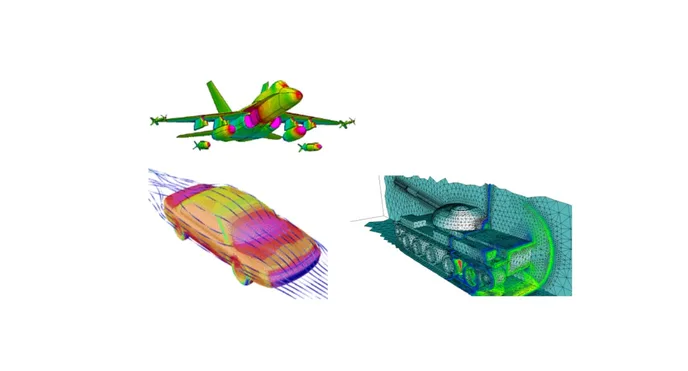
  • CFD Application

  • Fluid definition and properties

  • Types of fluid flow

  • Fluid Acceleration

  • Flow description

  • Scaler, Vector and Tensor

  • Steps involve in Modeling

  • Pre Processing - Geometry

  • Pre Processing - Grid Generation

  • Pre Processing - Selection of physical and chemical phenomena

  • Pre Processing - Selection of material properties

  • Typical flow boundary conditions

  • Finite volume method

  • Finite difference method

  • Analysis

  • Post processing

Course content

The course is readily available, allowing learners to start and complete it at their own pace.

3 lectures2 hr 59 min

Opportunities that await you!

Career opportunities

₹499

Access anytime

Questions and Answers

A: Picking the wrong regime here leads to a mesh that under-resolves the boundary layer, and your pressure drop won't match the rig data. Reynolds number comes out around 75,000 using velocity, diameter, density, and viscosity, which is well into turbulent flow for internal pipes, driving the need for turbulence modeling and attention to y+.

A: Calling this general corrosion sends you chasing chemistry while the pipe keeps thinning and fails early. Local pressure drops at the valve can fall below vapor pressure, creating cavitation bubbles that collapse downstream, something a steady CFD run without cavitation modeling won't show.

A: Skipping basic installation checks means you may tune the CFD to bad data and lock in the error. Plate orientation and correct bore are mechanical truths, and zeroing the DP with equalized lines removes bias before any comparison to simulation results.

A: Choosing the wrong mechanism risks a pipe spec that looks fine on paper but thins in service. High wall shear can strip protective oxide layers, accelerating corrosion even in otherwise mild fluids, which points material selection toward FAC resistance rather than exotic alloys.