Skip to main contentEngineering Courses, Mentoring & Jobs | EveryEng
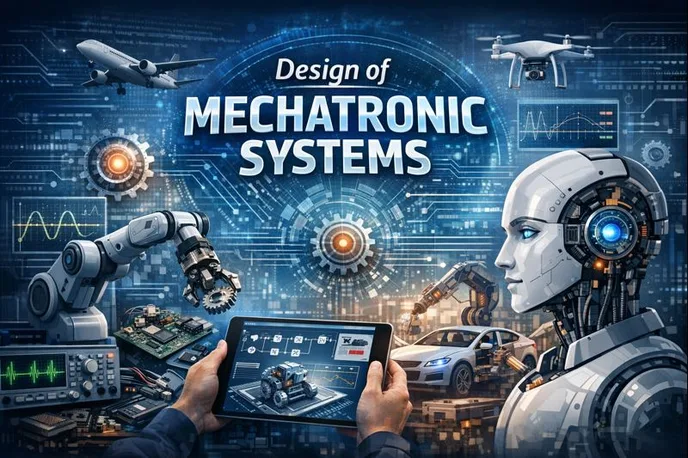
Design of Mechatronic Systems - II banner
Preview this course

Design of Mechatronic Systems - II

Design of Mechatronic Systems - II banner
Preview this course
Self-paced Advanced

Design of Mechatronic Systems - II

3(9)
56 views
FREE
740 min
Anytime
English

Engineering Academy
Engineering AcademyLearn Without Limits: Free Engineering Courses
  • Lifetime access
  • Certificate of completion
  • Anytime Learning
  • Learn from Industry Expert
Volume pricing for groups of 5+

Why enroll

Participants join Design of Mechatronic Systems to develop a strong interdisciplinary skill set that is essential for designing modern intelligent and automated products. The course enables learners to understand how mechanical, electrical, electronic, control, and software components interact within a single system, allowing them to move beyond isolated domain knowledge to a complete system-level design perspective.

Many participants are motivated to gain practical competence in modeling, simulation, sensor and actuator selection, control system design, and embedded implementation—skills that are highly valued in industries such as robotics, industrial automation, automotive, aerospace, medical devices, and smart manufacturing. The course helps bridge the gap between theoretical concepts and real-world applications through structured design methodologies and practical case studies.

Participants also join to enhance their career prospects by acquiring industry-relevant expertise in mechatronics, preparing them for roles in product design, system integration, automation engineering, and R&D. Additionally, the course supports academic growth by strengthening fundamentals needed for advanced studies and research in mechatronics, robotics, and control systems, making it valuable for both students and working professionals.

Is this course for you?

You should take this if

  • You work in Mechanics & Turbomachinery
  • You're a Mechanical / Production professional
  • You have 3+ years of hands-on experience in this field
  • You prefer self-paced learning you can revisit

You should skip if

  • You're new to this field with no prior experience
  • You need a different specialisation outside Mechanical
  • You need live interaction with an instructor

Course details

Design of Mechatronic Systems is an advanced interdisciplinary course that concentrates on the structured design, analysis, and realization of intelligent engineering systems by synergistically combining mechanical components with electronics, control strategies, and embedded computing. The course emphasizes design thinking at the system level, where functionality, performance, cost, reliability, and safety are considered simultaneously throughout the product development lifecycle.

The course introduces participants to the complete mechatronic design process, starting from problem definition and requirement analysis to conceptual design, detailed modeling, and system integration. Learners study how physical systems are represented using mathematical models and block diagrams, enabling prediction of system behavior under various operating conditions. Simulation tools are used extensively to evaluate design alternatives, optimize parameters, and reduce development risks before physical implementation.

A major focus is placed on sensing and actuation technologies that form the interface between the physical and digital domains. The course explores a wide range of sensors for motion, force, pressure, temperature, and position, along with actuators such as electric drives, hydraulic and pneumatic systems, and smart actuators. Topics include interfacing techniques, signal conditioning, noise reduction, and data acquisition, with attention given to real-world constraints and performance trade-offs.

Control system development is addressed from both theoretical and practical perspectives. Participants learn to design and implement feedback and digital control systems that ensure accuracy, stability, and robustness. The integration of control algorithms with microcontrollers and embedded platforms is emphasized, including real-time constraints, communication protocols, and hardware–software co-design considerations.

The course also covers system integration, testing, and validation, highlighting methods for troubleshooting, performance evaluation, and fault detection. Case studies from robotics, automotive systems, industrial automation, and smart products illustrate how mechatronic principles are applied in practice. By the end of the course, participants are equipped with the knowledge and design methodologies required to develop efficient, reliable, and intelligent mechatronic systems suited to modern engineering challenges.

source : NPTEL[ youtube]

Course suitable for

Key topics covered

  • selection of sensors

  • closed loop control implementation in microcontroller

  • application of control design for linear systems

  • trajectory tracking controller : robotic system

  • signal processing

  • hands on activities

Course content

The course is readily available, allowing learners to start and complete it at their own pace.

20 lectures12 hr 20 min

Opportunities that await you!

Career opportunities

Our Alumni Work At

Why people choose EveryEng

Industry-aligned courses, expert training, hands-on learning, recognized certifications, and job opportunities-all in a flexible and supportive environment.

What learners say about this course

Boora Mahesh
Boora Mahesh civil engineer
Mar 14, 2026

drtudfjygfygughihj

Hemanth TK
Hemanth TK
Feb 27, 2026

Fhjfkgc

Bhavani S
Bhavani S Student
Feb 22, 2026

Nice

Jayalaxmi Sudi
Jayalaxmi Sudi
Feb 15, 2026

Good

FREE

Access anytime

Questions and Answers

Q: You're reviewing a supplier deviation and searching "API 617 material substitution yield strength safety margin rotor". The supplier proposes a shaft material with 8% lower yield strength but higher ultimate strength. Rev 4 GA notes only reference "min FoS per API" with no value, and the original designer is unavailable. What's the correct disposition?

A: A sounds conservative, but it's tied to why the margin exists. Yield controls elastic behavior under transient loads and thermal gradients; that's what keeps clearances intact. B is tempting if you think only about burst, but overspeed tests don't prove elastic stability in service. C mixes quality controls with physics; balance doesn't recover lost yield margin. D leans on testing, yet a short overspeed run doesn't map to long-term strain or rub initiation.