Skip to main contentEngineering Courses, Mentoring & Jobs | EveryEng
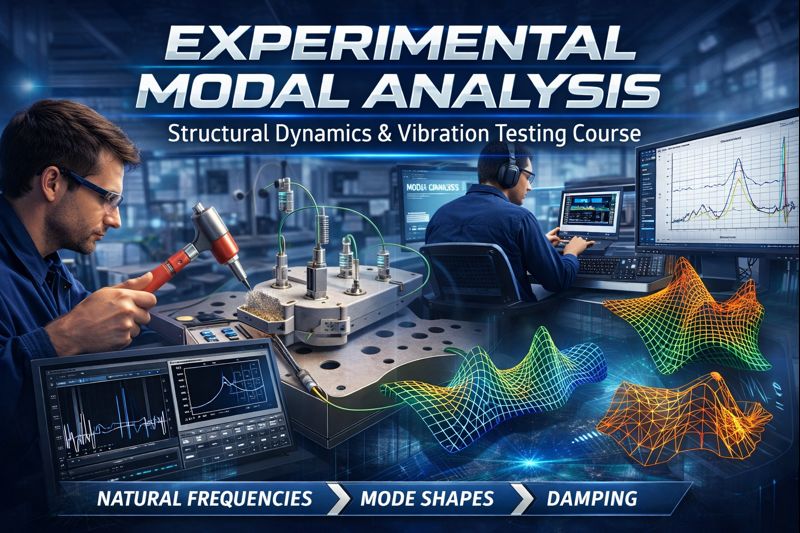
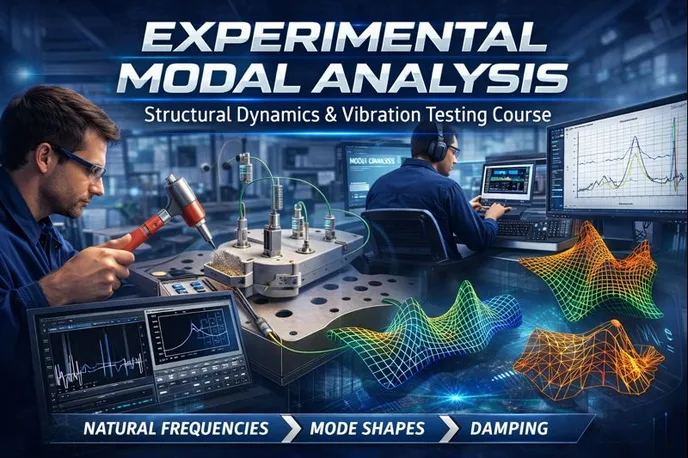
Experimental modal analysis banner
Preview this course

Experimental modal analysis

26 min of video

2 enrolled

Experimental modal analysis banner
Preview this course
Self-paced Advanced

Experimental modal analysis

3(9)
2 enrolled
139 views
FREE
1577 min
Anytime
English

Engineering Academy
Engineering AcademyLearn Without Limits: Free Engineering Courses
  • Lifetime access
  • Certificate of completion
  • Anytime Learning
  • Learn from Industry Expert
Volume pricing for groups of 5+

Why enroll

Participants join Experimental Modal Analysis programs to develop a strong practical understanding of structural dynamics and vibration behavior through hands-on testing and data interpretation. The course enables learners to accurately identify natural frequencies, mode shapes, and damping characteristics of real structures, which are essential for diagnosing vibration problems and improving dynamic performance.

By joining, participants gain exposure to industry-standard experimental techniques, including impact hammer testing, shaker excitation, sensor placement, and frequency response function (FRF) analysis. The program helps bridge the gap between theoretical vibration concepts and real-world applications, enhancing the ability to validate and update analytical and finite element models.

Additionally, participants benefit from learning how experimental modal analysis supports noise and vibration reduction, design optimization, and structural health assessment. These skills are highly valued in sectors such as automotive, aerospace, civil structures, and machinery design, making the course particularly beneficial for engineers, researchers, and postgraduate students seeking practical expertise in advanced vibration analysis.

Is this course for you?

You should take this if

  • You work in Mechanics & Turbomachinery
  • You're a Mechanical / Production professional
  • You have 3+ years of hands-on experience in this field
  • You prefer self-paced learning you can revisit

You should skip if

  • You're new to this field with no prior experience
  • You need a different specialisation outside Mechanical
  • You need live interaction with an instructor

Course details

Experimental Modal Analysis (EMA) is a systematic and widely used vibration analysis technique employed to determine the dynamic characteristics of a physical structure through experimental testing. The primary objective of EMA is to identify a structure’s modal parameters—namely natural frequencies, mode shapes, and damping ratios—by measuring its response to controlled external excitation. These parameters are fundamental for understanding how a structure behaves under dynamic loading and for predicting its vibration and noise performance.

In experimental modal analysis, the test structure is excited using known input forces, typically applied through impact hammers, electrodynamic shakers, or hydraulic actuators. The resulting vibration response is measured at selected locations using sensors such as accelerometers, velocity transducers, or laser vibrometers. The input–output data are then processed using signal analysis techniques, including Fast Fourier Transform (FFT) and frequency response functions (FRFs), to extract the modal parameters of the system.

EMA is particularly valuable for validating analytical and numerical models, such as finite element models, by comparing experimentally obtained modal data with predicted results. It helps engineers identify discrepancies caused by modeling assumptions, boundary conditions, or material property variations. The technique is also extensively used in design optimization, structural modification, fault detection, and troubleshooting of vibration-related issues.

Applications of experimental modal analysis span a wide range of engineering fields, including mechanical, aerospace, civil, and automotive engineering. It is commonly applied to structures such as machine tools, automotive components, aircraft structures, bridges, and electronic assemblies. By providing accurate insight into real-world dynamic behavior, experimental modal analysis plays a critical role in improving structural reliability, performance, and durability under dynamic operating conditions.

source: NPTEL[youtube]

Course suitable for

Key topics covered

  • introduction to experimental modal analysis

  • SDOF system with structural damping

  • modal analysis of MDOF system with proportional viscous damping

  • IRF and transient response

  • fourier transform

  • test planning for FRF measurement

Course content

The course is readily available, allowing learners to start and complete it at their own pace.

30 lectures26 hr 17 min

Opportunities that await you!

Career opportunities

Our Alumni Work At

Why people choose EveryEng

Industry-aligned courses, expert training, hands-on learning, recognized certifications, and job opportunities-all in a flexible and supportive environment.

What learners say about this course

Boora Mahesh
Boora Mahesh civil engineer
Mar 14, 2026

drtudfjygfygughihj

Hemanth TK
Hemanth TK
Feb 27, 2026

Fhjfkgc

Bhavani S
Bhavani S Student
Feb 22, 2026

Nice

Jayalaxmi Sudi
Jayalaxmi Sudi
Feb 15, 2026

Good

FREE

Access anytime

Questions and Answers

Empty state icon

No questions yet - Be the first one to ask!