Gain Practical, No-Code AI Skills: You don't need to be a software engineer or know Python to leverage machine learning. Learn how to use intuitive, modern AI tools to solve complex production problems effortlessly.
Leverage Power BI & Excel for Energy Insights: Move past static tables. Master advanced data cleansing, structuring, and dynamic visualization techniques tailored specifically to oilfield data streams.
Real-Time Production Optimization: Understand how to use AI to predict liquid loading, catch electrical submersible pump (ESP) anomalies early, and optimize artificial lift systems before costly downtime occurs.
Accelerate Your Career in Digital Oilfields: Position yourself at the cutting edge of upstream energy. This course equips you with the highly sought-after technical profile of a "Citizen Data Scientist" in the petroleum sector.
Make Faster, Data-Driven Decisions: Replace gut-check engineering and outdated decline curve heuristics with highly accurate, multi-variable predictive forecasting models.
You're a Petroleum Technology / Production Engineering professional
You have 3+ years of hands-on experience in this field
You want to build skills in Artificial Intelligence
You should skip if
You're new to this field with no prior experience
You need a different specialisation outside Petroleum Technology
You need fully self-paced, on-demand content
Course details
Master AI-Driven Well Performance Analysis' course. This comprehensive program is designed to bridge the gap between traditional petroleum engineering and advanced data science, equipping you with the skills to revolutionize how we analyze, predict, and optimize well performance.
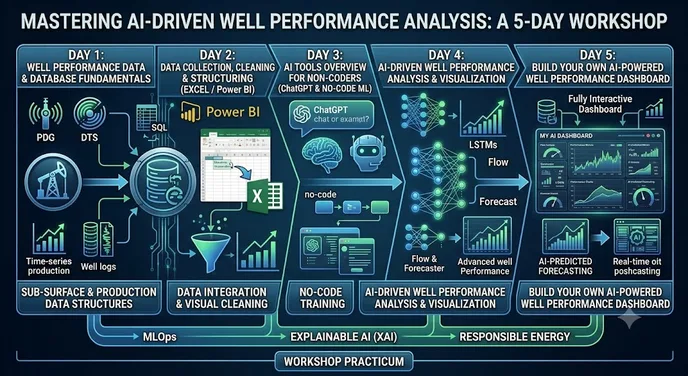
Our curriculum progresses through five key modules, moving from the fundamentals of data acquisition and machine learning to the deployment of state-of-the-art physics-informed and generative models.
Day 1: Well Performance Data & Database Fundamentals
The Architecture of Subsurface Data: Understanding high-frequency data streams including Permanent Downhole Gauges (PDG), Distributed Temperature Sensing (DTS), and well logs.
Relational Databases for Petroleum Engineers: Introduction to SQL fundamentals—how production data is stored, indexed, and retrieved.
Data Structures: Mastering the difference between time-series production logs, depth-dependent reservoir data, and spatial wellbore trajectories.
Day 2: Data Collection, Cleaning & Structuring in Excel / Power BI
The War on Dirty Data: Eliminating sensor noise, handling data gaps, and isolating outliers from actual well shut-ins.
Data Integration Pipelines: Connecting Excel and Power BI directly to live data sources to establish automated cleaning workflows.
Feature Engineering for Production: Generating derived domain-specific indicators (e.g., productivity indices, water-cut trends, and flow regime flags) within Power BI.
Day 3: AI Tools Overview for Non-Coders — ChatGPT & No-Code ML
Prompt Engineering for Engineers: Using ChatGPT to write advanced Excel formulas, debug SQL queries, and synthesize complex technical manuals.
Democratizing Machine Learning: Introduction to No-Code ML platforms that allow you to drag-and-drop your way to advanced predictive modeling.
Pattern Recognition & Clustering: Using automated unsupervised learning algorithms to group wells by performance and automatically isolate underperforming assets.
Day 4: AI-Driven Well Performance Analysis & Visualization
Advanced Decline Curve & Beyond: Replacing traditional Arps equations with multi-variable machine learning forecasting.
Time-Series Forecasters: Understanding how modern sequential models (like LSTMs) predict future oil, gas, and water rates based on historical data.
Anomalies and Early Warning Systems: Setting up automated predictive flags to identify downhole mechanical failures before they happen.
Day 5: Build Your Own AI-Powered Well Performance Dashboard
The Capstone Workshop Practicum: Bring everything together by building a fully interactive, live-updating Well Performance Dashboard.
Integrating the AI Layer: Embedding your trained predictive models directly into Power BI to display real-time forecasting panels alongside uncertainty bounds.
Operational Deployment (MLOps) & Explainability: Designing executive-ready visual layouts that translate complex algorithmic outputs into trusted, auditable engineering decisions.
Opportunities that await you!
Skills & tools you'll gain
Artificial Intelligence
Career opportunities
Training details
This is a live course that has a scheduled start date.