
Article details
The growing availability of AI has raised a difficult question for oil and gas companies: can its recommendations be trusted in environments that demand predictable performance and strict safety controls? This challenge shaped discussions at the Oil & Gas Automation and Digitalisation Congress (Automa) 2026, held on 5 and 6 October in Amsterdam, the Netherlands, in partnership with Shell Energy & Chemicals Park Rheinland, Fluor, Linde plc, Repsol, MOL Group and Saipem.
Throughout the two days, participants explored the gap between technological capability and successful implementation. Although many organisations already possessed the infrastructure needed to adopt AI, earlier projects with disappointing outcomes encouraged a cautious approach to broader deployment. Speakers consequently focused on selecting applications with clear objectives, dependable information and measurable benefits for everyday work.
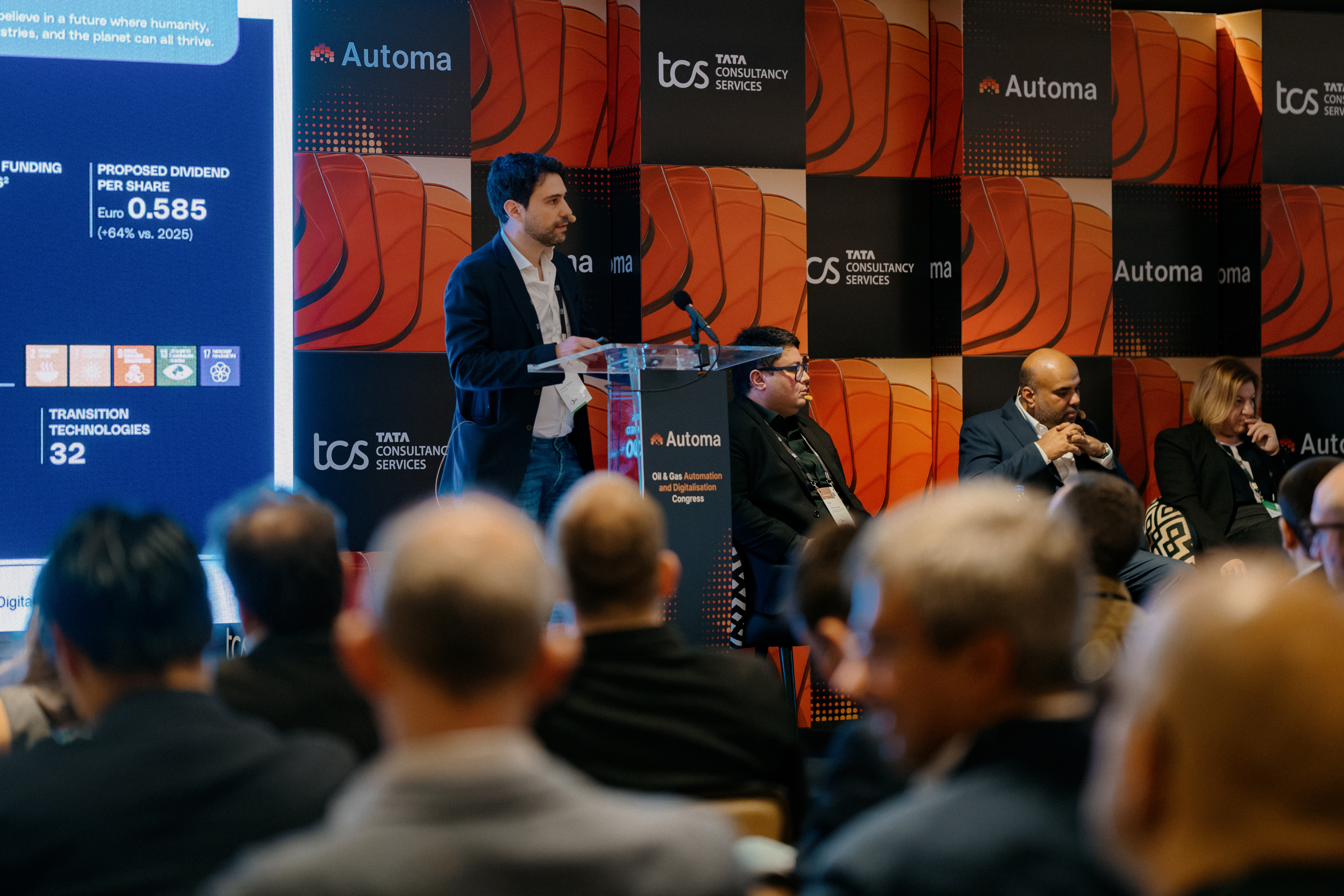
Aninda Mukherjee, AI Business Unit Leader, Energy, Resources and Utilities at Tata Consultancy Services UK & Europe, connected this challenge with the need to preserve established industrial safeguards. The presentation summarised the relationship directly: “Intelligence without control is a risk. Control without intelligence is a ceiling. Industrial AI requires both.” Mukherjee outlined a layered approach in which algorithms identified patterns, anticipated equipment degradation and advised operators, while existing control systems retained responsibility for execution and people determined the boundaries of autonomy.
This principle also informed contributions from Linde on trust and accountability and Shell on governance and responsible deployment. OMV extended the discussion to capital project delivery, bringing attention to the practical requirements of incorporating artificial intelligence into complex engineering activities. Across these perspectives, workforce skills remained essential, since employees needed suitable training and intuitive interfaces to interpret recommendations and apply them confidently within established routines.
Digital twins offered concrete examples of the connection between technical innovation and operational needs. PETROBRAS explored hybrid process models and generative AI for refinery optimisation, while Siemens discussed autonomous processes supported by comprehensive virtual representations. Fluor broadened the scope through advanced analytics in project controls and operator training simulators, demonstrating opportunities to improve construction predictability and prepare personnel for plant duties.
The discussion of equipment performance led naturally to the availability of spare parts and the resilience of maintenance supply chains. Christian Duun Norberg, CEO at Fieldnode, presented digital inventories and manufacturing on demand, outlining a process that connected equipment owners, producers and engineering partners through standardised specifications, traceable workflows and quality assurance. His contribution demonstrated the steps required to turn isolated production cases into repeatable sourcing arrangements for qualified components.
Alongside maintenance efficiency, the programme explored technologies designed to protect personnel and facilities. Repsol presented plant supervision integrating robots, cameras, drones and AI, while Saipem discussed video analytics for proactive monitoring at biorefinery construction sites and wearable IoT devices for workers. TotalEnergies complemented these contributions with early acoustic detection of gas leaks, illustrating the potential for faster identification of hazards.
Delegates could experience emerging solutions directly during the Smart Tech Showcase, which combined demonstrations with conversations about their practical applications. Reflecting on an encounter that captured the interactive nature of the display, Angela María Segade, Operations Support Technician at Repsol Coruna Refinery, commented: “I’ve seen a robot dancing and interacting with humans, and I think that was quite a surprising situation.” Such experiences gave delegates an opportunity to assess unfamiliar capabilities alongside the specific requirements of their organisations.
Decarbonisation discussions highlighted two sides of technological progress: solutions introduced to improve sustainability can also increase energy demand and create additional pressure on resources. Contributions from McDermott, INA and MAIRE covered sustainable EPC execution, refinery modernisation and energy monitoring at temporary construction facilities, linking environmental goals to practical challenges throughout the project lifecycle. These perspectives underlined the need to assess both the benefits of innovation and the consumption associated with its implementation, so that improvements in industrial performance also deliver measurable reductions in environmental impact.
Scheduled B2B meetings allowed participants to build on the ideas presented and explore potential partnerships with relevant contacts. Dedicated personal managers helped delegates coordinate appointments and navigate a concentrated business agenda, providing consistent support throughout the Сongress. Feedback highlighted this combination of focused networking and individual attention, with participants describing Automa among the industry’s premier events.
Registration is now open for the anniversary 10th edition of Automa, scheduled for 18-19 October 2027 in Vösendorf, Austria. Secure your participation at https://sh.bgs.group/555 to exchange expertise with industry leaders and contribute to the next chapter of oil and gas automation and digitalisation.
