

Article details
Engineers do not actually pump a river dry. They build a temporary watertight enclosure (a cofferdam) around the pier location, then pump the water out of that enclosure only. This gives a dry (or nearly dry) work area on the riverbed where they can excavate, place reinforcement, and pour concrete. Where the water is too deep or the ground too leaky, they use alternatives such as caissons or drilled shafts cast under water, which avoid the need to dewater at all.
Why the Work Must Be Done “in the Dry”
Reinforcement and concrete are far easier to place and inspect in dry conditions
Water flowing through fresh concrete washes out cement and weakens it
Workers need to see the founding level and check soil or rock quality
Excavation below the riverbed is unsafe if water floods in
Quality control (cover, bar spacing, joints) is much harder underwater
Main Methods of Creating a Dry Work Area
Method | Best suited to | Idea |
|---|---|---|
Sheet pile cofferdam | Shallow to moderate depth, soft bed | Interlocking steel sheets driven into the bed to form a wall |
Earth or rock-fill cofferdam | Very shallow, slow-moving water | Embankment of soil or rock built into the river |
Braced cofferdam | Deeper water | Sheet piles with internal walers and struts |
Double-wall cofferdam | Deep or fast water | Two sheet pile walls with fill between them |
Cellular cofferdam | Deep water, rock bed | Large circular steel cells filled with soil |
Precast or steel box (caisson) cofferdam | Deep, open water | Prefabricated hollow box floated out and sunk |
Diversion | Small rivers | River is channeled around the site temporarily |
Open caisson or pneumatic caisson | Very deep, soft ground | Structure sunk by excavating inside it |
Bored piles or drilled shafts with casing | Deep water, no dewatering wanted | Concrete placed by tremie under water |
Building a Sheet Pile Cofferdam, Step by Step
Investigate: river depth, flow velocity, flood levels, bed material, rock depth, and permeability.
Design: the cofferdam must resist water pressure, soil pressure, current, ice or debris impact, and flood risk.
Set up a work platform: a temporary trestle, jack-up barge, or floating crane gives access.
Install guide frames: steel frames hold sheet piles in position as they are driven.
Drive the sheet piles: vibratory hammers or impact hammers push them into the bed, ideally into clay or rock to cut off seepage.
Close the ring: the final sheets must interlock exactly. Errors in alignment make closure difficult.
Install the first brace level: walers and struts are placed near the top, often by divers or from above.
Place a seal (if needed): see Part 5.
Pump out the water in stages: lower the level a little, install the next brace level, then lower again.
Excavate and build the pier inside the dry enclosure.
Remove the cofferdam after the pier is above water level and strong enough.
How the Pumping Actually Works
Dewatering the enclosure
Submersible or centrifugal pumps remove the initial volume of water inside the ring
Pumping is done gradually, since a sudden drop in inside level makes outside water pressure push hard on the walls
Each stage is checked for leaks and brace loads before going lower
Handling seepage
No cofferdam is perfectly watertight. Water seeps through interlocks, under the toe, and through the bed. Control methods:
Sumps and pumps: water collects in low pits and is pumped out continuously
Wellpoints: small, closely spaced pipes around the excavation lower the water table in sandy ground
Deep wells: larger wells with submersible pumps for deeper or more permeable ground
Toe embedment: driving sheets deep enough to lengthen the seepage path
Grouting or clay sealing at leaky interlocks and bed contact
Cut-off layers: jet grout or slurry walls in very permeable ground
Why pumping must be controlled
Uplift (buoyancy): water pressure under the base can heave the bottom or float the whole structure
Piping or boiling: upward seepage in sand can carry soil into the pit, destabilizing it
Settlement: lowering the water table can settle nearby structures
The Concrete Seal (Tremie Plug)
When the riverbed is permeable or the water is deep, engineers often pour a seal slab underwater before pumping.
After excavating (by dredging or grab) to founding level, the bottom is cleaned
Concrete is placed through a tremie pipe, a vertical pipe whose lower end stays buried in fresh concrete so it never mixes with water
The concrete forms a thick plug across the base of the cofferdam
After it gains strength, the water is pumped out
The plug resists uplift using its own weight and its bond to piles or sheet piles
The pier is built on top of the plug, in the dry
Seal thickness is designed so its weight plus anchor capacity exceeds the water pressure underneath, with a margin of safety.
When Pumping Is Not Practical
For very deep water, fast currents, or soft ground, other methods are safer:
Caissons
Open caisson (well foundation): a hollow concrete or steel shaft is sunk by excavating inside it with grabs; common in Indian bridges
Pneumatic caisson: compressed air in a working chamber keeps water out while workers excavate at the bottom; used for very deep foundations, with strict medical controls
Once at depth, the caisson is plugged with concrete and becomes the pier foundation
Drilled shafts and bored piles
A steel casing is driven or vibrated through the water to the bed
Soil is drilled out inside it, a reinforcement cage is lowered in, and concrete is placed with a tremie
No dewatering is needed
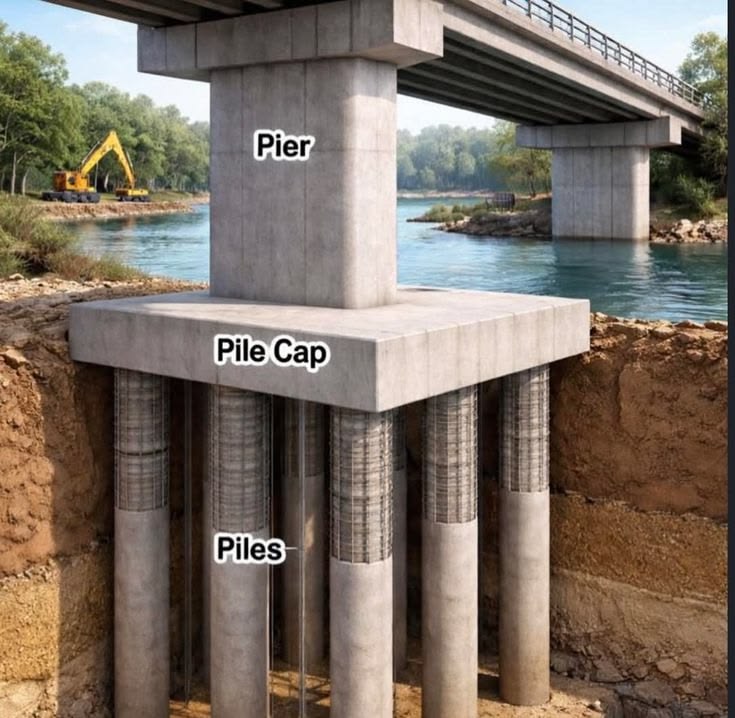
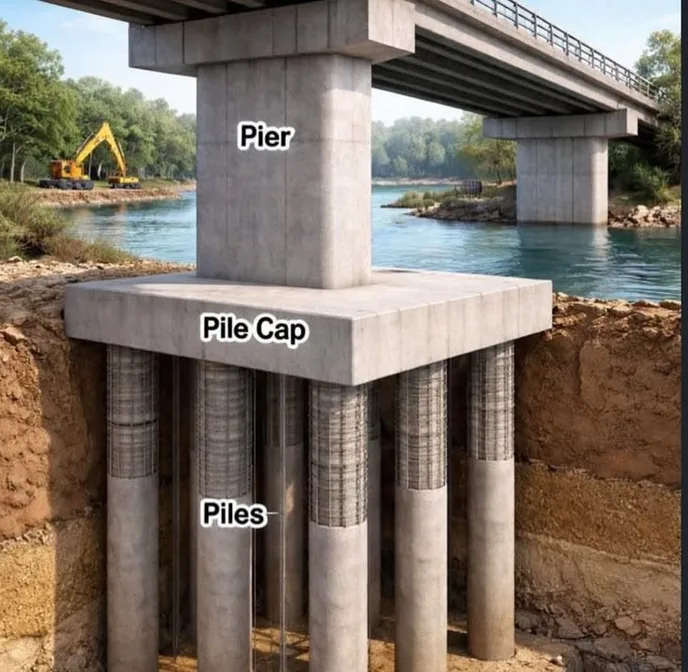
Multiple piles are capped with a pile cap, which may be cast in a small cofferdam or using precast shells
Precast and floating methods
Precast shell or “formwork” pier segments are floated or lifted into place and filled with concrete
Steel or concrete box caissons are fabricated on shore, floated, sunk, and grouted to the bed
Designing the Cofferdam
Load or check | Why it matters |
|---|---|
Hydrostatic pressure | Increases with depth and acts on all walls |
Soil pressure | From the retained ground |
Current and wave forces | Fast rivers push hard on the enclosure |
Debris and vessel impact | Floating logs or boats may strike it |
Flood level and overtopping | The top must stay above the likely water level during the work |
Uplift and heave | Base stability when pumped |
Seepage and piping | Leakage and soil movement |
Brace and waler capacity | Resist inward loads |
Sheet pile bending and embedment | Stability of the wall |
Scour around the toe | Fast water can erode the bed beside the walls |
Flood planning: teams monitor river forecasts and plan a flood-flooding strategy. In some cases the cofferdam is intentionally flooded to equalize pressure and prevent collapse during a flood.
Safety Considerations
Workers inside a dewatered cofferdam are below water level, so failure can be sudden and severe
Emergency evacuation routes (ladders, stairs) and alarms are essential
Continuous monitoring of pump capacity, leakage, wall movement, and river level
Backup pumps and power supply must be available at all times
Confined space and air quality controls apply in deep enclosures
Divers need qualified supervision and rescue plans
Weather and flood forecasting with defined stop-work triggers
Regular inspection of braces, welds, and interlocks
Never remove braces without engineering approval
Environmental Controls
Sediment control: silt curtains and settling basins prevent muddy discharge to the river
Treated pump discharge: water from the cofferdam is checked and treated before returning to the river
Fish protection: screened intakes, fish rescue before dewatering, and timing work outside spawning seasons
Spill prevention: fuel and concrete washout controls on barges and platforms
Noise and vibration limits for pile driving near sensitive areas
Restoration of the riverbed after removal
After Dewatering: Building the Pier
Final excavation to founding level, with inspection against the geotechnical report
Blinding concrete and cleaning of the base
Pile installation or footing reinforcement
Pile cap or footing concrete, usually with temporary formwork and cooling controls for thick pours
Pier stem formwork and reinforcement
Pier concrete in lifts, often with climbing or slip forms
Curing and strength checks before loading
Pier raised above flood level, then cofferdam removal begins
Backfilling, scour protection (riprap or concrete mattresses), and final inspections
Common Problems and Their Causes
Problem | Likely cause |
|---|---|
Leakage through interlocks | Poor driving, damaged sheets, or misalignment |
Boiling or piping at the base | Excessive pumping lowering the inside level too quickly, or insufficient embedment |
Uplift of the seal slab | Seal too thin or poorly bonded |
Bracing failure | Under-design, missing members, or overloading during pumping |
Scour at the toe | Fast current, no protection |
Overtopping in flood | Cofferdam too low, poor forecasting |
Concrete washout in the seal | Tremie pipe lifted out of the concrete, or poor placement |
Sheet piles stuck or damaged | Boulders or hard layers |
Settlement of nearby structures | Excessive dewatering |
Conclusion
The phrase “pumping a river dry” is really a story of building a small, strong, temporary island of dry ground in the middle of moving water. The success of the method depends on a good ground investigation, a cofferdam designed for water pressure, uplift, and floods, careful staged pumping, and strict safety and environmental controls. When depth, current, or soft ground make that too risky, engineers switch to caissons or drilled shafts that never need the enclosure emptied. Figures and methods here are general, so actual design must follow the site investigation, applicable codes, and the judgment of experienced bridge and geotechnical engineers.