

Article details
Introduction
Accurate angle measurement is an essential part of woodworking, carpentry, construction, and various manufacturing activities. When materials such as wood, plastic, or other suitable components need to be cut at specific angles, precise measurement helps achieve clean edges, proper alignment, and reliable joints. A miter saw angle protractor is a measuring instrument designed to determine angles and assist in setting cutting equipment for accurate angled cuts.
The instrument is particularly useful when preparing materials for corner joints, frames, decorative mouldings, trim work, and other applications that require angular precision. By measuring the angle between two surfaces or directions, it helps operators determine the appropriate cutting setting and reduce errors during fabrication.
A miter saw angle protractor combines the basic principles of angular measurement with practical requirements in woodworking. Its design allows users to measure angles directly, making it easier to transfer measurements to a cutting tool. Understanding its construction, working principle, types, and applications is important for achieving consistent results in projects that depend on accurate geometric measurements.
Design and Construction of a Miter Saw Angle Protractor
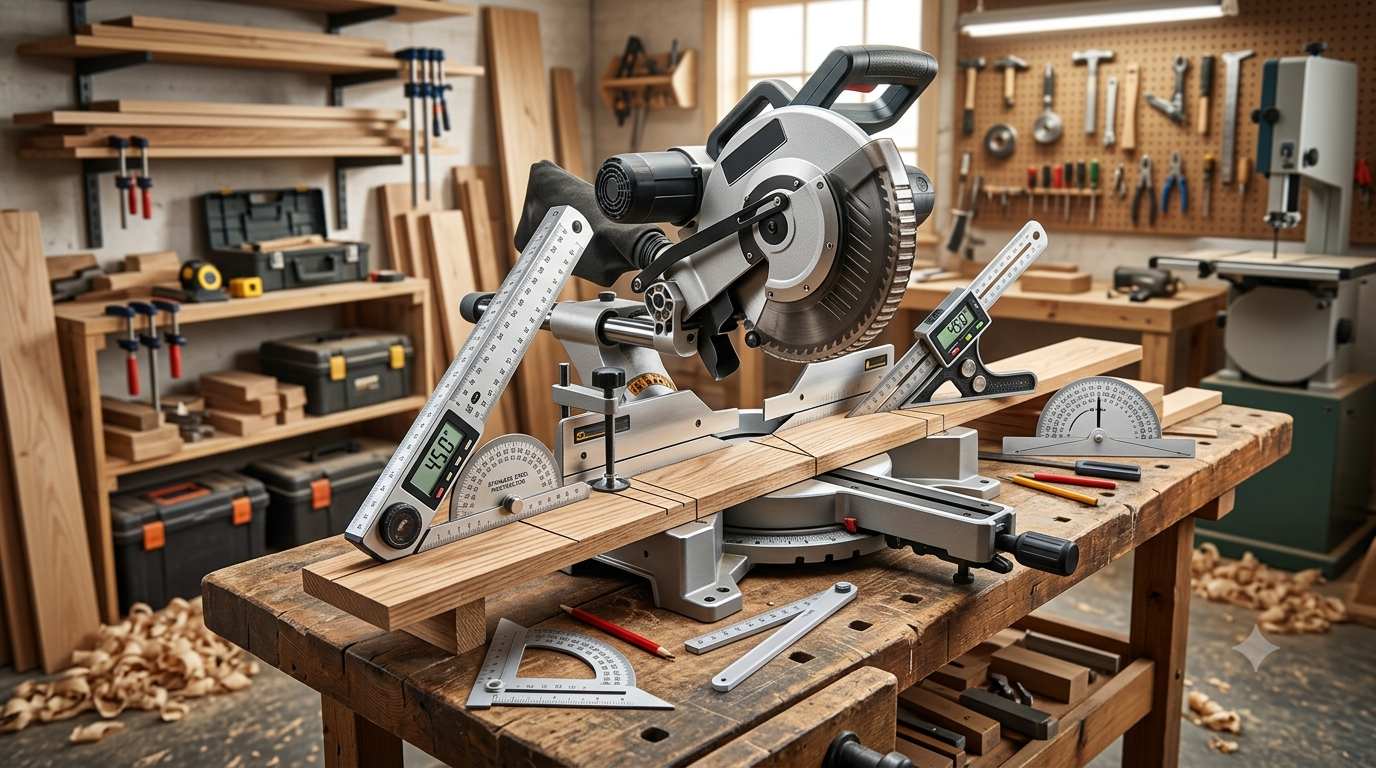
A miter saw angle protractor is generally constructed with two measuring arms connected by a pivot or hinge. These arms can move relative to one another to align with the surfaces whose angle must be measured. A graduated scale or angular display indicates the measured value, depending on the instrument's design.
Traditional models commonly use a printed or engraved scale marked in degrees. The user opens or closes the arms until they align with the reference surfaces and then reads the angle from the scale. Digital models may include an electronic sensor and display that provide a numerical measurement.
The measuring arms are designed to maintain contact with the surfaces being measured. Their length, rigidity, and alignment influence the instrument's practical accuracy. Some models incorporate locking mechanisms that hold the measured angle in position, allowing the user to transfer the measurement to a cutting machine or workpiece.
The construction of the instrument supports portability and convenient operation. Compact models can be carried between workstations and used for measurements in confined spaces. Depending on the design, materials such as plastic, aluminium, or other durable components may be used to provide suitable strength and handling characteristics.
Working Principle and Angle Measurement
The working principle of a miter saw angle protractor is based on measuring the angular relationship between two intersecting lines or surfaces. The pivot allows the measuring arms to rotate, while the graduated scale or electronic sensor identifies the angle formed between them.
To measure an angle, the user places one arm against a reference surface and adjusts the second arm until it follows the adjacent surface. The angle indicated by the instrument represents the relative orientation of the two surfaces. This measurement can then be used to determine the appropriate cutting setting.
For example, when measuring the corner of a room, the instrument can establish the angle between two adjoining walls. This information is useful when cutting baseboards, skirting boards, crown mouldings, or other trim components that must fit closely at the corner.
A standard miter saw makes angled cuts by rotating the saw blade or workpiece relative to a reference position. The measured corner angle must therefore be interpreted correctly before selecting the cutting setting. For a symmetrical joint between two pieces meeting at an internal corner, the required miter angle is often half the measured corner angle. However, the exact setting depends on the joint geometry, the saw configuration, and whether the cut involves a miter, bevel, or compound angle.
A common example is a right-angle corner measuring 90 degrees. For two matching pieces joined symmetrically, each piece is typically cut at a 45-degree miter angle. If the corner measures 100 degrees, the corresponding symmetrical miter setting is generally 50 degrees for each piece, assuming the conventional setup and reference orientation.
These calculations illustrate why accurate measurement and correct interpretation are both important. A measured angle does not always correspond directly to the angle that must be entered on the saw.
Types of Miter Saw Angle Protractors
Miter saw angle protractors are available in different designs to accommodate varying levels of accuracy, convenience, and working conditions. Manual protractors use a graduated scale and require the user to read the angle visually. They are straightforward, do not require batteries, and are suitable for routine measurement tasks where an analogue reading is sufficient.
Digital angle protractors use electronic measuring components to display the measured angle numerically. They can simplify reading and reduce errors associated with interpreting closely spaced scale markings. Some models also include a zero-setting function, which allows measurements to be taken relative to a selected reference surface rather than only to an absolute angular position.
The choice between manual and digital instruments depends on the application, the required precision, the working environment, and the user's preference. Regardless of the design, proper alignment, stable contact with the surfaces, and correct reading of the measurement remain essential for reliable results.
Applications of Miter Saw Angle Protractors
Miter saw angle protractors are widely used in woodworking, carpentry, furniture manufacturing, interior finishing, and construction. Their primary purpose is to identify the angle between surfaces and support the accurate preparation of components that must fit together. In woodworking, they are commonly used for picture frames, cabinet structures, wooden boxes, shelving, and decorative pieces. Accurate angular measurements help ensure that individual components form tight joints without unnecessary gaps.
In construction and interior finishing, the instrument is useful for measuring corners before cutting baseboards, door casings, skirting boards, and crown mouldings. Since building corners may deviate from standard right angles, direct measurement allows workers to adjust cutting settings according to actual site conditions. This improves the fit of finished components and reduces the need for repeated trimming or corrective work.
The instrument can also support furniture assembly and workshop fabrication, where components must align at specific angles. In these situations, reliable measurements contribute to dimensional consistency and improve the overall appearance of the finished product. Its usefulness extends to maintenance and renovation activities, where existing structures frequently require custom-fitted replacement components.
Factors Affecting Measurement Accuracy
The accuracy of a miter saw angle protractor depends on several factors, including its construction, scale readability, alignment, and condition. The measuring arms must sit firmly against the reference surfaces to capture the correct angular relationship. Any gap, obstruction, surface irregularity, or unintended movement can affect the reading.
The condition of the pivot mechanism is also important. Excessive looseness may cause the arms to move after the measurement has been taken, while excessive resistance can make alignment difficult. Instruments should therefore be inspected periodically to ensure smooth movement and stable positioning.
Reading the correct scale is another essential consideration. Some models include separate scales for a single angled cut and a symmetrical miter joint. These scales serve different purposes and should not be used interchangeably. Users should consult the instrument's markings and operating instructions before transferring a measurement to the saw.
Environmental conditions and handling practices may also influence results. Dirt, sawdust, damaged graduations, or worn components can interfere with measurement. Keeping the instrument clean, storing it appropriately, and checking it against a known reference angle can help maintain dependable performance. Making a trial cut on scrap material provides an additional way to verify the setting before cutting the final workpiece.
Conclusion
A miter saw angle protractor is a practical measuring instrument that supports accurate angular cutting in woodworking, carpentry, construction, and furniture fabrication. Its pivoting arms allow users to measure existing corners and transfer the resulting information to cutting equipment. By reducing dependence on visual estimation and assumed standard angles, the instrument helps improve joint fit, material efficiency, and consistency.
Selecting a suitable model, understanding its scale, maintaining proper alignment, and interpreting the measurement correctly are essential for achieving reliable results. When combined with careful setup and verification, a miter saw angle protractor contributes to more precise fabrication and better-quality finished work.
