Skip to main contentEngineering Courses, Mentoring & Jobs | EveryEng
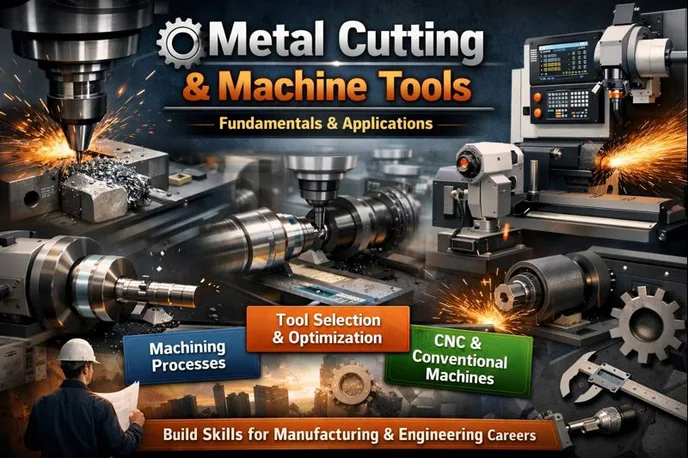
Metal cutting and machine tools banner
Preview this course

Metal cutting and machine tools

Metal cutting and machine tools banner
Preview this course
Self-paced Advanced

Metal cutting and machine tools

3(115)
2 enrolled
169 views
FREE
663 min
Anytime
English
169 views

Engineering Academy
Engineering AcademyLearn Without Limits: Free Engineering Courses
  • Lifetime access
  • Certificate of completion
  • Anytime Learning
  • Learn from Industry Expert

Why enroll

Participants join this course to gain a strong foundational and practical understanding of metal cutting principles and machine tool operations, which are essential skills in manufacturing and mechanical engineering industries. The course helps learners develop the ability to analyze machining processes, select suitable machine tools and cutting parameters, and improve productivity while ensuring quality and precision.

The program is particularly valuable for students and professionals seeking industry-relevant knowledge in conventional and CNC machining, tool materials, and process optimization. By understanding real-world machining challenges such as tool wear, heat generation, and surface finish, participants enhance their employability and readiness for roles in production, process planning, manufacturing design, and quality control.

Is this course for you?

You should take this if

  • You work in Manufacturing & Industrial
  • You're a Manufacturing Engineering / Mechanical Engineering professional
  • You have 3+ years of hands-on experience in this field
  • You prefer self-paced learning you can revisit

You should skip if

  • You're new to this field with no prior experience
  • You need a different specialisation outside Manufacturing Engineering
  • You need live interaction with an instructor

Course details

Metal Cutting and Machine Tools is a core manufacturing engineering subject that deals with the principles, mechanics, and applications of machining processes used to shape and finish metallic components. The course introduces the fundamentals of metal cutting, including chip formation, cutting forces, heat generation, tool wear, and surface integrity. Emphasis is placed on understanding the interaction between the cutting tool, workpiece material, and machining parameters to achieve dimensional accuracy, high productivity, and optimal surface quality.

The course also provides a comprehensive overview of conventional and modern machine tools such as lathes, drilling machines, milling machines, grinding machines, and CNC machine tools. Students learn the construction, working principles, kinematics, and operational capabilities of these machines, along with tool geometry, tool materials, cutting fluids, and work-holding devices. By integrating theory with practical considerations, the course equips learners with the knowledge required to select appropriate machining processes, tools, and cutting conditions for industrial manufacturing applications.

Source: NPTEL [Youtube]

Course suitable for

Key topics covered

  • geometry of single point turning

  • geometry of cutting tools and numerical problems

  • different types of tools and MCQ

  • the lathe

  • milling machines

  • gear cutting CNC and non traditional machining

Course content

The course is readily available, allowing learners to start and complete it at their own pace.

20 lectures11 hr 3 min
  1. Introduction
    40 min
  2. Geometry of single point turning tools - 1
    42 min
  3. Geometry of turning tools - 2
    33 min
  4. Geometry of single point turning tools -3
    30 min
  5. Geometry of cutting tools and numerical problems
    37 min
  6. Different types of tools and mcq
    34 min
  7. Mechanism of chip formation
    31 min
  8. Mechanics of material removal
    29 min
  9. Measurement Of Cutting Forces
    32 min
  10. Numerical problems and MCQ
    30 min
  11. Tool wear and Tool life
    32 min
  12. Wear and life of cutting tools - 2
    29 min
  13. The lathe
    29 min
  14. Calculations on mechanisms in machine tools
    34 min
  15. Numerical problems on lathe
    30 min
  16. milling machines
    31 min
  17. Milling machine - indexing
    37 min
  18. Gear cutting CNC and non traditional machining
    34 min
  19. CNC and non-traditional machining methods
    37 min
  20. Numerical problems for week 4
    32 min

Opportunities that await you!

Career opportunities

Where this fits — what comes before, what comes next

Why people choose EveryEng

Industry-aligned courses, expert training, hands-on learning, recognized certifications, and job opportunities-all in a flexible and supportive environment.

FREE

Access anytime

Questions and Answers

A: The right choice isolates a safeguard gap by showing motion can still occur without the interlock addressing control logic faults. Option A fails because the door is a physical barrier against chips, not tool integrity. Option C falls apart since the interlock directly prevents access to rotating tools. Option D misses that enclosure doors are meant to contain fluids and mist.

A: The correct path gets physical barriers confirmed before relying on logic, closing exposure quickly. Option A reverses physical and functional checks, leaving a gap if guards are missing. Option C introduces motion before safeguards are proven. Option D trades throughput for paperwork and leaves operators exposed.

A: The right estimate lands power where torque demand and material removal rate intersect realistically. Option A ignores cutting force scaling with width and depth. Option C overweights material type without doing the math. Option D drops force magnitude by focusing only on feed.

A: The correct answer traces the failure to loss of separation between person and hazard. Option B assumes torque feedback that doesn't exist. Option C confuses guarding with clamping mechanics. Option D invents a load path unrelated to the guard.