

Article details
For decades, structural engineering relied primarily on Elastic Design Methods, ensuring that maximum stresses under service loads never exceeded the material's yield strength. While safe, this approach assumes structural failure occurs the moment yielding begins at extreme fibers, completely ignoring the remarkable post-yield ductility of structural steel.
Plastic Analysis revolutionizes this philosophy. By evaluating how steel structures behave well beyond initial yielding—forming plastic hinges and utilizing structural redundancy—engineers can design lighter, more economical frameworks while maintaining absolute safety under Ultimate Limit State (ULS) conditions.
1. Beyond Elasticity: Yield Moment vs. Plastic Moment
To understand plastic analysis, one must distinguish between the moment required to initiate yielding and the ultimate moment capacity of a cross-section.
Yield Moment (My): The bending moment at which the outermost fibers of a cross-section reach the specified yield stress (Fy). At this stage, the stress distribution across the section is purely elastic (triangular).
Plastic Moment (Mp): The ultimate bending moment capacity reached when the entire cross-section has yielded in tension and compression. The stress distribution forms two equal rectangular blocks separated by the neutral axis.
The Shape Factor
The efficiency of a cross-section in resisting plastic bending is measured by its Shape Factor (f):
Where Z is the plastic section modulus and S is the elastic section modulus.
For a rectangular cross-section, the shape factor is 1.5 (representing a 50% reserve strength beyond initial yield).
For standard structural I-beams (W-shapes) bent about their major axis, the shape factor typically ranges between 1.12 and 1.15, because most of the steel area is concentrated in the flanges far from the neutral axis.
2. Plastic Hinges and Collapse Mechanisms
When an indeterminate steel beam or frame is subjected to increasing loads, it does not collapse all at once when the first yield occurs. Instead, progressive failure unfolds through the formation of plastic hinges:
First Yield: High-stress locations (such as fixed supports or peak moment regions) reach yield stress, forming a localized plastic hinge that permits rotation under a constant plastic moment (Mp).
Redistribution of Forces: Because the structure possesses static redundancy, excess bending moments shed away from the yielded plastic hinge and redistribute to stiffer, elastic portions of the frame.
The Collapse Mechanism: As loads continue to increase, additional plastic hinges form sequentially until the structure loses its stability, transforms into a kinematic mechanism, and undergoes unrestricted plastic collapse.
3. Core Theorems of Plastic Limit Analysis
Plastic analysis is governed by two fundamental theorems that bound the true ultimate load capacity of a structure:
Lower-Bound (Safe) Theorem: If a bending moment distribution can be found that satisfies static equilibrium everywhere and nowhere exceeds the plastic moment capacity (Mp), the corresponding load is equal to or less than the true collapse load. (If you can find a safe distribution, the structure will not fail).
Upper-Bound (Kinematic) Theorem: If a structural collapse mechanism is assumed and external work done by the loads is equated to internal work dissipated by plastic rotations at the hinges, the resulting calculated load is equal to or greater than the true collapse load. (If you guess a collapse geometry, the calculated load is an upper limit).
4. Elastic Design vs. Plastic Limit Design At A Glance
Parameter | Elastic Design Approach | Plastic Limit Design Approach |
|---|---|---|
Material Utilization | Conservative; limits stress to allowable limits | Advanced; taps into the full plastic plateau of steel |
Section Economy | Requires larger profile sizes | Permits smaller sections, reducing material tonnage |
Failure Understanding | Localized initial yield | Global collapse mechanism and load redistribution |
5. Practical Engineering Applications
Structural engineers apply plastic analysis techniques across critical infrastructure and building typologies:
Low-Rise Industrial Portal Frames: Gable frames and warehouses benefit immensely from plastic design, allowing engineers to optimize rafter and column sizes based on ultimate collapse mechanisms rather than service yield limits.
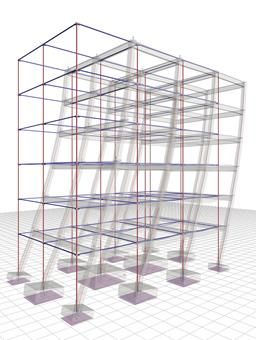
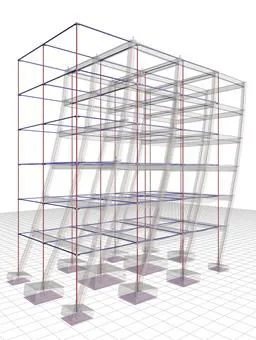
Seismic Energy Dissipation: Modern seismic design intentionally designates specific plastic hinge zones (such as beam links in eccentrically braced frames) to yield and absorb massive earthquake energy safely without catastrophic column collapse.
Progressive Collapse Mitigation: Evaluating alternate load paths in framed structures relies on plastic hinge rotations to bridge over damaged or removed columns.
Conclusion
Plastic analysis transforms structural steel design from a restrictive elastic mindset into a powerful exploration of true material ductility. By calculating shape factors, tracking sequential plastic hinge formation, and applying limit analysis theorems, civil engineers can design steel structures that are not only exceptionally safe under Ultimate Limit States, but significantly more economical and material-efficient.
