<link href="https://fonts.googleapis.com/css2?family=Caveat:wght@500;700&family=JetBrains+Mono:wght@400;500;600&display=swap" rel="stylesheet" /> Skip to main contentEngineering Courses, Mentoring & Jobs | EveryEng
Analyse Composite Materials using ANSYS banner

Analyse Composite Materials using ANSYS

Analyse Composite Materials using ANSYS banner
Self-paced Beginner

Analyse Composite Materials using ANSYS

4(1581)
21 enrolled
2072 views
FREE
8 min
Anytime
English
2072 views
Team EveryEng
Team EveryEngMechanical Engineering
  • Lifetime access
  • Certificate of completion
  • Foundational Learning
  • Access to Study Materials
Volume pricing for groups of 5+

Why enroll

Participants join this course to gain practical, industry-relevant skills in analyzing advanced composite materials using ANSYS. Many engineers and students are eager to understand how lightweight, high-strength materials behave under real-world conditions, especially in industries like aerospace and automotive. This course helps them build confidence in modeling and simulation, enabling them to predict performance, improve designs, and reduce failure risks. It is also valuable for those looking to enhance their career opportunities by adding in-demand CAE and simulation skills to their profile, making them more competitive in the job market.

Is this course for you?

You should take this if

  • You work in Aerospace
  • You're a Mechanical Engineering professional
  • You prefer self-paced learning you can revisit

You should skip if

  • You need a different specialisation outside Mechanical Engineering
  • You need live interaction with an instructor

Course details

This course is designed to equip participants with the knowledge and skills to effectively analyze composite materials using ANSYS software. Composite materials, consisting of two or more distinct constituents with different properties, are widely used in aerospace, automotive, marine, and civil engineering applications due to their lightweight, high strength-to-weight ratio, and tailored properties. By mastering the fundamentals of composite material analysis, participants will learn how to model, simulate, and analyze the behavior of composite structures under various loading conditions using ANSYS Mechanical.

Course suitable for

Key topics covered

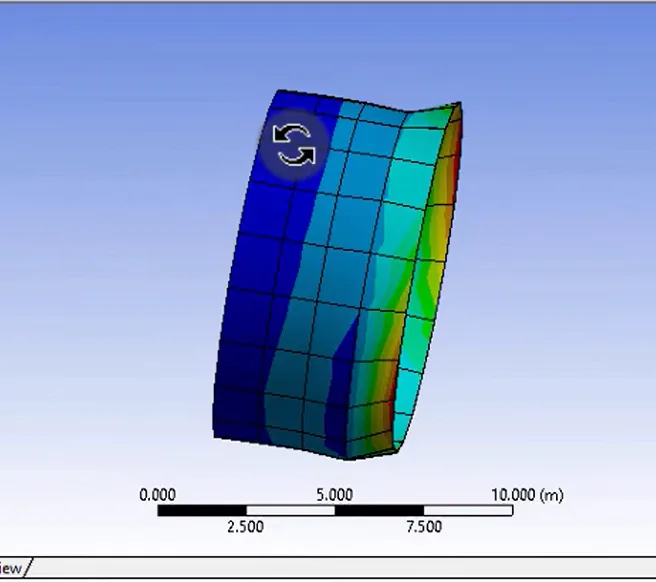
  • Learn to create and simulate the composite tube in ANSYS.

Course content

The course is readily available, allowing learners to start and complete it at their own pace.

1 lectures8 min
  1. Simulation of composite tube
    8 min

Opportunities that await you!

Skills & tools you'll gain

ANSYS

Career opportunities

FREE

Access anytime

Questions and Answers

A: The boundary is the reference axis, not symmetry. Symmetric stacks cancel bending-extension coupling, but sign errors still flip shear coupling if the angle reference is wrong. Without instrument datasheets, axis intent is all you have. You confirm whether the drawing's X-axis matches ANSYS global X before touching ply order.

A: The threshold is the failure mode. Coupon data alone doesn't cover load introduction, free-edge, or ply drop effects. The guidance pushes you to one higher level of test that exercises the same failure mechanism you're claiming in ANSYS.

A: The number is 135 GPa. For a single 0° ply loaded in its 1-direction, Ex equals E1 under plane stress. Poisson terms affect coupling, not the axial modulus you read back.

A: The boundary is cycles, not peak load. Trending divergence under repeat loading points at damage accumulation, something a limit-load pass doesn't clear, especially without full build records.