Skip to main contentEngineering Courses, Mentoring & Jobs | EveryEng
Business Excellence through Quality, QMS & TQM banner
Live Online Class Beginner

Business Excellence through Quality, QMS & TQM

4(8)
1 enrolled
1692 views
COMPLETED

Tell us and we’ll notify you when the next batch is scheduled.

3 hrs
Jan 4, 2025 · 5:30 AM
English , Hindi
1692 views
Vijay Sachdev
Vijay SachdevConsultant - Project & Procurement
  • 7-day money-back guarantee
  • Session recordings included
  • Foundational Learning
  • Access to Study Materials

Why enroll

We all are working in a "Business" domain. Prime objective of any business is to earn profit ethically / legally. But "No Customer" means "No Sale" that means "No Business". And every customer wants best Quality at lowest price. How to do it?

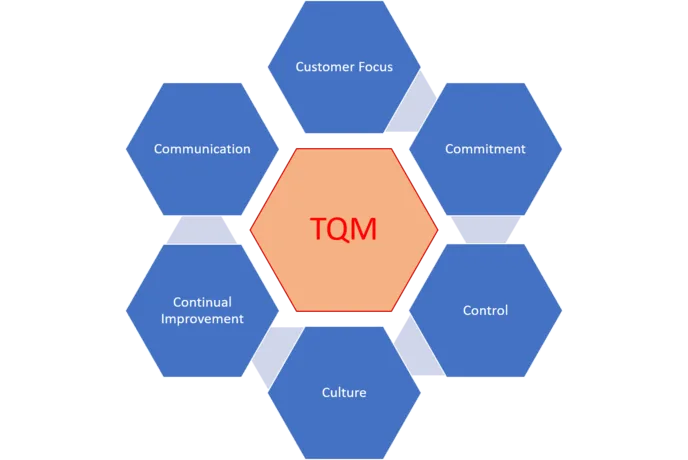
To achieve the Business Excellence, Quality Management Systems must be in place and effectively implemented across the Organisaiton at all levels. This can be termed as Total Quality Management (TQM) - EFQM Model. How to achieve Business Excellence will be explained during the training session,

ISO-9001 which talks about Quality Management Systems. Many organisations have obtained ISO-9001 Accreditation (just because, top management has decided to go for ISO-9001). Only very few Organisation could get the benefits / improvement after they implemnted ISO-9001.

Rest assured, your understanding and perception of Quality and Total Quality Management will change. You can learn, how to implement ISO-9001 effectively across the organisation to get the tangible and intangible gains.

Is this course for you?

You should take this if

  • You work in Manufacturing & Industrial
  • You're a Quality & Management Standards / Industrial Engineering professional
  • You prefer live, instructor-led training with Q&A

You should skip if

  • You need a different specialisation outside Quality & Management Standards
  • You need fully self-paced, on-demand content

Course details

Objective of this course is to train young Engineers to understand the terms "Quality" & "Quality Improvement" and to understand, "Quality is not costly". Sr Executives and Management can learn, how to bring Quality Improvement Culture in the Organisation, so as to uplift the Organisation to World Class Level.

Aim of "Total Quality Management" means to bring a Culture for Business Excellence and growth of the Organisation in the Competitive Environment. As Quality is not limited to Preventing Defects. Quality Management Systems must be established and effectively implemented across the whole Organisation, so that there is no mistake, defect, non-conformity, deficiency, accidents, delay, communication gap, in any of the activity or process of the Organisation.

Training will be purely based on practical example and sharing experience of Manufacturing Plants of Heavy Machineries, Precision work of Power Plants, Effecitve Implemenation of Quality Management Systems and Quality Culture across the Organisation. All your questions will be answered to your satisfaction and understanding.

Course suitable for

Opportunities that await you!

Career opportunities

Training details

This is a live course that has a scheduled start date.

Live session

Started

Sat, Jan 4, 2025 Ended

5:30 AM UTC· your timezone

Duration

3 hours per day

Why people choose EveryEng

Industry-aligned courses, expert training, hands-on learning, recognized certifications, and job opportunities-all in a flexible and supportive environment.

COMPLETED

Jan 4, 2025 · 5:30 AM

Questions and Answers

A: Governing principle: verification moves from electrical integrity to functional response before exposure to live process. Here, dry loop checking confirms wiring, scaling, and direction without adding process risk, then SCADA validation closes the loop. Applying pressure earlier breaks PTW sequencing and hides wiring polarity errors. Option B traps engineers who trust process response first; it feels real-world but skips the control-system failure modes that cause start-up delays.

A: Governing principle: dominant corrosion is set by chemistry plus transient operating states, not just normal operation. High chlorides combined with oxygen during shutdown promote localized attack; that risk controls coating, material, and inspection choices more than steady-state sulfide levels. Option C catches engineers who know chlorides are bad for stainless but overapply SCC risk without the tensile stress and temperature drivers present here.

A: Governing principle: separator liquid level follows liquid mass balance, not gas throughput intent. Lower gas velocity improves disengagement but doesn't remove liquid; without matching liquid outflow, level rises. Adjusting liquid handling keeps the vessel within design residence time. Option B traps those who recall density effects yet misapply them, adding pressure stress without fixing the liquid imbalance.

A: Governing principle: defects are cheapest to remove before hardware and schedule constraints exist. Full FAT proves logic and protective actions early; SAT then confirms integration and real-world signals. Reversing this inflates offshore rework under PTW pressure. Option D catches engineers who trust vendor packages, forgetting that integration logic failures sit outside equipment guarantees.