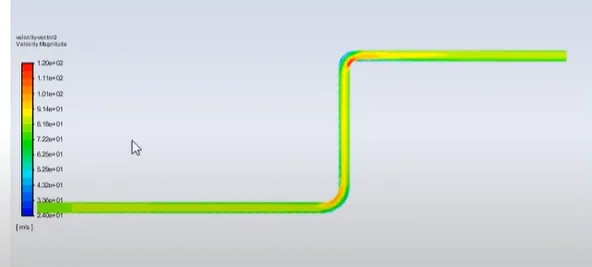
CFD Analysis of Double Elbow Pipe
- 7-day money-back guarantee
- Lifetime access
- Certificate of completion
Why enroll
What enrolled engineers say
Initially, I wasn’t sure what to expect from this course. As someone working mainly on automotive exhaust routing and some aerospace ducting layouts, the double elbow pipe felt very specific. That said, the CFD setup turned out to be closer to real problems than expected. The walkthrough in ANSYS on meshing tight bends and defining boundary conditions helped fill a gap I had around handling secondary flows and pressure losses in curved sections. One challenge was getting stable convergence when refining the mesh around the elbows. The course showed why overly aggressive mesh refinement near the bend can actually hurt solver stability, which is something I’ve run into on an automotive intake project without fully understanding why. The discussion around turbulence modeling, especially using k-epsilon for internal flows, connected well to both under-hood airflow and aerospace ECS duct analysis. A practical takeaway was learning a repeatable workflow to extract pressure drop and velocity profiles that can be reused for quick design comparisons. That’s already been applied to sanity-check a double-bend exhaust section before physical testing. Overall, it felt grounded in real engineering practice.
At first glance, the topics looked familiar, but the depth surprised me. Double elbow flow is something that shows up all the time in automotive exhaust routing and even in aerospace environmental control system ducting, yet it’s often oversimplified. The course did a decent job of slowing things down and walking through the ANSYS setup without hiding behind defaults. One challenge was getting the meshing strategy right around the elbows. Capturing secondary flows and separation without blowing up the cell count took a few iterations, and it highlighted an edge case that shows up in industry too: small geometric tweaks can swing pressure loss more than expected. The discussion around turbulence model selection felt grounded, especially when comparing what’s acceptable for a beginner study versus what would be required for a production-level automotive or aerospace analysis. A practical takeaway was being more deliberate about boundary condition placement and monitoring convergence beyond just residuals. In real programs, those shortcuts come back to bite at the system level, especially when pressure drop feeds into pump or compressor sizing. It wasn’t flashy, but the workflow mirrored how these problems are actually approached. It definitely strengthened my technical clarity.
Coming into this course, I had some prior exposure to the subject. From a senior engineer’s perspective, the value here was seeing how a seemingly simple double elbow pipe can create non‑intuitive flow separation and secondary vortices. That shows up all the time in automotive exhaust routing and aerospace environmental control system ducting, yet it’s often simplified too aggressively in early design phases. One challenge was getting stable convergence around the elbow junctions without over‑refining the mesh. Balancing y+ targets with reasonable solve times in ANSYS felt familiar, especially when comparing this to industry practice where turnaround time often matters more than academic perfection. Some edge cases, like sensitivity of pressure drop to elbow spacing, highlighted how small geometry changes can cascade into system‑level impacts on pump sizing or thermal margins. A practical takeaway was a more disciplined setup workflow: defining boundary conditions and monitoring mass imbalance early saved rework later. That’s directly applicable to automotive cooling loops and aerospace fuel lines where CFD results feed into broader system models. The course doesn’t cover advanced turbulence modeling, but for a beginner level, it sharpened how to think about flow physics rather than just clicking through menus. It definitely strengthened my technical clarity.
Your instructor
Team EveryEng
Engineer
Mechanical Engineering
Is this course for you?
You should take this if
- You work in Manufacturing & Industrial
- You're a Mechanical Engineering / CAD & Analysis professional
- You prefer self-paced learning you can revisit
You should skip if
- You need a different specialisation outside Mechanical Engineering
- You need live interaction with an instructor
Course details
Course suitable for
Key topics covered
Course content
The course is readily available, allowing learners to start and complete it at their own pace.
- Geometry14 min
- Meshing4 min
- Material And Initialization7 min
- Run calculation13 min