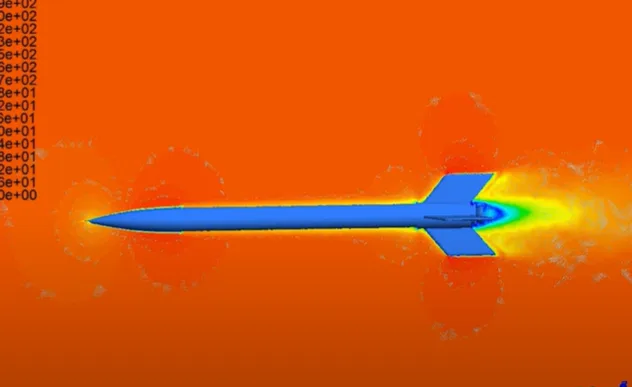
CFD Analysis of Rocket In ANSYS
CFD Analysis of Rocket In ANSYS

- 7-day money-back guarantee
- Lifetime access
- Certificate of completion
Why enroll
What enrolled engineers say
This course turned out to be more technical than I anticipated. From a senior engineering standpoint, it does a decent job introducing CFD concepts in ANSYS while keeping the rocket example concrete. The sections on external aerodynamics and basic compressible flow tie directly to aerospace practice, especially when discussing drag prediction and pressure distribution along the body. Some parallels with automotive aerodynamics also came up, particularly around bluff body effects and wake behavior, which helped ground the material in familiar industry problems. One challenge was getting stable solutions with coarse meshes. Early simulations were very sensitive to boundary conditions and turbulence model choice, and convergence issues popped up fast. That’s realistic, though, and it exposed an important edge case: model rockets sit in a gray area where Mach number, Reynolds number, and mesh resolution all interact in non-obvious ways. The course doesn’t deeply cover mesh independence studies, but it at least flags why they matter. A practical takeaway was a repeatable setup workflow in ANSYS—geometry cleanup, meshing strategy, solver settings, and basic result validation. At a system level, the coupling between aerodynamics, structural loads, and thermal effects was clear enough to show why siloed analysis breaks down quickly. The content felt aligned with practical engineering demands.
Coming into this course, I had some prior exposure to the subject, mostly from working around CFD results rather than building the models myself. The focus on rocket aerodynamics helped fill a gap I’ve had since most of my background is in automotive CFD, where external flow and drag studies dominate. Seeing compressible flow, Mach number effects, and pressure distribution around a rocket body was a useful shift in perspective. One part that took some effort was getting the mesh and boundary conditions right in ANSYS Fluent. Mesh refinement near the nose cone and understanding why results changed with different turbulence models took longer than expected. That struggle was actually helpful, since it forced a better understanding of solver setup instead of just clicking through steps. A practical takeaway was learning a repeatable workflow for setting up CFD cases and interpreting contour plots and coefficients, not just looking at colorful results. The thermal and structural analysis sections also tied nicely into real aerospace design constraints, especially around heat loads at higher speeds. Overall, the course felt grounded and usable, and it definitely strengthened my technical clarity.
Coming into this course, I had some prior exposure to the subject, mostly from aerospace CFD work and a bit of automotive external aerodynamics. The content is clearly aimed at beginners, but it still touched on real concepts like compressible flow around the rocket body and basic thermal coupling near the motor section. The walkthrough of ANSYS meshing and solver setup felt closer to how junior engineers are actually onboarded in industry, rather than the overly clean examples you sometimes see. One challenge was dealing with mesh sensitivity and convergence. Even at low Mach numbers, small changes in boundary layer refinement noticeably affected drag predictions, which is a good lesson early on. Turbulence model selection was simplified, but it did open the door to discussing edge cases, like how transitional flow on a model rocket compares poorly to full-scale aerospace vehicles. That scaling issue is something also seen in automotive wind tunnel vs. road correlation. A practical takeaway was developing a repeatable CFD setup checklist—geometry cleanup, boundary conditions, and result sanity checks. At a system level, the course reinforced how aerodynamic, structural, and thermal considerations can’t really be treated in isolation. I can see this being useful in long-term project work.
Your instructor
Team EveryEng
Engineer
Mechanical Engineering
Is this course for you?
You should take this if
- You work in Aerospace
- You're a Mechanical Engineering / CAD & Analysis professional
- You prefer self-paced learning you can revisit
You should skip if
- You need a different specialisation outside Mechanical Engineering
- You need live interaction with an instructor
Course details
Course suitable for
Course content
The course is readily available, allowing learners to start and complete it at their own pace.
- Geometry and Meshing8 min
- Setup and Solution12 min
- Results7 min
Opportunities that await you!
Skills & tools you'll gain
Career opportunities
Why people choose EveryEng
Industry-aligned courses, expert training, hands-on learning, recognized certifications, and job opportunities-all in a flexible and supportive environment.


 Aug 29, 2026