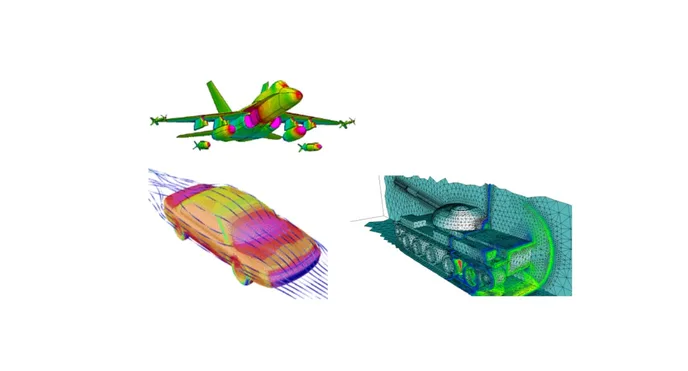
Computational Fluid Dynamics: Overview Fundamentals, Applications & Fluid flow basics
Computational Fluid Dynamics: Overview Fundamentals, Applications & Fluid flow basics

- 7-day money-back guarantee
- Lifetime access
- Certificate of completion
Why enroll
What enrolled engineers say
Coming into this course, I had some prior exposure to the subject, mostly from using CFD as a downstream tool rather than building intuition from the equations up. The walkthrough of Navier–Stokes and how finite volume discretization actually shows up in a solver helped connect dots that are often hidden in commercial packages. From an aerospace angle, the sections on boundary layer behavior and grid resolution near walls were directly relevant to external aerodynamics, especially where y+ targets get ignored in beginner setups. On the automotive side, the examples tied reasonably well to underhood thermal management and internal flow, where incompressible assumptions usually hold but turbulence modeling choices (k‑ε vs. k‑ω) still matter at a system level. One challenge was keeping track of stability and convergence criteria while also learning the software workflow; it’s easy to get a “pretty” contour that is numerically wrong. The discussion around edge cases like skewed meshes and poor boundary condition definitions mirrored problems seen in industry reviews. A practical takeaway was learning to sanity‑check results using mass balance and residual trends before trusting velocity or pressure plots. The content felt aligned with practical engineering demands.
At first glance, the topics looked familiar, but the depth surprised me. Coming from an automotive background working on under‑hood cooling and some external aerodynamics, CFD was always a bit of a black box. This course helped connect the Navier–Stokes equations to what the solver is actually doing when predicting pressure drop or temperature rise. The sections on finite volume methods and grid generation were especially relevant. In past projects, poor mesh quality around boundary layers caused noisy results on a vehicle cooling duct, and this course finally explained why that happens. Stability and convergence criteria were another gap for me; understanding residuals and time-step sensitivity cleared up a lot of trial-and-error habits. A similar takeaway applies to aerospace-style problems like airfoil flow, where small changes in discretization can swing lift and drag numbers. One real challenge was wrapping my head around choosing between different discretization schemes without overcomplicating a beginner setup. It took a bit of rewinding and experimenting. The most practical takeaway is being able to sanity-check CFD results before sending them to a design review. That alone saves time and awkward questions. I can see this being useful in long-term project work.
Initially, I wasn’t sure what to expect from this course. Coming from an automotive background, CFD had always felt a bit like a black box beyond post-processing plots. The sections on the Navier–Stokes equations and finite volume discretization helped connect the math to what’s actually happening in the solver. Seeing how grid generation and boundary layer resolution affect results made a lot of sense, especially when thinking about under-hood airflow and thermal management in automotive applications. One area that stood out was the discussion around convergence and stability. A real challenge during the assignments was dealing with a case that simply wouldn’t converge because of poor meshing near walls. That was frustrating, but also realistic. In aerospace projects, especially around external aerodynamics and airfoil analysis, the same issues show up if y+ and turbulence modeling aren’t handled carefully. A practical takeaway was learning a basic checklist before trusting results: mesh quality, residual trends, and sensitivity to boundary conditions. That’s already been applied to a cooling flow study at work. Overall, it felt grounded in real engineering practice.
Your instructor
Team EveryEng
Engineer
Mechanical Engineering
Is this course for you?
You should take this if
- You work in Automotive or Aerospace
- You're a Mechanical Engineering professional
- You prefer self-paced learning you can revisit
You should skip if
- You need a different specialisation outside Mechanical Engineering
- You need live interaction with an instructor
Course details
Course suitable for
Key topics covered
Course content
The course is readily available, allowing learners to start and complete it at their own pace.
- Lecture 0160 min
- Lecture 0260 min
- Lecture 0359 min
Opportunities that await you!
Career opportunities
Why people choose EveryEng
Industry-aligned courses, expert training, hands-on learning, recognized certifications, and job opportunities-all in a flexible and supportive environment.


 Aug 29, 2026