Skip to main contentEngineering Courses, Mentoring & Jobs | EveryEng
Control Engineering for Robotics banner
Preview this course
Control Engineering for Robotics banner
Preview this course
Self-paced Advanced

Control Engineering for Robotics

4(117)
1 enrolled
286 views
FREE
303 min
Anytime
English
286 views

Engineering Academy
Engineering AcademyLearn Without Limits: Free Engineering Courses
  • Lifetime access
  • Anytime Learning
  • Learn from Industry Expert
  • Career Option Guideline

Why enroll

This course helps you apply control theory to real robotic systems in a simple way.
It builds strong practical skills in controller design used in industry and research.
Ideal for students interested in robotics, automation, and control engineering.

Is this course for you?

You should take this if

  • You work in Industrial Automation
  • You're a Mechatronics and Robotics / Mechanical Engineering professional
  • You have 3+ years of hands-on experience in this field
  • You want to build skills in Engineering & Design, Project Management

You should skip if

  • You're new to this field with no prior experience
  • You need a different specialisation outside Mechatronics and Robotics
  • You need live interaction with an instructor

Course details

This course provides a practical introduction to classical and modern control theory with a strong focus on robotics applications. It emphasizes learning through design and application rather than only mathematical theory. Students will learn how to model dynamic systems commonly used in robotic platforms and understand key classical control concepts such as system response and stability. The course guides learners in designing and tuning P, PI, and PID controllers for real-world systems. In the modern control section, students are introduced to state-space modeling of dynamic systems along with important concepts such as controllability and observability. The course also covers controller design using pole placement techniques and introduces optimal control using the Linear Quadratic Regulator (LQR). By the end of the course, learners will be able to design effective controllers for robotic and other dynamic systems.

Source:
NPTEL IIT Guwahati [Youtube Channel]

Course suitable for

Key topics covered

  • Control Engineering for Robotics – Intro Video

  • Signals and Systems

  • Types of Systems

  • Differential Equation of a System

  • Differential Equation of an LTI System

  • Laplace Transform

  • Finding Response Using Transfer Function

  • Finding Transfer Functions – Examples

  • Finding Transfer Functions – Experimentally

  • Natural Response of a System

  • Forced Response of a System

  • Introduction to Bode Plots

  • Bode Plots – Continued

  • Finding Transfer Function from Frequency Response

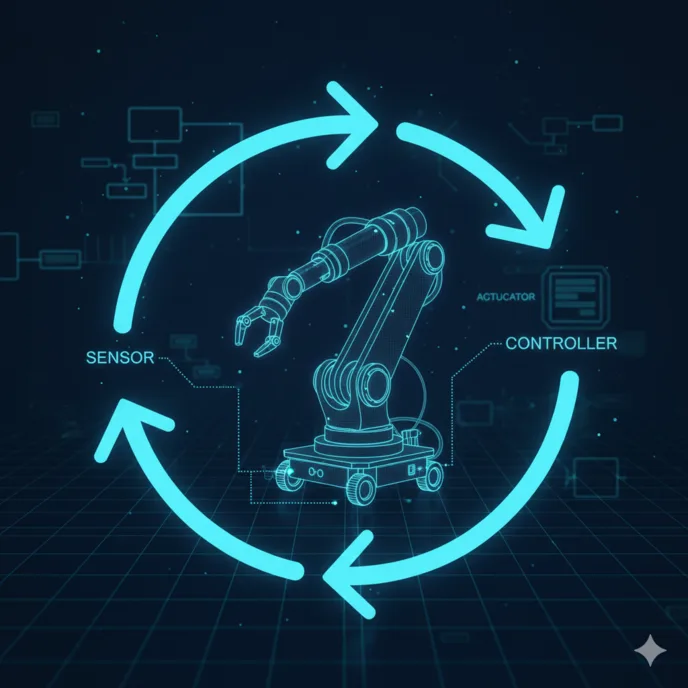
  • Configuration of a Control System

Course content

The course is readily available, allowing learners to start and complete it at their own pace.

15 lectures5 hr 3 min
  1. Control Engineering for Robotics [Intro video]
    3 min
  2. Signals and Systems
    16 min
  3. Types of Systems
    25 min
  4. Differential equation of a system
    12 min
  5. Differential equation of an LTI system
    27 min
  6. Laplace Transform
    12 min
  7. Finding response using transfer function
    24 min
  8. Finding Transfer Functions - Examples
    13 min
  9. Finding Transfer Functions - Experimentally
    23 min
  10. Natural Response of a system
    31 min
  11. Forced Response of a system
    21 min
  12. Introduction to Bode Plots
    34 min
  13. Bode Plots Continued
    23 min
  14. Finding Transfer Function from Frequency
    24 min
  15. Configuration of a control system
    15 min

Opportunities that await you!

Career opportunities

✎ Where this fits — what comes before, what comes next

Why people choose EveryEng

Industry-aligned courses, expert training, hands-on learning, recognized certifications, and job opportunities-all in a flexible and supportive environment.

FREE

Access anytime

Questions and Answers

A: Designing to the latest edition closes the legal and safety gap created by the contract wording. Option B ignores the contract clause and leaves you exposed in an audit. Option C creates an untraceable safety case with mixed assumptions. Option D swaps standards and drops robot-specific stop behavior.

A: The sequence proves the entire chain from device to actuator under real conditions. Option A bypasses the field device and masks wiring faults. Option C validates software only and misses power-side behavior. Option D skips the safety function when it matters.

A: The GA communicates design intent for redundancy that must be matched in hardware. Option B assumes internal architecture without evidence. Option C confuses diagnostics with fault tolerance. Option D ignores standard symbology practice.

A: STO removes torque but doesn't provide a brake to hold load. Option A is exactly what STO prevents when healthy. Option C is mitigated by stop time and inertia limits. Option D is covered by removal of drive energy.