<link href="https://fonts.googleapis.com/css2?family=Caveat:wght@500;700&family=JetBrains+Mono:wght@400;500;600&family=Plus+Jakarta+Sans:wght@600;700;800&display=swap" rel="stylesheet" /> Skip to main contentEngineering Courses, Mentoring & Jobs | EveryEng
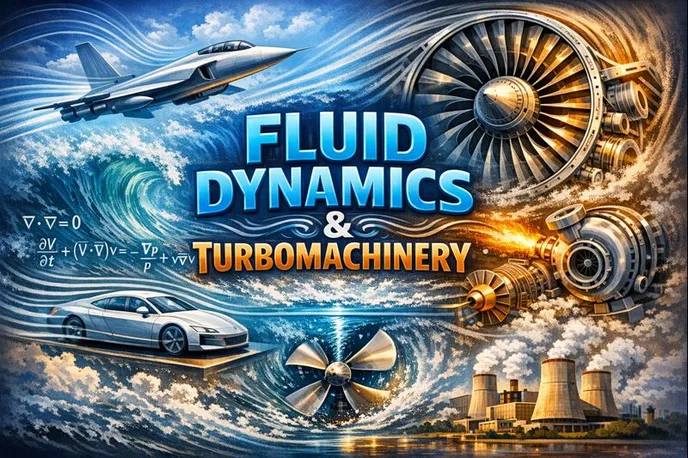
Fluid Dynamics and Turbomachines banner
Preview this course

Fluid Dynamics and Turbomachines

Fluid Dynamics and Turbomachines banner
Preview this course
Self-paced Advanced

Fluid Dynamics and Turbomachines

3(115)
4 enrolled
141 views
FREE
1251 min
Anytime
English
141 views
Engineering Academy
Engineering AcademyLearn Without Limits: Free Engineering Courses
  • Lifetime access
  • Certificate of completion
  • Anytime Learning
  • Learn from Industry Expert
Volume pricing for groups of 5+

Why enroll

Participants join the Fluid Dynamics and Turbomachines course to gain a strong theoretical and practical foundation in analyzing fluid flow and energy transfer in engineering systems. The course enables learners to understand and predict the performance of turbines, pumps, compressors, and fans, which are critical components in power generation, aerospace, manufacturing, and thermal systems. By mastering core principles such as conservation laws, velocity triangles, efficiency analysis, and performance characteristics, participants develop the ability to solve complex, real-world fluid flow and turbomachinery problems. This course is particularly valuable for students and professionals seeking to strengthen their core mechanical engineering knowledge, prepare for advanced studies and competitive examinations, and enhance their technical competence and career opportunities in energy, propulsion, and process industries.

Is this course for you?

You should take this if

  • You work in Mechanics & Turbomachinery
  • You're a Mechanical Engineering / Production Engineering professional
  • You have 3+ years of hands-on experience in this field
  • You prefer self-paced learning you can revisit

You should skip if

  • You're new to this field with no prior experience
  • You need a different specialisation outside Mechanical Engineering
  • You need live interaction with an instructor

Course details

Fluid Dynamics and Turbomachines is an advanced engineering course that provides an in-depth understanding of the behavior of fluids in motion and the principles governing energy transfer between fluids and rotating machinery. The course begins with fundamental concepts of fluid properties, fluid statics, and fluid kinematics, followed by a detailed study of fluid dynamics, including conservation of mass, momentum, and energy. Emphasis is placed on analyzing fluid flow through pipes, ducts, nozzles, and channels, as well as understanding losses due to friction, turbulence, and flow separation.

The turbomachinery component of the course focuses on the working principles, performance characteristics, and design aspects of machines that convert energy between fluids and mechanical systems. This includes a comprehensive study of turbines, pumps, compressors, and fans, covering velocity triangles, stage efficiency, specific speed, and characteristic curves. Practical considerations such as cavitation, flow instabilities, and operational limitations are also addressed. By integrating theoretical analysis with real-world applications in power plants, aerospace propulsion, HVAC systems, and process industries, the course equips learners with the skills required to analyze, select, and optimize fluid flow systems and turbomachines for efficient and reliable engineering performance.

Source: NPTEL Youtube

Course suitable for

Key topics covered

  • introduction to fluid flow

  • non newtonian fluid, classification of flow, analuysis of flow

  • differential analysis

  • navier stroke equation for 2D incompressible flow

  • basic thermodynamics

  • dimensional analysis

Course content

The course is readily available, allowing learners to start and complete it at their own pace.

34 lectures20 hr 51 min
  1. Introduction to Fluid Flow
    47 min
  2. Flow field, Stresses on fluid element, Newtonian fluid
    37 min
  3. Non Newtonian fluid, Classification of flow, Analysis of flow
    42 min
  4. Tutorial -1
    18 min
  5. Integral analysis, Control volume, Generalised conservation equation
    40 min
  6. Mass and linear momentum conservation in CV
    30 min
  7. Angular momentum conservation, Non-inertial frame of reference
    30 min
  8. Tutorial - 2
    34 min
  9. Differential Analysis
    43 min
  10. Navier-Stokes equation for 2D incompressible flow
    33 min
  11. Vorticity, Stream function, Bernoulli's equation
    44 min
  12. Tutorial - 3
    28 min
  13. External flows, Laminar and Turbulent Boundary Layer
    54 min
  14. Differential analysis of boundary layer, Blassius equation
    30 min
  15. Boundary Layer flow with pressure gradient, Flow separation
    52 min
  16. Internal flow, Pipe friction
    56 min
  17. Basic Thermodynamics
    44 min
  18. Turbomachines: Definition and classification
    25 min
  19. Dimensional Analysis
    52 min
  20. Tutorial - 4
    21 min
  21. Representation of Turbomachines and Definition of velocity
    49 min
  22. Euler's energy equation
    33 min
  23. Real fluid flow and efficiency of turbomachine
    43 min
  24. Tutorial -5
    12 min
  25. Pumps
    45 min
  26. Pumping Systems
    22 min
  27. Hydraulic Turbines: Pelton Turbine
    46 min
  28. Hydraulic Turbines: Reaction Turbines
    36 min
  29. Cavitation in Hydroturbomachines
    54 min
  30. Tutorial - 6
    26 min
  31. Introduction to compressible flow
    47 min
  32. Steam and Gas Turbine : Introduction and classification
    26 min
  33. Steam and Gas Turbine : h-s Plots and velocity triangle
    36 min
  34. Tutorial-7
    16 min

Opportunities that await you!

Career opportunities

FREE

Access anytime

Questions and Answers

A: That's the most common mistake — stopping at hydraulic power and forgetting how fast efficiency erodes at this scale. Start from first principles: ρgQH gives about 98 kW hydraulic. Single-stage cooling water pumps rarely beat 70% wire-to-water once you roll in pump and motor. That pushes you into the 140 kW neighborhood. The 50 kW answer feels tidy but drops losses. The big 400 kW guess imports cavitation thinking into power sizing, and velocity head doesn't make static head disappear.

A: That's the most common mistake — forcing pressure ratio logic onto a flow-dominated problem. At 120 kg/s and PR 1.25, axial machines live in their comfort zone: high flow, small ΔP per stage, good efficiency, and a slimmer envelope. Centrifugals can be coerced there, but impeller size and tip speed spiral. Screws fall apart on flow. Two stages plus intercooling fixes temperature, not the basic mismatch.

A: That's the most common mistake — treating a datasheet point like it’s a law of nature. Rated head assumes stated density, temperature, and impeller trim. FAT loops often run cold water and sometimes a different trim to protect margin. Suction conditions shift NPSH, not developed head. Wear doesn’t show up brand-new. Read the fine print before you write an NCR.

A: That's the most common mistake — mixing formulas across unit systems. Metric specific speed uses rpm, m³/s, and meters straight up. Plugging in gives Ns ≈ 1480√0.12 / 35^(3/4), landing near 120. Converting rpm to rad/s or head to pressure double-counts constants. A value near 35 feels neat but comes from dropping the exponent on head.