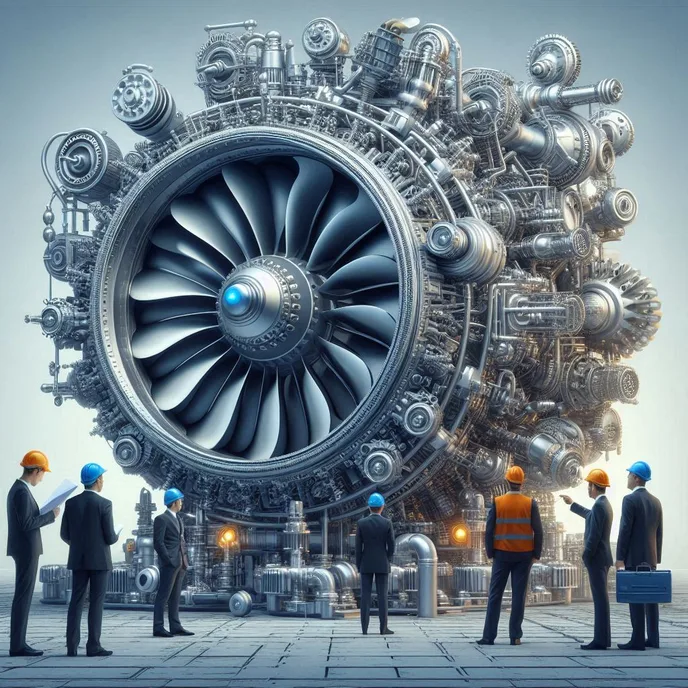
Introduction to TurboMachinary
Introduction to TurboMachinary

- Lifetime access
- Certificate of completion
- Foundational Learning
- Access to Study Materials
Why enroll
What enrolled engineers say
This course turned out to be more technical than I anticipated. Despite being labeled beginner, it dives fairly quickly into thermodynamic analysis and velocity triangles, which are core to real turbomachinery work. The treatment of compressors and turbines lined up well with what’s seen in aerospace gas turbine cores, especially around stage loading and efficiency definitions. On the automotive side, the discussion helped frame how turbochargers behave, particularly when thinking about compressor maps, surge, and choke limits. One challenge was keeping the sign conventions straight in the Euler turbomachinery equation and reconciling the idealized derivations with the messy losses seen in practice. That gap is real in industry, and the course doesn’t fully smooth it over, which is actually useful. Edge cases like cavitation in pumps and off-design operation were mentioned just enough to flag system-level risks, even if not deeply explored. Compared to industry practice, the material is more theory-heavy and lighter on empirical correlations, but that’s acceptable at this level. A practical takeaway was being able to sanity-check performance claims using affinity laws and basic efficiency breakdowns. It definitely strengthened my technical clarity.
At first glance, the topics looked familiar, but the depth surprised me. Coming from aerospace and automotive programs, the treatment of turbines and compressors went beyond hand‑wavy explanations and actually walked through the thermodynamic analysis and velocity triangles. That helped connect axial compressors in aircraft engines with centrifugal compressors used in automotive turbochargers. One challenge was keeping the sign conventions and reference frames straight when applying the Euler turbomachinery equation. It’s easy to lose track of what assumptions are being made, especially for beginners, and a bit more emphasis on common pitfalls would help. Edge cases like compressor surge, choke, and pump cavitation were touched on just enough to flag their importance, which matches what’s seen in industry when machines run off‑design. Compared with typical industry training, the course is more theory‑heavy, but that’s not a bad thing. Understanding why efficiency drops or why a pump needs adequate NPSH has system‑level implications, from thermal management in automotive cooling loops to stability margins in aerospace engines. A practical takeaway was learning how to read basic compressor and pump performance maps and relate them to real operating constraints. The content felt aligned with practical engineering demands.
At first glance, the topics looked familiar, but the depth surprised me. Coming from an automotive background, turbomachinery usually meant “the turbocharger works or it doesn’t.” This course helped fill a real gap between rule‑of‑thumb decisions and the underlying thermodynamics. The sections on velocity triangles and the Euler turbomachinery equation connected directly to how compressors and turbines actually exchange energy, which I’ve also seen on the aerospace side when looking at axial compressor stages in gas turbines. One challenge was keeping track of sign conventions and flow angles during the early lectures. It took a couple of rewatches to stop mixing up inlet and outlet velocity components, especially when comparing pumps versus turbines. Still, that struggle paid off. A practical takeaway was learning how parameters like specific speed and pressure ratio influence machine selection. That immediately helped on a recent automotive cooling system review, where pump choice had been more guesswork than analysis. The compressor performance discussion also made turbocharger maps less intimidating and more usable in real sizing conversations. It’s a beginner course, but it doesn’t feel watered down. I can see this being useful in long-term project work.
Your instructor
Team EveryEng
Engineer
Mechanical Engineering
Is this course for you?
You should take this if
- You work in Mechanics & Turbomachinery
- You're a Mechanical Engineering professional
- You prefer self-paced learning you can revisit
You should skip if
- You need a different specialisation outside Mechanical Engineering
- You need live interaction with an instructor
Course details
Course suitable for
Key topics covered
Course content
The course is readily available, allowing learners to start and complete it at their own pace.
- Introduction25 min
- Basic Theory of Turbomachines - Part-0113 min
- Basic Theory of Turbomachines - Part-0216 min
- Basic Theory of Turbomachines-Part-0315 min
- Basic Theory of Turbomachines-Part-0410 min
- Basic Theory of Turbomachines-Part-0512 min
- Basic Theory of Turbomachines-Part-067 min
- Hydro Turbomachines - Centrifugal pumps-Part-0118 min
- Hydro Turbomachines - Centrifugal pumps-Part-0216 min
- Hydro Turbomachines - Centrifugal pumps-Part-0321 min
- Hydro Turbomachines - Centrifugal pumps-Part-0412 min
- Hydro Turbomachines - Francis turbine-Part-015 min
- Hydro Turbomachines - Francis turbine-Part-0210 min
- Hydro Turbomachines - Kaplan turbine15 min
- Hydro Turbomachines - Pelton turbine25 min
- Positive Displacement Pumps - Gear pump18 min
- Thermal Turbomachines - Introduction20 min
- Thermal Turbomachines - Gas turbines17 min
- Thermal Turbomachines - Steam Turbines17 min
- Thermal Turbomachines-Part-015 min
- Thermal Turbomachines-Part-027 min
Opportunities that await you!
Career opportunities
Why people choose EveryEng
Industry-aligned courses, expert training, hands-on learning, recognized certifications, and job opportunities-all in a flexible and supportive environment.


 Aug 29, 2026