Skip to main contentEngineering Courses, Mentoring & Jobs | EveryEng
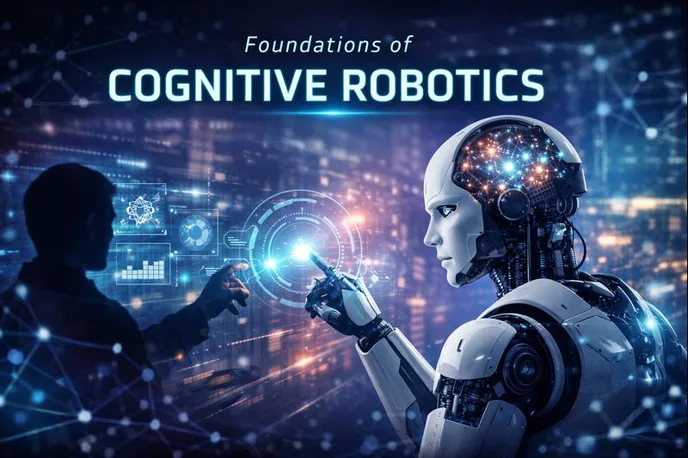
Foundations of cognitive robotics banner
Preview this course
Foundations of cognitive robotics banner
Preview this course
Self-paced Advanced

Foundations of cognitive robotics

3(121)
333 views
Trainers Rating
3(121)
Course type
Watch to learn anytime
Duration
610 min
Start
Anytime
Language
English
Views
333
  • Lifetime access
  • Anytime Learning
  • Learn from Industry Expert
  • Career Option Guideline
FREE
Engineering Academy
Engineering AcademyLearn Without Limits: Free Engineering Courses

Why enroll

Participants join the Foundations of Cognitive Robotics course to gain a deep understanding of how intelligent behavior is created in autonomous robotic systems. The course provides a strong conceptual foundation that bridges artificial intelligence and robotics, enabling learners to understand not just how robots move, but how they perceive, reason, learn, and make decisions in complex, real-world environments.

This course is particularly valuable for students and professionals who want to work at the intersection of AI, robotics, and cognitive science. Participants benefit from exposure to modern cognitive architectures, learning algorithms, and decision-making frameworks that are essential for developing adaptive and human-aware robots. The course equips learners with the ability to analyze and design systems that can operate under uncertainty, interact naturally with humans, and adapt to dynamic conditions.

Course details

Foundations of Cognitive Robotics is an interdisciplinary course that explores how intelligent behavior can be designed, implemented, and evaluated in autonomous robotic systems. The course focuses on the integration of cognition, perception, learning, and action, enabling robots to reason about their environment, make decisions under uncertainty, and adapt to dynamic real-world conditions. Drawing from artificial intelligence, robotics, cognitive science, neuroscience, and control theory, the course provides a comprehensive framework for understanding how cognitive capabilities emerge in embodied agents.

The course begins with the fundamental principles of cognitive robotics, emphasizing the concept of embodiment and the tight coupling between perception, cognition, and motor action. Learners are introduced to sensing and perception mechanisms, including visual, auditory, and proprioceptive inputs, and how these sensory streams are transformed into internal representations of the environment. Topics such as sensor fusion, world modeling, and state estimation are covered to explain how robots maintain situational awareness in complex and uncertain settings.

Source : IIT Kanpur (Youtube Channel)

Course suitable for

Is this course for you?

Perfect for

  • You're a Mechanical Engineering / Production Engineering professional
  • You have 3+ years of hands-on experience in this field
  • You prefer self-paced learning you can revisit

Before you enrol

  • Advanced level — assumes working knowledge of Mechanical Engineering
  • Self-paced video, 610 min — watch anytime
New to Mechanical Engineering? Browse beginner courses →

Ready for the next step?

Paid courses that build on what this one teaches.

Course curriculum

The course is readily available, allowing learners to start and complete it at their own pace.

15 lectures10 hr 10 min
  1. Intro - Foundations of Cognitive Robotics
    4 min
  2. Introduction to Cognitive Robotics
    35 min
  3. Smart Materials-I
    37 min
  4. Smart Materials-II
    32 min
  5. Smart Materials-III
    38 min
  6. Architecture of the Brain
    54 min
  7. Architecture of the Brain- Continued
    53 min
  8. Nerve Cells
    41 min
  9. Introduction to Synchronisation Models
    47 min
  10. Synchronisation models (continued)
    47 min
  11. Introduction to EEG
    50 min
  12. Theories of Intelligence-I
    24 min
  13. Theories of Intelligence-II
    55 min
  14. Kuramoto Model
    47 min
  15. Child Robot Interaction
    46 min

Key topics covered

  • introduction to cognitive robotics

  • architecture of the brain

  • nerve cells

  • introduction to synchronisation models

  • theories of intelligence

  • kuramoto model

Opportunities that await you!

Career opportunities

Frequently asked questions

A: That's the most common mistake — mixing functional descriptions with wiring assumptions. The datasheet describes the safety function’s capability, not how many wires you’ve actually landed. The drawing looks compliant because it shows dual channels, but unless both terminate on safety‑rated inputs, the STO claim doesn’t hold. Throughput suffers later when you’re forced into a retrofit.

A: That’s the classic sequencing trap — electrical checks aren’t behavioral checks. Calibration sets the robot’s internal world model, and offsets propagate straight into motion planning. Doing it out of order creates hidden rework when the robot ‘learns’ the wrong physics.

A: That’s the most common mistake — dropping the reaction distance. The robot keeps moving before deceleration even starts, and zoning that short leads to nuisance trips or worse, unsafe gaps. Lean cells hate both surprises.

A: That’s the usual misunderstanding — PFL limits energy, not geometry. Trapping hazards don’t care about peak force alone, and that’s why layout and escape paths still matter. You can’t kaizen your way out of physics.

FREE

Access anytime

What learners say about this course

Industry-aligned courses, expert training, hands-on learning, recognized certifications, and job opportunities-all in a flexible and supportive environment.

Put no limit on your engineering passion.

We would love to hear from you.

Engineers collaborating around a laptop