Skip to main contentEngineering Courses, Mentoring & Jobs | EveryEng
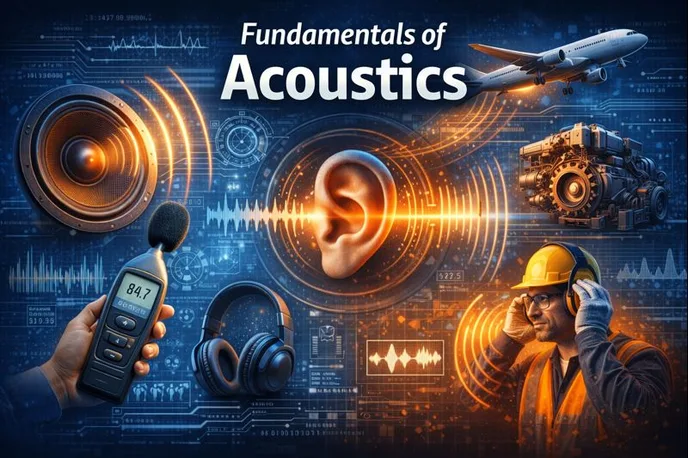
Fundamentals of Acoustics-I banner
Preview this course

Fundamentals of Acoustics-I

Fundamentals of Acoustics-I banner
Preview this course
Self-paced Advanced

Fundamentals of Acoustics-I

3(115)
1 enrolled
188 views
FREE
1062 min
Anytime
English
188 views

Engineering Academy
Engineering AcademyLearn Without Limits: Free Engineering Courses
  • Lifetime access
  • Certificate of completion
  • Anytime Learning
  • Learn from Industry Expert

Why enroll

Participants join Fundamentals of Acoustics to build a strong conceptual understanding of sound and vibration phenomena that are essential in many engineering and scientific applications. The course helps learners grasp how sound is generated, propagates, and interacts with materials and structures, providing a solid foundation for addressing noise and vibration issues in real-world systems.

Many participants are motivated to acquire practical knowledge of acoustic measurement techniques, noise evaluation, and basic control methods used in industries such as automotive, aerospace, construction, manufacturing, and environmental engineering. The course supports the development of skills needed to analyze sound quality, comply with noise regulations, and improve acoustic performance of products and spaces.

Participants also join to strengthen their academic base for advanced courses, research, or specialization in acoustics, noise and vibration engineering, or related fields. By connecting theory with practical applications, the course benefits students, researchers, and professionals seeking to enhance their technical competence and career opportunities in acoustics and noise control.

Is this course for you?

You should take this if

  • You work in Mechanics & Turbomachinery
  • You're a Mechanical Engineering / Production Engineering professional
  • You have 3+ years of hands-on experience in this field
  • You prefer self-paced learning you can revisit

You should skip if

  • You're new to this field with no prior experience
  • You need a different specialisation outside Mechanical Engineering
  • You need live interaction with an instructor

Course details

Fundamentals of Acoustics is a core course that introduces the principles governing the generation, propagation, measurement, and control of sound and vibration. The course provides a strong theoretical foundation in acoustics while linking fundamental concepts to practical engineering and real-world applications across mechanical, civil, aerospace, and environmental domains.

The course begins with the basic physics of sound, covering wave motion, frequency, wavelength, sound speed, and sound pressure levels. Participants learn how sound propagates in different media such as air, liquids, and solids, and how boundary conditions and material properties influence acoustic behavior. Topics such as reflection, refraction, diffraction, and interference are discussed to explain sound behavior in enclosed and open environments.

Further, the course explores acoustic measurement techniques and instrumentation, including microphones, sound level meters, frequency analysis, and octave band analysis. Human hearing, psychoacoustics, and noise perception are also introduced to help participants understand how sound is perceived and evaluated. The principles of noise generation, transmission, and control are examined, with emphasis on practical noise reduction methods using absorption, insulation, and damping.

The course also introduces vibration fundamentals and their relationship to acoustics, along with basic room acoustics and environmental acoustics. Applications in noise control engineering, building acoustics, automotive and industrial noise, and product sound quality are highlighted through examples and case studies. By the end of the course, participants gain a clear understanding of acoustic principles and are equipped to analyze, measure, and control sound in engineering systems and environments.

source : NPTEL [ youtube]

Course suitable for

Key topics covered

  • introduction to fundamentals of acoustics

  • wave propagation on a string

  • wave solution : real notation vs complex notation

  • the force finite string with an end mass

  • the derivation of acoustic wave

  • acoustics inside a piston driven finite duct

Course content

The course is readily available, allowing learners to start and complete it at their own pace.

31 lectures17 hr 42 min
  1. INTRO - Fundamentals of Acoustics
    15 min
  2. The vibrating spring-mass-damper system
    32 min
  3. Power calculations in a vibrating spring-mass-damper system
    41 min
  4. Wave propagation on a string
    45 min
  5. Examples of waves on strings: finite and semi-infinite cases
    44 min
  6. General solution to 1-D wave equation: physical insights
    41 min
  7. Wave solution: real notation vs complex notation
    34 min
  8. The vibrating string with a general mechanical impedance
    40 min
  9. The forced finite string with an end mass
    29 min
  10. The one-D wave solution: physical insights
    34 min
  11. Longitudinal wave propagation in a rod
    30 min
  12. Forced semi-infinite and finite rods
    34 min
  13. The derivation of the acoustic wave equation
    40 min
  14. The derivation of the acoustic wave equation contd.-I
    30 min
  15. The derivation of the acoustic wave equation contd.-II
    36 min
  16. The derivation of the acoustic wave equation contd.-III
    27 min
  17. Sound propagation in piston driven semi-infinite and finite ducts
    34 min
  18. Acoustics inside a piston driven finite duct with a general end impedance.
    30 min
  19. Time averaged power in a 1-D acoustic wave
    31 min
  20. The Free Space Green Function in acoustics.
    32 min
  21. The Free Space Green Function contd.
    30 min
  22. Various Green Functions and their uses
    37 min
  23. Derivation of the interior Kirchhoff Helmholtz Integral Equation
    28 min
  24. Derivation of the exterior Kirchhoff Helmholtz Integral Equation
    36 min
  25. Acoustic wave equation in spherical coordinates.
    31 min
  26. Legendre polynomials, spherical harmonics, orthogonality relations.
    33 min
  27. Spherical harmonics, Legendre polynomials and their orthogonality relations contd.
    32 min
  28. Interior Neumann Green function.
    45 min
  29. Exterior Neumann and Dirichlet Green functions.
    41 min
  30. Pulsating sphere using the exterior Neumann Green function
    32 min
  31. Equivalence of Neumann Green function and separation of variables solution.
    38 min

Opportunities that await you!

Career opportunities

Why people choose EveryEng

Industry-aligned courses, expert training, hands-on learning, recognized certifications, and job opportunities-all in a flexible and supportive environment.

FREE

Access anytime

Questions and Answers

A: The hard boundary here is environment dependence. Sound power is source-based; reflections, distance, and enclosure geometry drop out. That’s why ISO pushes it for contractual acceptance — you don’t want a redo when the same machine lands in a different acoustic field.

A: The trap is the narrowband peak. Reactive elements attack discrete tones efficiently; absorptive designs waste volume when the problem is a single frequency tied to speed. Space hurts, but throughput improves when you fix the right mechanism once.

A: The kicker is chloride drift. Once the perforated liner pits, acoustic impedance changes fast and performance slides. It’s not dramatic failure, just steady loss — classic hidden waste.

A: The number that matters is background correction margin. If ambient is too close, the data’s useless. Baseline first keeps rework off the schedule and prevents endless debates.