
Preview this course
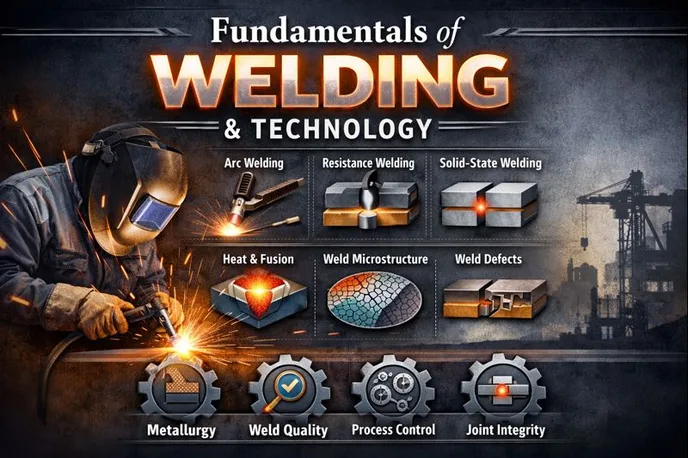
Fundamentals of welding science and technology
Self-paced Advanced
Fundamentals of welding science and technology
3(115)
202 views
FREE
1231 min
Anytime
English
202 views

Engineering AcademyLearn Without Limits: Free Engineering Courses
- Lifetime access
- Certificate of completion
- Anytime Learning
- Learn from Industry Expert
Why enroll
Is this course for you?
You should take this if
- You work in Manufacturing & Industrial
- You're a Manufacturing Engineering / Mechanical Engineering professional
- You have 3+ years of hands-on experience in this field
- You prefer self-paced learning you can revisit
You should skip if
- You're new to this field with no prior experience
- You need a different specialisation outside Manufacturing Engineering
- You need live interaction with an instructor
Course details
Course suitable for
Key topics covered
Course content
The course is readily available, allowing learners to start and complete it at their own pace.
24 lectures20 hr 31 min
- Fundamental of Welding Science and Technology [Intro Video]3 min
- Introduction of welding36 min
- Classification of welding and joints49 min
- Parts of weld joint49 min
- Welding Symbol71 min
- Welding power source - 149 min
- Welding power source 255 min
- Welding Power sources characteristics-161 min
- Welding Power sources characteristics-259 min
- Physics of welding-153 min
- Physics of welding - 257 min
- Physics of welding-343 min
- Physics of welding-4 (Arc Stability and Arc Blow)55 min
- Physics of welding-5 (Metal Transfer-1 )50 min
- Physics of welding-6 (Metal Transfer-2 )52 min
- Physics of welding-7 (Metal Transfer-3 )47 min
- Physics of welding-8 (Metal Transfer-4 )55 min
- Physics of welding-9 (Metal Transfer-5 )58 min
- Physics of welding-10 ( Metalting Efficiency )52 min
- Oxy-Fuel Gas Welding49 min
- Shielded Metal Arc Welding48 min
- Gas Metal Arc Welding62 min
- Submerged Arc Welding62 min
- Welding Defects and Inspection56 min
Opportunities that await you!
Career opportunities
Why people choose EveryEng
Industry-aligned courses, expert training, hands-on learning, recognized certifications, and job opportunities-all in a flexible and supportive environment.

 Oct 2, 2026