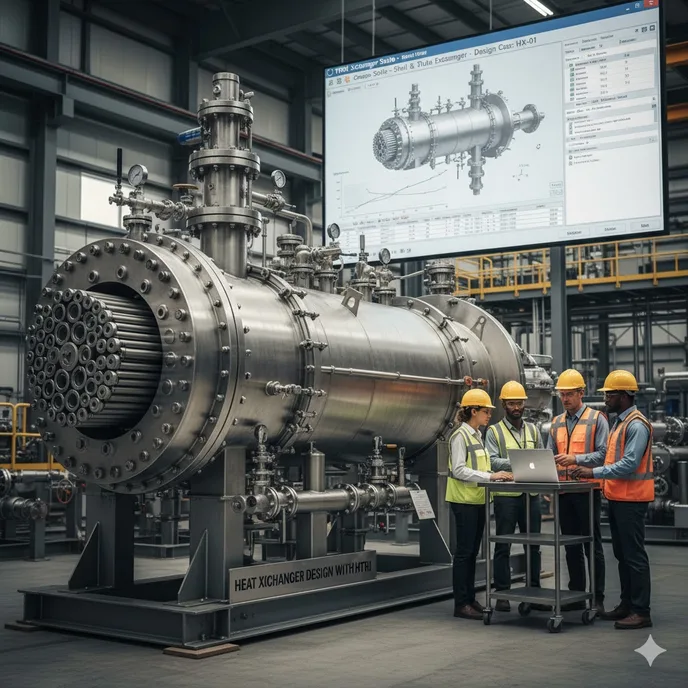
Heat Exchanger Design with HTRI
Tell us and we’ll notify you when the next batch is scheduled.
- 7-day money-back guarantee
- Session recordings included
- Certificate of completion
Why enroll
What enrolled engineers say
This course turned out to be more technical than I anticipated. The early refresh on LMTD and NTU methods helped close a gap that had crept in over the years, especially when switching between hand checks and HTRI results. What stood out was how closely the examples matched real work in oil & gas and energy utilities, like crude preheat trains and steam condensers for power plants, rather than clean textbook cases. The biggest challenge was getting consistent process data into HTRI without over‑simplifying it. Small assumptions around fouling factors or allowable pressure drop quickly pushed designs out of spec, which is something that also shows up on chemical and pharmaceutical utility exchangers. Working through TEMA class selection and multi‑pass configurations made it clearer why some past designs were hard to operate. A practical takeaway was learning how to sanity‑check HTRI outputs against heat balance and pressure drop limits before trusting the software. That alone will save time on reviews and rework. The discussion on vibration and thermal stress felt very close to field issues seen during revamps. I can see this being useful in long-term project work.
At first glance, the topics looked familiar, but the depth surprised me. The refresher on heat balance, LMTD, and NTU methods went beyond textbook treatment and tied directly into how HTRI actually solves the problem. Coming from oil & gas projects, the sections on TEMA selection and shell-and-tube layouts were immediately relevant to a crude preheat train I’ve been supporting. The discussion on pressure drop trade-offs also connected well with energy & utilities work, especially around condenser sizing and pump limitations. One challenge during the course was keeping up with the multi-pass exchanger modeling in HTRI. The software logic isn’t always intuitive, and a few trial-and-error runs were needed to understand how small input changes affect thermal performance and vibration checks. That part felt very real-world. A practical takeaway was learning how to validate HTRI results against operating constraints instead of just accepting the software output. The fouling and thermal stress examples mirrored issues seen on-site and helped close a knowledge gap between design and operations. Overall, the course sharpened how design decisions translate into actual plant behavior. It definitely strengthened my technical clarity.
Coming into this course, I had some prior exposure to the subject from refinery work, but it was mostly rule-of-thumb sizing and vendor back-and-forth. This workshop filled a real gap around doing defensible thermal design in HTRI instead of just reviewing datasheets. The refresher on LMTD versus NTU methods was useful, especially when tied to actual process data from oil & gas crude preheat trains and energy utilities like boiler feedwater exchangers. Walking through TEMA classifications and seeing how pass arrangements affected pressure drop and vibration risk made the trade-offs clearer than in day-to-day work. One challenge during the course was balancing thermal performance against allowable pressure drop in multi-pass shell-and-tube designs; it took a few iterations in HTRI to see how small changes ripple through the design. The fouling and thermal stress discussions were very practical, particularly for exchangers handling dirty services common in chemical and pharmaceutical utility systems. A key takeaway was a repeatable workflow for validating HTRI results against process constraints before issuing anything to mechanical design. This is something that can be applied immediately and refined over time. I can see this being useful in long-term project work.
Your instructor
Trinergy Engineering
DIRECTOR
Is this course for you?
You should take this if
- You work in Oil & Gas Downstream or Energy & Utilities
- You're a Chemical & Process / Mechanical Engineering professional
- You have 3+ years of hands-on experience in this field
- You want to build skills in Engineering & Design
You should skip if
- You're new to this field with no prior experience
- You need a different specialisation outside Chemical & Process
- You need fully self-paced, on-demand content
Course details
Course suitable for
Key topics covered
Opportunities that await you!
Skills & tools you'll gain
Career opportunities
Training details
This is a live course that has a scheduled start date.
Why people choose EveryEng
Industry-aligned courses, expert training, hands-on learning, recognized certifications, and job opportunities-all in a flexible and supportive environment.
What learners say about this course
Reads like field notes from someone who’s actually carried designs into prod and owned the fallout, not a polished slide deck. As a TeamLead, that mattered; the tradeoffs are framed in terms of cost, operability, and what breaks when schedules slip, which helps align arch calls with infra reality. The section on distillation design where he walks through tray efficiency vs flooding limits, then sanity-checks with a back-of-the-envelope energy balance, stuck with me because it mirrors how we review PRs under time pressure. I wasn’t sold on the long thermodynamics refresher mostly, wished there was a bit more on debottlenecking under changing feed specs, especially for chemicalpharmaceutical contexts. still, the way he ties design reviews to obs metrics felt familiar—like thinking in RPS and failure modes instead of textbook ideals. I’ve already lifted a few patterns into our repo reviews and CI checklists, which is about as far as praise goes between meetings.
Useful for getting from PFDs to a workable arch; the Chapter 7 pinch analysis walk-through with ΔTmin tradeoffs and a quick HYSYS check stuck, especially for chemical/pharma work. Mostly efficient, though I wasn't sold on the short HAZOP segment—would've liked more on control loops before signoff.
Came in needing a tighter handle on the internals behind process design decisions. The advanced section on heat‑exchanger network synthesis, especially the pinch calc walkthrough where utilities shift and the Aspen case breaks, stuck with me; it maps cleanly to infra choices in prod units I’ve seen. mostly great, though I wasn’t sold on the brief treatment of dynamic simulation and wished for one more pass on control interactions. It’s changed how I read other people’s calc sheets and P&IDs when reviewing PRs.
Brought this in to sanity-check whether it’s worth running a team session, not as light viewing. The level’s advanced and it moves fast, but it lines up with how we think about arch and infra in prod, just applied to process design; the analogies didn’t feel forced. The moment that stuck was Section 4’s walk-through of a HAZOP on the distillation column, especially how the deviation table fed back into sizing assumptions—I paused and sketched it like a PR comment thread. Mostly worked for me, though I wasn’t sold on the short treatment of control strategies; wished there was more on how those decisions age under real RPS swings. some examples leaned chemical/pharmaceutical without flagging assumptions, which slowed me down a bit. Net effect: fewer fuzzy takes when reviewing designs, and clearer calls on what I’d push back on versus let ship.