Skip to main contentEngineering Courses, Mentoring & Jobs | EveryEng
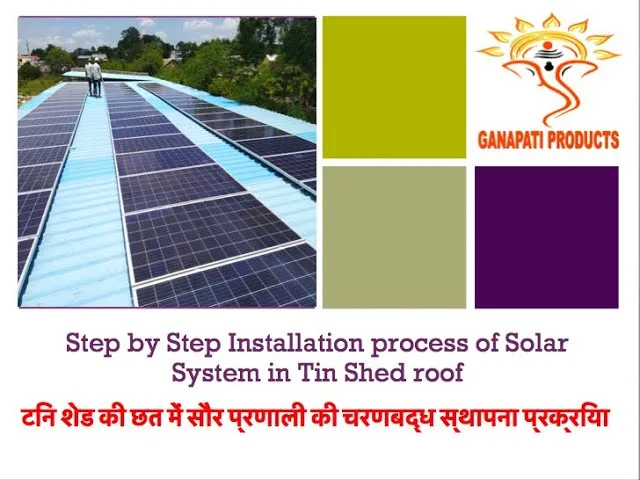
Installation process of Solar System in TinShed: टिन शेड की छत में सौर प्रणाली की  स्थापना प्रक्रिया banner
Preview this course
Installation process of Solar System in TinShed: टिन शेड की छत में सौर प्रणाली की  स्थापना प्रक्रिया banner
Preview this course
Self-paced Advanced

Installation process of Solar System in TinShed: टिन शेड की छत में सौर प्रणाली की स्थापना प्रक्रिया

4(4)
1 enrolled
1223 views
FREE
32 min
Anytime
Hindi
1223 views
Debojyoti sen
Debojyoti senMD & CEO, SAURYAJYOTI RENEWABLES PVT LTD
  • Lifetime access
  • Anytime Learning
  • Learn from Industry Expert
  • Career Option Guideline

Why enroll

This video shows the basic step by step process of installation of solar power plant system in a tin shed industrial roof. So watch the video till the end and understand the complete process of installation. This will let you know what all materials are required for solar power plant installation in tin shed industrial Roof and how to do the same properly. This will help enterprenuers and Engineers who is looking for careers in solar or thinking of starting own business in solar.

Is this course for you?

You should take this if

  • You work in Renewable & New Energy or Energy & Utilities
  • You're a Electrical Engineering / Civil & Structural professional
  • You have 3+ years of hands-on experience in this field
  • You prefer self-paced learning you can revisit

You should skip if

  • You're new to this field with no prior experience
  • You need a different specialisation outside Electrical Engineering
  • You need live interaction with an instructor

Course details

This video shows the basic step by step process of installation of solar power plant system in a tin shed industrial roof. So watch the video till the end and understand the complete process of installation. This will let you know what all materials are required for solar power plant installation in tin shed industrial Roof and how to do the same properly. This will help enterprenuers and Engineers who is looking for careers in solar or thinking of starting own business in solar.

VIDEO COURTSEY:

SUKAM: https://www.youtube.com/watch?v=OGnf_aWxJDg&t=74s

TIN SHED INC BY MP TECH: https://www.youtube.com/watch?v=VtaI__CLyuA

Course suitable for

Course content

The course is readily available, allowing learners to start and complete it at their own pace.

1 lectures32 min
  1. Installation process of Solar System in TinShed: टिन शेड की छत में सौर प्रणाली की स्थापना प्रक्रिया
    32 min

Opportunities that await you!

Career opportunities

Course Attachments

Planning and Installing a Grid-Connected PV System revised.pdf

Why people choose EveryEng

Industry-aligned courses, expert training, hands-on learning, recognized certifications, and job opportunities-all in a flexible and supportive environment.

FREE

Access anytime

Questions and Answers

A: Option A follows the logic of not stressing equipment electrically before confirming mechanical restraint and protective earthing. B feels efficient, but meggering and energizing before clamp torque risks hidden frame faults. C jumps straight to AC verification when the DC side isn't even validated. D mixes final acceptance tests with construction activities; tightening clamps after IR testing can change bonding paths.

A: B addresses the root cause: elevated cell temperature from trapped heat under the tin shed roof. A seems logical but raises DC voltage risk at low temperature later. C gives short-term cooling but introduces thermal shock and electrical safety risk. D alters grid interaction but doesn't change cell temperature, so the derating continues.

A: At 5°C, Voc increases roughly 0.28% per °C below 25°C, so about 5.6% higher than STC. Effective Voc ≈ 52.3 V. Twenty-one modules give ~1098 V, just inside the inverter limit. Twenty looks conservative but leaves capacity unused. Twenty-two and twenty-three feel tempting for fewer strings, yet they breach the DC ceiling in cold mornings.

A: A hits the structural mismatch: clamps aligned wrong relative to purlins dump loads into thin sheet metal. B sounds plausible but bonding length changes are minor here. C distracts with performance, yet tilt isn't dictated by purlin direction. D can happen, but it's secondary compared to immediate structural capacity.