<link href="https://fonts.googleapis.com/css2?family=Caveat:wght@500;700&family=JetBrains+Mono:wght@400;500;600&display=swap" rel="stylesheet" /> Skip to main contentEngineering Courses, Mentoring & Jobs | EveryEng
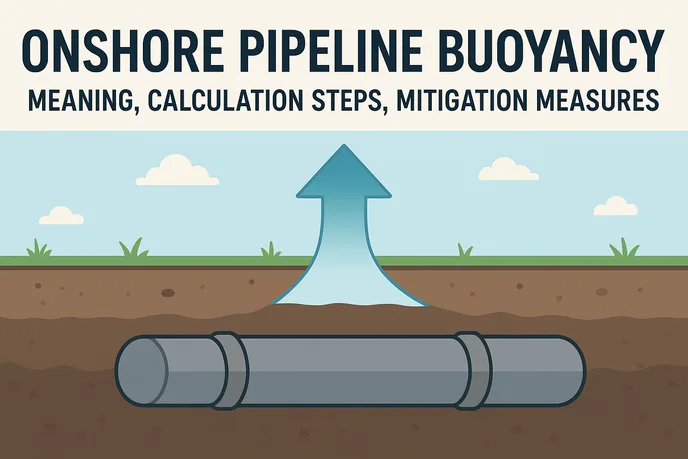
Onshore Pipeline Buoyancy: Meaning, Calculation Steps, Mitigation Measures banner
Preview this course

Onshore Pipeline Buoyancy: Meaning, Calculation Steps, Mitigation Measures

Onshore Pipeline Buoyancy: Meaning, Calculation Steps, Mitigation Measures banner
Preview this course
Self-paced Beginner

Onshore Pipeline Buoyancy: Meaning, Calculation Steps, Mitigation Measures

4(408)
1 enrolled
570 views
₹ 999
71 min
Anytime
English
Anup Kumar Dey
Anup Kumar DeyOwner of https://whatispiping.com/
  • 7-day money-back guarantee
  • Lifetime access
  • Certificate of completion
Volume pricing for groups of 5+

Why enroll

  1. To gain a clear understanding of how and why pipeline buoyancy occurs in real project conditions.

  2. To learn standardized calculation methods used in industry for assessing uplift risks.

  3. To improve decision-making skills for selecting effective and cost-efficient mitigation measures.

  4. To enhance their professional competency in pipeline design, construction, and integrity management.

  5. To apply practical knowledge through examples that mirror challenges encountered in onshore pipeline projects.

Is this course for you?

You should take this if

  • You work in Oil & Gas Upstream or Energy & Utilities
  • You're a Onshore Pipeline Engineering professional
  • You prefer self-paced learning you can revisit

You should skip if

  • You need a different specialisation outside Onshore Pipeline Engineering
  • You need live interaction with an instructor

Course details

The objective of this course is to build a clear and practical understanding of pipeline buoyancy and its implications in onshore environments. Learners will gain the ability to identify conditions that trigger uplift, apply industry-accepted calculation methods, and interpret results for design or field decisions. The course aims to strengthen engineering judgment by connecting theory with real-world scenarios. By the end, students will be equipped to recommend suitable mitigation strategies, justify design choices, and ensure pipeline stability throughout construction and operation.

This course explores the concept of pipeline buoyancy from both a theoretical and applied perspective. It explains why pipelines may rise, how external water forces interact with buried or submerged lines, and what parameters must be considered during design. Through step-by-step walkthroughs, participants learn how to compute uplift forces, assess safety factors, and compare industry methods. The subject also covers practical mitigation measures such as concrete coating, anchoring, trench modification, and drainage improvements. Learners engage with examples and typical project conditions, gaining a comprehensive view of how buoyancy challenges are evaluated and controlled in pipeline engineering.

Course suitable for

Key topics covered

  • Introduction to buoyancy forces and their relevance to pipeline integrity.

  • Parameters that affect pipeline buoyancy.

  • Calculation methods for estimating uplift buoyant forces on pipelines.

  • Design solutions to counteract buoyant forces.

  • Step-by-step example of buoyancy calculation for an onshore buried pipeline

Course content

The course is readily available, allowing learners to start and complete it at their own pace.

6 lectures1 hr 11 min

Opportunities that await you!

Career opportunities

₹999

Access anytime

Questions and Answers

A: Achieving buoyancy resistance during the hydrotest case while avoiding long-term coating damage is the target. B fails because anchor spacing based on low points ignores continuous uplift and clay remolding. C trades uplift for excessive excavation risk and doesn't address hydrotest buoyancy explicitly. D protects discrete locations but leaves long unsupported spans vulnerable during flooding.

A: The safeguard's job is to limit external uplift forces; losing it allows upward movement before any pressure-driven failure. B confuses hydraulic failure with geotechnical instability. C mixes thermal effects with a hydraulic trigger. D inverts the corrosion mechanism expected with stagnant water.

A: The aim is isolating pure buoyant force from displaced external volume. B drops wall thickness by using ID. C imports the wrong fluid density. D mixes resisting weight into the driving force term.

A: The intent is identifying added external mass for stability shown graphically. B would be dimensioned and localized. C belongs in material specs, not GA envelopes. D is rarely shown as a typ envelope on civil GAs.