Skip to main contentEngineering Courses, Mentoring & Jobs | EveryEng
Pipe Thickness Calculation Under External Design Pressure or Vacuum Condition banner
Preview this course

Pipe Thickness Calculation Under External Design Pressure or Vacuum Condition

Pipe Thickness Calculation Under External Design Pressure or Vacuum Condition banner
Preview this course
Self-paced Beginner

Pipe Thickness Calculation Under External Design Pressure or Vacuum Condition

4(408)
1468 views
₹ 999
118 min
Anytime
English
Anup Kumar Dey
Anup Kumar DeyOwner of https://whatispiping.com/
  • 7-day money-back guarantee
  • Lifetime access
  • Certificate of completion
Volume pricing for groups of 5+

Why enroll

Participants choose this course because it helps them:

  • Gain Specialized Knowledge – Learn concepts of external pressure and vacuum design rarely covered in detail during general piping courses.

  • Apply International Standards – Understand how to use ASME codes and charts for real-world thickness calculations.

  • Enhance Career Opportunities – Stand out as a piping professional with expertise in a critical and specialized design area.

  • Avoid Costly Design Errors – Prevent failures like buckling and collapse by applying correct design methodologies.

  • Work on Case Studies – Practice hands-on calculations and problem-solving based on industry scenarios.

  • Build Confidence – Be able to independently verify, review, and optimize pipe thickness designs under external loads.

Is this course for you?

You should take this if

  • You work in Energy & Utilities or Pharmaceutical & Healthcare
  • You're a Mechanical Engineering / Piping & Layout Engineering professional
  • You want to build skills in Engineering & Design
  • You prefer self-paced learning you can revisit

You should skip if

  • You need a different specialisation outside Mechanical Engineering
  • You need live interaction with an instructor

Course details

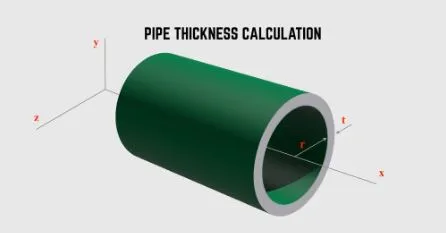
Pipe thickness calculation under external design pressure or vacuum conditions is primarily concerned with preventing collapse or buckling rather than failure due to internal pressure. When a pipe is subjected to external pressure (such as vacuum, submerged conditions, or buried installation), the pipe wall must be thick enough to resist instability caused by compressive forces. Unlike internal pressure design, which is governed by material strength, external pressure design depends heavily on the pipe’s geometry (diameter-to-thickness ratio), material stiffness, and support conditions.

The design is typically based on standards such as ASME Boiler and Pressure Vessel Code, specifically the external pressure charts provided in UG-28. The procedure involves calculating the allowable external pressure using parameters such as outside diameter (Do), wall thickness (t), and unsupported length (L). A key parameter is the ratio ( \frac{Do}{t} ), which indicates the pipe’s susceptibility to buckling—the higher the ratio, the more कमजोर (prone) the pipe is to collapse. Another important factor is the length parameter ( \frac{L}{Do} ), which accounts for the effect of supports; longer unsupported lengths reduce resistance to external pressure.

The process generally includes assuming a trial thickness, calculating geometric ratios, and then using design charts (or equations derived from them) to determine the allowable external pressure. This value must be greater than the design external pressure (including full vacuum if applicable). If not, the thickness is increased and the process is repeated. In some cases, instead of increasing thickness, engineers may add stiffening rings or reduce the unsupported span to improve resistance.

For practical design, it is important to also consider ovality (out-of-roundness), corrosion allowance, fabrication tolerances, and material properties at operating temperature, as these can significantly affect buckling resistance. Proper evaluation ensures that the pipe will not deform or collapse under vacuum or external pressure, maintaining structural integrity and safe operation.

Course suitable for

Key topics covered

- Rules for Pipe Thickness Calculation under External Pressure/ Vacuum Condition

- Steps for External Pipe Thickness Verification

- Example of Pipe Thickness Calculation under Vacuum Condition/External design pressure condition

- Examples when pipe thickness calculation under external pressure is required

Course content

The course is readily available, allowing learners to start and complete it at their own pace.

2 modules8 lectures1 hr 58 min

Opportunities that await you!

Skills & tools you'll gain

Engineering & Design

Career opportunities

Where this fits — what comes before, what comes next

₹999

Access anytime

Questions and Answers