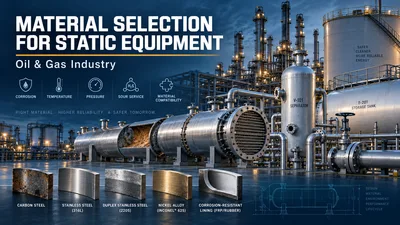
Piping Material Specification and related activities
Piping Material Specification and related activities

- 7-day money-back guarantee
- Lifetime access
- Certificate of completion
Why enroll
What enrolled engineers say
At first glance, the topics looked familiar, but the depth surprised me. Piping material specs are something dealt with daily in oil & gas and chemical projects, yet the course forced a more structured way of thinking about material selection. The breakdown of piping classes, ASTM material grades, and how pressure–temperature ratings tie back to ASME B31.3 was especially useful. Corrosion allowance and its impact on long-term operability in chemical and pharmaceutical services was another area that filled a gap I didn’t realize I had. One challenge was adjusting to the beginner pace at times, since some basics like flange ratings and valve materials felt slow. Still, sticking with it helped connect details that usually get skipped during fast-track projects. The most practical takeaway was learning how to read and cross-check a piping material specification against process conditions instead of blindly relying on standard templates. That’s already helping on a brownfield modification where material mismatches can become costly. Overall, it felt grounded in real engineering practice.
This course turned out to be more technical than I anticipated. Coming from an oil & gas background, the focus on piping material specification helped close a gap I’ve felt on a recent brownfield revamp where PMS reviews were slowing us down. Topics like material selection for hydrocarbon service, corrosion allowance philosophy, and how ASME B31.3 ties back to ASTM material grades were explained in a way that connected design intent to site reality. There was also useful context that applies equally to chemical and pharmaceutical plants, especially around cleanliness, MOC, and why certain stainless steels are preferred in specific services. One challenge was keeping up with the different standards and temperature-pressure limits, especially when carbon steel and SS options overlap. That part needed a bit of rewatching. A practical takeaway was learning how to structure a basic piping material specification and cross-check it against P&IDs and line classes, which was immediately useful on an ongoing project. It made discussions with vendors and stress teams more concrete instead of theoretical. Overall, the course added clarity where earlier learning was fragmented, and it definitely strengthened my technical clarity.
Initially, I wasn’t sure what to expect from this course. Coming from an oil & gas background with some exposure to chemical/pharmaceutical projects, piping material specs always felt fragmented—pieces picked up on the job, not structured learning. This course helped close that gap by tying material selection, service conditions, and safety together in a way that made sense. The sections on piping classes, corrosion allowance, and basic ASME B31.3 considerations were especially useful. In oil & gas work, material mismatches and over‑specification are common cost drivers, and seeing how specs are built from process data clarified a lot. The chemical/pharmaceutical angle around material compatibility and cleanliness requirements also stood out, since those constraints are easy to underestimate when switching industries. One challenge was adjusting to the beginner pace; some topics felt slow at first. Still, that helped reinforce fundamentals that often get skipped on live projects. A practical takeaway was being able to review a piping material specification and quickly sanity‑check materials against process conditions instead of relying blindly on legacy specs. Overall, the content felt aligned with practical engineering demands.
Your instructor
Team Piping Engineering
Sr Engineer
Founder Team Piping Engineering
Is this course for you?
You should take this if
- You work in Oil & Gas Upstream or Chemical
- You're a Piping & Layout Engineering / Chemical & Process professional
- You prefer self-paced learning you can revisit
You should skip if
- You need a different specialisation outside Piping & Layout Engineering
- You need live interaction with an instructor
Course details
Course suitable for
Key topics covered
Course content
The course is readily available, allowing learners to start and complete it at their own pace.
- Introduction, Piping Material Engineer, codes & standards20 min
- Criteria To Select Material16 min
- Responsibility of Piping Engineer Material52 min
Opportunities that await you!
Career opportunities
Why people choose EveryEng
Industry-aligned courses, expert training, hands-on learning, recognized certifications, and job opportunities-all in a flexible and supportive environment.


 Aug 29, 2026