
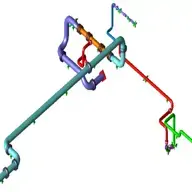
Basics of Pipe Stress Analysis
Basics of Pipe Stress Analysis

- Lifetime access
- Certificate of completion
- Foundational Learning
- Access to Study Materials
Why enroll
What enrolled engineers say
Coming into this course, I had some prior exposure to the subject, mostly from reviewing stress reports on oil & gas skid packages without fully understanding how they were built up. The basics here helped close that gap. Concepts like sustained vs. expansion load cases, thermal growth, and how supports and anchors actually influence stress were explained in a way that matched what shows up in real refinery and chemical plant piping. One challenge was wrapping my head around boundary conditions and restraint modeling. In past projects, especially on energy utilities steam lines, those assumptions were usually just “given.” Seeing how small changes in support stiffness or anchor location affect loads made it clearer why earlier designs ran into nozzle load issues. A practical takeaway was learning a simple, structured approach to checking thermal expansion and flexibility before jumping into software. That’s immediately usable on brownfield oil & gas modifications where space is tight and rerouting is limited. The course also helped when reviewing contractor stress calcs, since the terminology and logic are no longer black boxes. The content felt aligned with practical engineering demands.
This course turned out to be more technical than I anticipated. For a beginner-level class, it went beyond definitions and actually touched on how pipe stress shows up in oil & gas transfer lines and energy utilities steam systems. The sections on thermal expansion and sustained vs. occasional loads matched what’s seen in refinery and power plant work, although the examples were simplified compared to full ASME B31.3 or B31.1 projects. One challenge was bridging the gap between the hand-calculation logic presented and how stress is really evaluated in tools like CAESAR II. Load case combinations were explained, but edge cases such as cold springing or friction-dominated support systems needed more context. In chemical/pharmaceutical facilities, where routing constraints and cleanability drive layouts, those nuances matter. A practical takeaway was the emphasis on thinking system-level early—support spacing, anchor locations, and flexibility before detailed modeling. That aligns with industry practice, where early decisions save rework later. The course also highlighted how overstressing isn’t just a code issue but can affect connected equipment and long-term reliability. The content felt aligned with practical engineering demands.
At first glance, the topics looked familiar, but the depth surprised me. Coming from oil & gas projects, pipe stress was something handled by specialists, so this course helped fill a gap I’d been working around for years. The sections on thermal expansion and sustained vs. operating load cases were especially relevant to crude transfer lines and pump discharge piping. It also connected well to chemical/pharmaceutical layouts, where tight equipment spacing makes flexibility and nozzle loads a real concern. One challenge was translating the theory into how stress models are actually built, especially understanding boundary conditions and support assumptions. That part took a bit of rewinding and note-taking, but it mirrored the confusion I’ve seen on real projects. The discussion around codes like ASME B31 and how they apply differently in energy and utilities systems, such as steam lines, was practical and not overdone. A clear takeaway was learning how to sanity-check a piping layout before sending it to detailed analysis—basic expansion loops, support spacing, and where stress problems usually show up. That alone is already helping in design reviews. Overall, it felt grounded in real engineering practice.
Your instructor
Team EveryEng
Engineer
Mechanical Engineering
Is this course for you?
You should take this if
- You work in Oil & Gas Downstream or Energy & Utilities
- You're a Piping & Layout Engineering / Mechanical Engineering professional
- You prefer self-paced learning you can revisit
You should skip if
- You need a different specialisation outside Piping & Layout Engineering
- You need live interaction with an instructor
Course details
Course suitable for
Key topics covered
Course content
The course is readily available, allowing learners to start and complete it at their own pace.
- Basics of Pipe Stress Analysis52 min
Opportunities that await you!
Career opportunities
Why people choose EveryEng
Industry-aligned courses, expert training, hands-on learning, recognized certifications, and job opportunities-all in a flexible and supportive environment.
What learners say about this course

Execellent Course

It. Was so good we'll use for beginners

Valuable content

Good Course


 Aug 29, 2026

