<link href="https://fonts.googleapis.com/css2?family=Caveat:wght@500;700&family=JetBrains+Mono:wght@400;500;600&display=swap" rel="stylesheet" /> Skip to main contentEngineering Courses, Mentoring & Jobs | EveryEng
PLC DCS Programming Overview banner
Preview this course

PLC DCS Programming Overview

PLC DCS Programming Overview banner
Preview this course
Self-paced Beginner

PLC DCS Programming Overview

4(1)
2 enrolled
1494 views
FREE
71 min
Anytime
English
1494 views

Instrumentation Unlimited
Instrumentation UnlimitedAn Instrumentation Engineer
  • Lifetime access
  • Certificate of completion
  • Foundational Learning
  • Access to Study Materials
Volume pricing for groups of 5+

Why enroll

This course is to understand how automated systems are programmed and controlled, including basics of logic development, ladder diagrams, and process control strategies. It helps them learn how machines and industrial processes are monitored and operated efficiently.

Students enroll to build a strong base in automation, while working professionals take the course to upgrade their skills, transition into automation roles, or improve their ability to troubleshoot and maintain control systems.

Is this course for you?

You should take this if

  • You work in Industrial Automation or Electronics & Instrumentation
  • You're a Instrumentation Engineering / Electronics & Telecommunication professional
  • You prefer self-paced learning you can revisit

You should skip if

  • You need a different specialisation outside Instrumentation Engineering
  • You need live interaction with an instructor

Course details

Though there are differenct language formats to write program for different make PLC and DCS system but the basic things are common to have in mind programming a PLC and DCS.

One must have an idea of how to program a Digital inputs / Analog inputs / Drive / PID controller and other things and what are its interface and interlock words to program plant or process condition This course lets you learn the basic requirement of programming any signal / drive / PID contrller in a PLC and DCS system.

The course have been supplied with practical experience added, which author has encountered and one must have in mind whenever programming a fool proof logic.

Course suitable for

Key topics covered

1. PLC DCS Programming Basic Rules

2. Difference between DCS PLC & Selection

3. How to Program Group Function Block

4. How to Program Motor Drive

5. How to Program Digital Input

6. How to Program Analog Input

7. How to Program PID controller

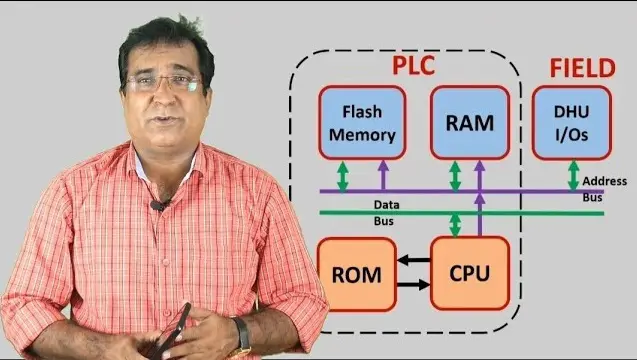
8. PLC Memory

9. Virtual PLC

Course content

The course is readily available, allowing learners to start and complete it at their own pace.

8 lectures1 hr 11 min
  1. PLC DCS Programming Basic Rules
    13 min
  2. Difference between DCS PLC & Selection
    8 min
  3. How to Program Group Function Block
    6 min
  4. How to Program Motor Drive
    8 min
  5. How to Program Digital Input
    7 min
  6. How to Program Analog Input
    9 min
  7. How to Program PID controller
    10 min
  8. PLC Memory
    10 min

Opportunities that await you!

Skills & tools you'll gain

PLC Programming

Career opportunities

FREE

Access anytime

Questions and Answers

A: The 4–20 vs 0–20 mA mismatch gives exactly a 25% span error potential, and an 8% high reading often lands when raw counts are scaled against the wrong low limit. Before touching field hardware, the AI type and scaling constants in the DCS are the fastest discriminator.

A: First-scan behavior is governed by initial conditions, not tuning. If the output initializes to zero while error is large, saturation is expected. Bumpless transfer with output tracking removes that jump before P or I even act.

A: The key threshold is "only when VFD runs". Dual-ended shield grounds create a circulating current path at drive switching frequencies. Resolution, damping, and D-term don’t correlate with motor ramp events.

A: Chloride-induced corrosion dominates in salt mist. 316 SS handles pitting far better than coated carbon steel or aluminum, and gasket integrity matters once condensation cycles start at ~40°C plus.