Skip to main contentEngineering Courses, Mentoring & Jobs | EveryEng
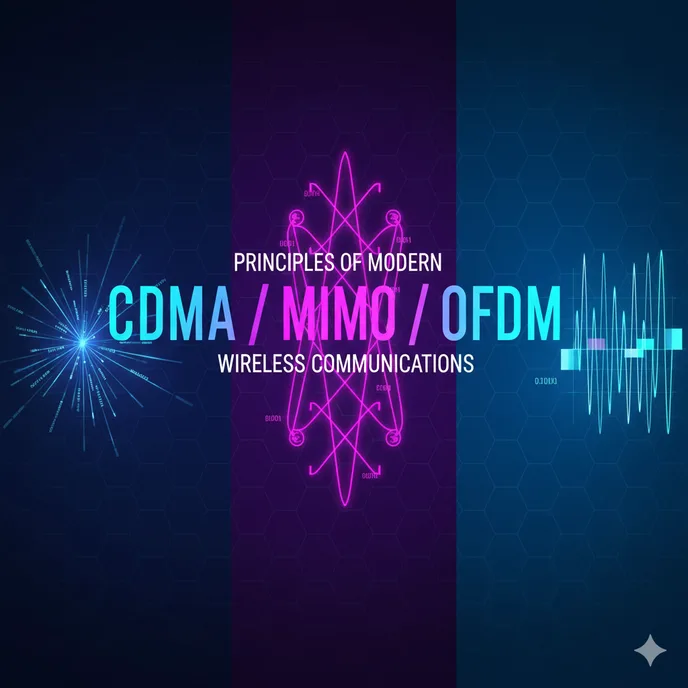
Principles of Modern CDMA/ MIMO/ OFDM Wireless Communications banner
Preview this course
Principles of Modern CDMA/ MIMO/ OFDM Wireless Communications banner
Preview this course
Self-paced Advanced

Principles of Modern CDMA/ MIMO/ OFDM Wireless Communications

3(118)
1 enrolled
311 views
Trainers Rating
3(118)
Course type
Watch to learn anytime
Duration
659 min
Start
Anytime
Language
English
Views
311
  • Lifetime access
  • Anytime Learning
  • Learn from Industry Expert
  • Career Option Guideline
FREE
Engineering Academy
Engineering AcademyLearn Without Limits: Free Engineering Courses

Why enroll

Participants join this course to understand how today’s fast mobile networks really work behind the scenes. It helps students and professionals learn the basic ideas used in 3G and 4G systems without getting confused by heavy theory. The course builds strong fundamentals in important technologies like CDMA, OFDM, and MIMO, which are essential for careers in wireless communication, telecom, and networking. Many learners also take this course to prepare for higher studies, competitive exams, or industry roles related to mobile networks and broadband wireless systems.

Course details

Wireless communication has changed a lot in the last few years. Earlier, 2G systems like GSM could only send data at very slow speeds of about 10 Kbps. Today, modern wireless systems can deliver very high-speed internet, even more than 100 Mbps. This huge improvement led to advanced technologies like 3G and 4G, including HSDPA, LTE, and WiMAX. These high speeds are possible because of smart technologies such as CDMA, OFDM, and MIMO. These methods help many users communicate at the same time, improve data speed, and make better use of available bandwidth. This course explains these core technologies clearly and helps learners understand how modern 3G and 4G wireless systems actually work.

Source: NOC July–Sep EC05 [Youtube Channel] NPTEL

Course suitable for

Is this course for you?

Perfect for

  • You work in Telecommunication or Electronics & Instrumentation
  • You're a Electronics & Telecommunication professional
  • You have 3+ years of hands-on experience in this field
  • You want to build skills in Engineering & Design, Project Management

Before you enrol

  • Advanced level — assumes working knowledge of Electronics & Telecommunication
  • Self-paced video, 659 min — watch anytime
New to Electronics & Telecommunication? Browse beginner courses →

Ready for the next step?

Paid courses that build on what this one teaches.

Course curriculum

The course is readily available, allowing learners to start and complete it at their own pace.

30 lectures10 hr 59 min
  1. Principles of Modern CDMA/MIMO/OFDM Wireless Communications
    4 min
  2. Evolution of Wireless Communication Technologies
    23 min
  3. Modeling Wireless Channel
    23 min
  4. Wireless Fading Channel Model
    23 min
  5. Rayleigh Fading Channel
    12 min
  6. Bit Error Rate (BER) Performance
    23 min
  7. Bit Error Rate (BER) of AWGN Channels
    22 min
  8. Bit Error Rate of Rayleigh Fading Wireless Channel
    30 min
  9. Exact BER Expression for Rayleigh Fading Wireless Channel
    19 min
  10. Deep Fade Analysis of Wireless Communication
    22 min
  11. Principle of Diversity
    15 min
  12. Multiple Antenna Diversity
    29 min
  13. Maximal-Ratio Combining
    19 min
  14. BER of Multiple Antenna Wireless Systems
    24 min
  15. Approximate BER for Multiple Antenna Wireless System
    15 min
  16. Examples for BER of Wireless Communication
    22 min
  17. Deep Fade in Multi Antenna Systems
    23 min
  18. Intuition for Deep Fade in Multi-Antenna System
    32 min
  19. Definition of Diversity Order
    18 min
  20. Max Delay Spread
    21 min
  21. RMS Delay Spread
    26 min
  22. Delay Spread and Inter Symbol Interference
    28 min
  23. Coherence Bandwidth of Wireless Channel
    26 min
  24. Mobility and Doppler Effect in Wireless Channels
    18 min
  25. Impact of Doppler Effect on Wireless Channel
    16 min
  26. Introduction to Code Division Multiple Access (CDMA)
    27 min
  27. Chip Time and Bandwidth Expansion in CDMA
    12 min
  28. Code Generation for CDMA
    23 min
  29. CDMA Codes: Properties of PN Sequences
    35 min
  30. BER of CDMA Systems
    29 min

Key topics covered

  • Introduction to modern wireless communication systems

  • Evolution from 2G to 3G and 4G technologies

  • Basics of wireless channels and propagation

  • Noise, interference, and fading concepts

  • Digital modulation basics for wireless systems

  • Multiple access techniques overview

  • Fundamentals of CDMA technology

  • CDMA codes and multiple access interference

  • Power control and capacity in CDMA systems

  • Introduction to OFDM concept

  • OFDM structure using FFT and IFFT

  • Advantages and limitations of OFDM

  • Introduction to MIMO wireless systems

  • MIMO diversity and spatial multiplexing

  • Use of CDMA, OFDM, MIMO in 3G/4G systems

Opportunities that await you!

Career opportunities

✎ Where this fits — what comes before, what comes next

Frequently asked questions

A: The correct answer preserves orthogonality while keeping multipath contained in the guard interval. Option A misses that CP coverage is a time-domain requirement and equalizer length doesn't fix ISI from CP underrun. Option C conflates phase noise with subcarrier spacing and ignores the CP mismatch. Option D addresses CFO estimation but leaves the physical ISI mechanism untouched.

A: The correct answer isolates a hardware-induced noise path that diversity can't average out. Option A is exactly what diversity is meant to mitigate when feeds are intact. Option C is reduced statistically by multiple branches even at high speed. Option D is another impairment diversity is designed to tolerate within limits.

A: The correct answer avoids understating worst-case sensitivity loss. Option B is mathematically sound once the correct loss value is chosen. Option C may be wrong in detail but doesn't directly hide margin. Option D is the conservative placement for NF accounting.

A: The correct answer restores decoding margin without stressing RF limits. Option A may violate PA linearity and masks the real trade. Option C helps estimation error but doesn't fix symbol decision spacing. Option D treats the symptom and burns latency.

FREE

Access anytime

What learners say about this course

Industry-aligned courses, expert training, hands-on learning, recognized certifications, and job opportunities-all in a flexible and supportive environment.

Put no limit on your engineering passion.

We would love to hear from you.

Engineers collaborating around a laptop