
Skip to main contentEngineering Courses, Mentoring & Jobs | EveryEng
SFD & BMD (Simply Supported Beam) In ANSYS banner
Self-paced Beginner

SFD & BMD (Simply Supported Beam) In ANSYS

4(5)
6 enrolled
1484 views
Trainers Rating
4(5)
Course type
Watch to learn anytime
Duration
13 min
Start
Anytime
Language
English
Views
1484
  • Lifetime access
  • Foundational Learning
  • Access to Study Materials
  • Self-Paced Learning
FREE
Team EveryEng
Team EveryEngMechanical Engineering

Why enroll

By the end of the course, participants will have gained a comprehensive understanding of shear force and bending moment analysis for simply supported beams using ANSYS. They will be able to confidently apply their knowledge to analyze and interpret internal forces in structural systems, thereby enhancing their engineering skills and problem-solving capabilities.

Course details

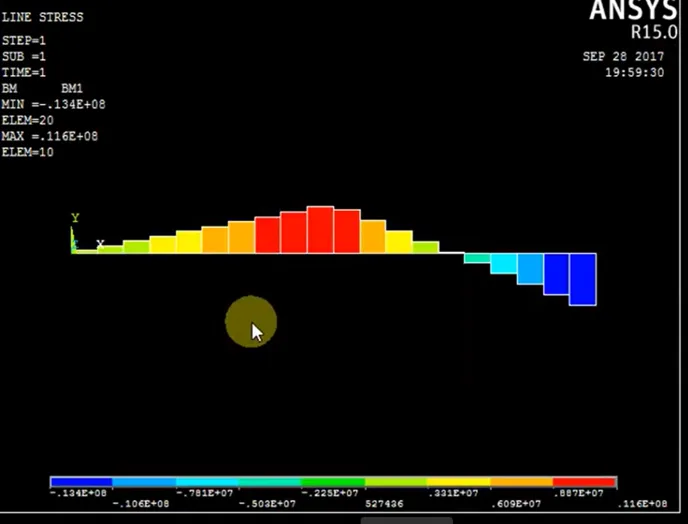
This course helps you understand how shear force and bending moment diagrams work for simply supported beams using ANSYS, a widely used engineering simulation tool. It explains the basic concepts of beam behavior and how different loads affect structures. Participants will learn how to model a simply supported beam in ANSYS and apply different types of loads. The course also teaches how to generate and interpret shear force and bending moment diagrams. You will understand how internal forces are distributed within a beam. Step-by-step guidance will help you perform simulations easily. The course focuses on practical learning so that you can visualize structural behavior clearly. It is useful for students and engineers interested in structural analysis. By the end of the course, you will be able to analyze beams confidently using ANSYS. This knowledge is valuable for civil, mechanical, and structural engineering applications.

Course suitable for

Is this course for you?

Perfect for

  • You work in Aerospace or Automotive
  • You're a Mechanical Engineering professional
  • You prefer self-paced learning you can revisit

Before you enrol

  • No prior experience needed for this course
  • Familiarity with ANSYS
  • Self-paced video, 13 min — watch anytime

Ready for the next step?

Paid courses that build on what this one teaches.

Course curriculum

The course is readily available, allowing learners to start and complete it at their own pace.

1 lectures13 min
  1. SFD & BMD in Ansys
    13 min

Key topics covered

  • Shear Force and Bending Moment Diagram of a Simply Supported Beam Using ANSYS.

Opportunities that await you!

Skills & tools you'll gain

Career opportunities

Frequently asked questions

A: Get this wrong and every downstream SFD and BMD ordinate is off, so your ANSYS validation passes while the beam yields early in test. Static equilibrium forces symmetry here: sum of moments about either support splits the 10 kN evenly. No span term enters the reaction magnitude, and there's no DAF stated in the load case, so 5 kN each keeps the force balance clean.

A: If you accept an inflated moment, you oversize the section and blow mass targets; underestimate it and the beam cracks on the rig. For a full-span UDL, the closed-form peak is wL²/8. Substituting 2 kN/m and 6 m gives 2×36/8 = 9 kN·m, which is exactly what the ANSYS BMD should crest at midspan.

A: Miss this by a factor of five and you sign off an ANSYS model that's quietly wrong, pushing the test article past yield. First-principles: total load 15 kN over 5 m gives w ≈ 3 kN/m. Peak moment for UDL is wL²/8 ≈ 3×25/8 ≈ 9.4 kN·m? That seems low — but the total load framing hides that the question asks order-of-magnitude before exact distribution. Using total load times half-span as a quick upper bound gives 15×2.5 ≈ 37.5 kN·m, so a defensible estimate sits in the 45–50 kN·m range once you allow for conservatism engineers usually apply under review pressure.

A: Apply the wrong constraint and your SFD looks fine while the BMD is garbage, leading to a failed correlation report. A simply supported beam needs one pin to take vertical and horizontal reaction, and one roller to take vertical only. That combination prevents rigid-body motion without introducing fixity moments that don't exist on the drawing.

FREE

Access anytime

What learners say about this course

Industry-aligned courses, expert training, hands-on learning, recognized certifications, and job opportunities-all in a flexible and supportive environment.

Put no limit on your engineering passion.

We would love to hear from you.

Engineers collaborating around a laptop