
Sour Water System Optimisation
Sour Water System Optimisation
- Trainers Rating
- 4(1595)
- Course type
- Instructor led live training
- Duration
- -
- Start
- Next month
- Views
- 1630
- Session recordings included

Why enroll
Enhance your career in chemical engineering with expertise in Sour Water System Optimization! By mastering this specialized skill, you'll become a highly sought-after professional in the oil and gas industry, qualified for roles like Process Engineer, Operations Optimization Specialist, or Environmental Engineer. With expertise in sour water system optimization, you'll minimize environmental impact, reduce operating costs, and improve safety for top companies like Shell, Total, or Saudi Aramco. This course will give you the edge to advance your career, lead process optimization teams, and drive sustainable operations in the energy sector.
Course details
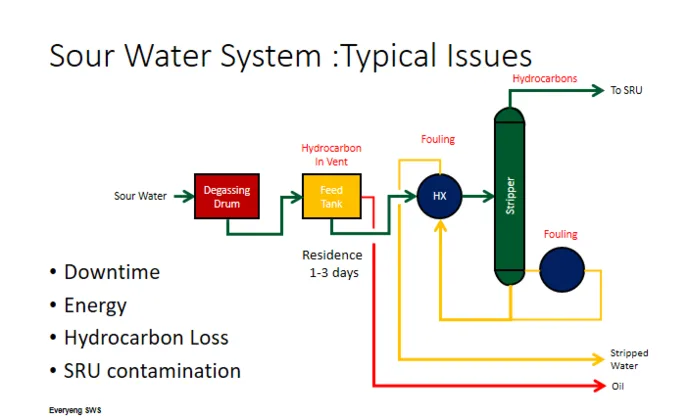
Hydrocarbon contamination of sour water streams feeding sour water strippers is a well-known challenge in the refining and gas processing industry. The source of this challenge is the formation of a stable oil emulsion in an aqueous phase that may contain both H2S and NH3. The typical approach to the problem involves large residence time tanks under the estimation that droplet settling will occur over a long enough time frame. In practice, droplet settling is very slow due to a variety of reasons, and as a result, operators encounter sour water heat exchanger fouling, stripper fouling, hydrocarbon excursions to sulfur recovery units along with other operating challenges. This course will address the relevant issues and identify possible approaches to optimisation, with very significant contribution to energy savings, emission control and improved sulphur recovery goals.
Trainer - Chemical Engineer from IIT Varanasi and MBA from University of bath UK.
30+ years of experience across manufacturing, design engineering, oil and gas, and speciality chemicals in leadership roles including CXO, General Management, Technical Support, and Business Development positions.
Specialist in Filtration: Advanced Separation Technology for separation of contaminants and process optimization in refineries, gas processing, petrochemicals, upstream-produced water, and power plants.
Other Industries served : Design Engineering, Flame Retardant Additives & Masterbatches, Process Filtration, Petroleum, Refining, Specialty Chemicals, Oil Field Chemicals, Water Treatment & Petrochemicals.
Course suitable for
Is this course for you?
Perfect for
- You work in Oil & Gas Upstream or Pharmaceutical & Healthcare
- You're a Chemical & Process / Geoscience professional
- You prefer live, instructor-led training with Q&A
Before you enrol
- No prior experience needed for this course
- Live online sessions — join on the scheduled dates
Key topics covered
Introduction to Hydrocarbon Contamination
Sources and types of hydrocarbon contaminants
Formation of stable oil emulsions
Chemistry of Sour Water Streams
Interaction of H2S and NH3 in aqueous phases
Impact on refining and gas processing operations
Challenges of Droplet Settling
Factors affecting droplet settling rates
Common operational issues caused by slow settling
Optimization Techniques for Sour Water Strippers
Enhancing droplet separation
Design and operational improvements
Energy Efficiency Strategies
Reducing energy consumption in separation processes
Techniques for energy savings in sour water management
Emission Control Measures
Reducing H2S and NH3 emissions
Environmental compliance strategies
Improving Sulfur Recovery
Advanced sulfur recovery techniques
Maximizing efficiency and yield
Case Studies and Practical Examples
Real-world scenarios and solutions
Best practices from leading industry players
Troubleshooting and Problem-Solving
Addressing common operational challenges
Practical tools and techniques for operators
Training details
This is a live course that has a scheduled start date.
Opportunities that await you!
Career opportunities
Frequently asked questions
A: That's the most common mistake — treating control checks as a starting point. Internal orientation errors or blocked downcomers don’t show up in a dry loop check, and once you’ve stroked valves and signed ITPs the incentive to reopen the column drops. Mechanical completeness and hydrostatic integrity come first, then instrumentation proves it can control what’s physically correct.
A: That’s the classic slip — forgetting Cp is per unit mass. Once you convert 120 m3/h to about 34 kg/s, the arithmetic lands near 34 × 4.2 × 50, which is well into double‑digit megawatts. Dissolved NH3 and H2S barely move Cp at these concentrations, so discounting them doesn’t rescue an under-sized heater.
A: That’s the confusion — mixing up uniform corrosion with SSC. In wet H2S, crack initiation tracks microstructure and hardness far more than nominal corrosion rate. Keeping welds and base metal below specified hardness cuts the cracking mechanism at its root without forcing a full metallurgy change.
A: That’s where people overthink stripping as evaporation. Almost all the duty is sensible heating of a very large water mass; you’re not boiling it. Convert the flow to about 28 kg/s, multiply through Cp and ΔT, then divide by steam latent heat and you land in the low‑teens tonnes per hour.
