Skip to main contentEngineering Courses, Mentoring & Jobs | EveryEng
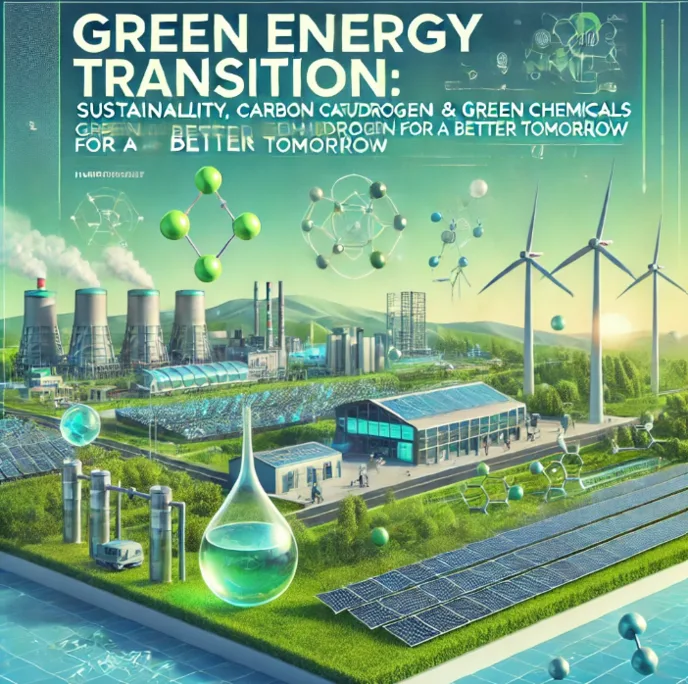
The Green Energy Transition: Sustainability, Carbon Capture, Green Hydrogen & Green Chemicals for a Better Tomorrow banner

The Green Energy Transition: Sustainability, Carbon Capture, Green Hydrogen & Green Chemicals for a Better Tomorrow

The Green Energy Transition: Sustainability, Carbon Capture, Green Hydrogen & Green Chemicals for a Better Tomorrow banner
Live online Intermediate

The Green Energy Transition: Sustainability, Carbon Capture, Green Hydrogen & Green Chemicals for a Better Tomorrow

4(400)
722 views
COMPLETED

Tell us and we’ll notify you when the next batch is scheduled.

30 hrs
-
English
722 views
Process Engineering World
  • 7-day money-back guarantee
  • Session recordings included
  • Certificate of completion

Why enroll

Comprehensive Knowledge: Participants will gain a thorough understanding of key concepts in green energy, including sustainability practices, carbon capture technologies, green hydrogen production, and green chemicals.

Practical Applications: The course emphasizes real-world applications, providing participants with the tools and techniques necessary to implement sustainable practices in their professional environments.

Expert Insights: Learners will benefit from insights and expertise from industry professionals, enhancing their understanding of current trends and challenges in the green energy sector.

Contribution to Sustainability: Participants will play an active role in promoting sustainability and addressing climate change, making a positive impact on their communities and the environment.

This course not only empowers individuals with knowledge but also enables them to contribute to a more sustainable future, making it a valuable investment in their personal and professional growth.

Is this course for you?

You should take this if

  • You work in Renewable & New Energy or Energy & Utilities
  • You're a Environment & Sustainability (ESG) / Chemical & Process professional
  • You have some foundational knowledge in the subject
  • You prefer live, instructor-led training with Q&A

You should skip if

  • You're looking for an introductory overview course
  • You need a different specialisation outside Environment & Sustainability (ESG)
  • You need fully self-paced, on-demand content

Opportunities that await you!

Career opportunities

Training details

This is a live course that has a scheduled start date.

Live session

Starts

Sat, Mar 22, 2025

2:30 PM UTC· your timezone

Duration

1 hour per day

30 days total

Why people choose EveryEng

Industry-aligned courses, expert training, hands-on learning, recognized certifications, and job opportunities-all in a flexible and supportive environment.

What learners say about this course

Avatar icon
Manish Kumar
Jan 8, 2026

Great

Balaji Paskanti
Balaji Paskanti mechanical engineer
May 3, 2026

Coming from software, this course reframed an old control problem the way refactoring a legacy service does: same constraints, clearer mental model. The walk through the ISA sizing equation, especially the Cv vs Kv example with water at 60°F, stuck because it mirrored how I sanity-check RPS assumptions in prod before a PR lands. I liked the section on flashing vs cavitation; the pressure drop chart felt like reading infra limits instead of hand-wavy arch talk, and it clicked fast. As a beginner track it mostly lands, though I wasn't sold on how briefly valve trim selection was handled; a few more edge cases would help folks crossing over from chemicalpharmaceutical or energyutilities. The pacing works for between-meeting study, and the exercises felt closer to CI checks than homework. I've already reused the sizing worksheet like a repo snippet, which is saying something.

Sachin Gowda
Sachin Gowda
May 3, 2026

Module 4 dragged a bit, and the homework assumes you’re already fluent in Excel Solver. That aside, the selection logic is what pulled me in: the decision trees for choosing shell-and-tube vs plate in Chapter 2, especially the LMTD vs ε‑NTU fork with the fouling factor example at minute ~18. As someone who thinks in arch diagrams and failure modes, mapping thermal constraints the way we map infra tradeoffs clicked. The counterflow vs parallel-flow section tied pressure drop back to maintenance in a way I’ve actually seen in chemicalpharmaceutical plants. it wasn’t fluffy, and it didn’t pretend everyone’s starting from zero. I’ve already bookmarked the pinch-temperature walkthrough for quick reference between meetings.

vijay cyprus
vijay cyprus Engineer
May 3, 2026

Needed material that wouldn’t fall apart under a PR-level sanity check, and this mostly held. The LMTD vs ε-NTU section, especially the shell-and-tube example where fouling factors changed sizing, stuck with me and maps well to how I think about legacy arch versus modern constraints. It connects old plant math to how I reason about infra tradeoffs in prod, even if the plate exchanger coverage felt light. still, it trimmed a lot of mental tech debt I’d been carrying from chemicalpharmaceutical work.

COMPLETED

-

Questions and Answers

A: Picking the wrong mechanism here gets you through commissioning and then cracks the shell months later, right under HSE observation. Oxygen plus degraded amine drives cracking rather than uniform wall loss, so corrosion allowance logic doesn't save you. Sulfidic and carbonic acid corrosion explain thinning, not cracking, and chloride pitting assumes a chloride source that isn't in the process envelope.

A: Choosing a high-strength grade looks tidy on paper and then fails by brittle cracking under pressure cycling. Dry hydrogen removes wet corrosion drivers, but atomic hydrogen still degrades toughness in stronger steels. CO2 corrosion and MIC need water, and high-temperature attack simply isn't active at ambient service.

A: Chasing the wrong cause here burns schedule while the stack degrades irreversibly. Dehydrated membranes raise ohmic losses, increase DP, and let oxygen leak into hydrogen. Poisoned catalysts or fouled cooling loops don't explain the pressure signal, and a downstream restriction doesn't drive voltage inside the stack.

A: Misreading this leads to the wrong trip logic and a wrecked compressor on day one. Surge happens before pressure relief acts, and the temperature and vibration spike fast enough to damage internals. Overpressure and releases are secondary, and lube oil issues come later if at all.