
<link href="https://fonts.googleapis.com/css2?family=Caveat:wght@500;700&family=JetBrains+Mono:wght@400;500;600&family=Source+Serif+4:ital,opsz,wght@0,8..60,600;0,8..60,700;1,8..60,700&display=swap" rel="stylesheet" /> Skip to main contentEngineering Courses, Mentoring & Jobs | EveryEng
Material Selection for Static Equipment banner

Material Selection for Static Equipment

  • ASME VIII Div.1
  • ASME Section IX
  • ASME VIII Div.2
Material Selection for Static Equipment banner
Live online Intermediate

Material Selection for Static Equipment

3(70)
4 views
FREE
Starts in
20d
08h
23m
02s
0 hrs
Oct 2, 2026 · 4:00 PM
English
4 views
Shanmugam V
Shanmugam VLead / Senior Mechanical Engineer/Static Equipment Engineer
  • Session recordings included
  • Certificate of completion
  • Interactive Video Lessons
  • Completion Certificate

Why enroll

Selecting the wrong material can lead to premature corrosion, cracking, leakage, unplanned shutdowns and costly equipment replacement. This focused one-hour course provides a practical understanding of how materials are selected for static equipment in the oil and gas industry.

Is this course for you?

You should take this if

  • You work in Oil & Gas Downstream or Oil & Gas Upstream
  • You're a Mechanical Engineering / Onshore Pipeline Engineering professional
  • You have some foundational knowledge in the subject
  • You want to build skills in Corrosion, Engineering & Design

You should skip if

  • You're looking for an introductory overview course
  • You need a different specialisation outside Mechanical Engineering
  • You need fully self-paced, on-demand content

Course details

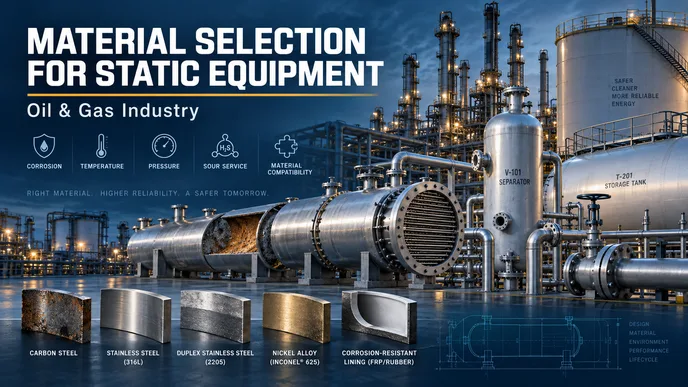
Provide a practical understanding of how materials are selected for pressure vessels, heat exchangers, storage tanks and associated static-equipment components based on service conditions, corrosion risks, mechanical properties, fabrication requirements, applicable codes and lifecycle cost.

Course suitable for

Key topics covered

Fundamentals of material selection for static equipment

Essential process and design inputs

Carbon steel, low-temperature carbon steel and alloy steels

Stainless steel, duplex stainless steel, nickel alloys and titanium

Corrosion allowance and design-life considerations

Material requirements for sour, chloride, hydrogen and low-temperature services

Solid alloy, clad plate, weld overlay, coatings and linings

Practical material-selection case study and common mistakes to avoid

Opportunities that await you!

Skills & tools you'll gain

CorrosionEngineering & DesignMechanical Maintenance

Career opportunities

Industry standards covered

ASME VIII Div.1ASME Section IXASME VIII Div.2

Training details

This is a live course that has a scheduled start date.

Live session

Starts

Fri, Oct 2, 2026

4:00 PM UTC· your timezone

Duration

1 hour per day

Why people choose EveryEng

Industry-aligned courses, expert training, hands-on learning, recognized certifications, and job opportunities-all in a flexible and supportive environment.

What learners say about this course

Sunil Pol
Sunil Pol
May 3, 2026

Our team’s been circling a few vessel design choices lately, so a beginner pass through this helped anchor the codes. The walk-through comparing ASME Section VIII Div 1 vs Div 2, especially the MAWP calc using joint efficiency Table UW-12, stuck because I could map it to checks we’d flag in an arch review. wasn't sold on how briefly fatigue is handled—would’ve liked a short bridge to Div 2 methods or FEA assumptions for oilgas cases. I'll keep this bookmarked for the next arch review.

Rajnikant Patel
Rajnikant Patel
May 3, 2026

Curriculum looked heavy on codes, but delivery stayed lean and to the point. The walk-through in the ASME Section VIII Div 1 chapter, especially the UG-27 shell thickness example with allowable stress tables, stuck because it mirrors the calcs I still see in prod reviews. It doesn't oversell Div 2, which is fine for a beginner track, though I wasn't sold on how lightly hydrotest considerations were handled. Rare to see training map this cleanly to day-to-day work in energyutilities—close enough to what lands in a PR.

Avatar icon
Muhammad Adnan Nasir
May 3, 2026

Came in expecting production‑grade patterns, but it’s framed for beginners and that’s fine. The ASME Section VIII Div 1 walkthrough, especially the UG‑27 thickness calc example with units spelled out, stuck because I can sanity‑check numbers during design reviews. it's practical enough to map to our review checklist in prod, though I wasn’t sold on how briefly fatigue got treated—wished there was a bit more on cyclic loads we see in energyutilities. I’ve already flagged a few assumptions to revisit on current vessels.

Amit Mishra
Amit Mishra
May 3, 2026

Useful refresher on pressure vessel material choices, especially the chapter walking through ASME Section II‑D allowables inside COMPRESS and the UCS‑66 impact exemption example—it matched decisions I make in client work. mostly practical, though I wasn't sold on the short treatment of corrosion allowance vs temperature; wished there was more on low‑temp service checks.

FREE

Oct 2, 2026 · 4:00 PM

Questions and Answers

Empty state icon

No questions yet - Be the first one to ask!