<link href="https://fonts.googleapis.com/css2?family=Caveat:wght@500;700&family=JetBrains+Mono:wght@400;500;600&family=Plus+Jakarta+Sans:wght@600;700;800&display=swap" rel="stylesheet" /> Skip to main contentEngineering Courses, Mentoring & Jobs | EveryEng
Thermal Analysis of Fin in ANSYS banner
Preview this course

Thermal Analysis of Fin in ANSYS

Thermal Analysis of Fin in ANSYS banner
Preview this course
Self-paced Beginner

Thermal Analysis of Fin in ANSYS

4(1581)
1047 views
₹ 199
55 min
Anytime
English
1047 views
Team EveryEng
Team EveryEngMechanical Engineering
  • 7-day money-back guarantee
  • Lifetime access
  • Certificate of completion
Volume pricing for groups of 5+

Why enroll

By the end of this course, participants will have the knowledge and skills necessary to proficiently analyze the thermal behavior of fins using ANSYS, enabling them to tackle complex heat transfer problems and optimize fin designs for various engineering applications.

Is this course for you?

You should take this if

  • You work in Aerospace or Energy & Utilities
  • You're a Mechanical Engineering professional
  • You prefer self-paced learning you can revisit

You should skip if

  • You need a different specialisation outside Mechanical Engineering
  • You need live interaction with an instructor

Course details

This course delves into the fundamental principles and practical applications of thermal analysis of fins using ANSYS software. Fins are integral components in various engineering systems designed to enhance heat transfer, and understanding their behavior is crucial for optimizing system performance.
Throughout this course, participants will gain a comprehensive understanding of heat transfer mechanisms, governing equations, and analytical methods related to fins. They will learn how to model different types of fins, analyze their thermal performance, and predict temperature distributions using ANSYS, a powerful finite element analysis tool widely used in engineering simulations.

Course suitable for

Key topics covered

  • What is Fin?

  • Need of fin

  • Why fin used?

  • Fin profiles

  • Finding the temperature distribution

  • Fin effectiveness

  • Fin Efficiency

  • Results

  • Velocity plot

  • Material Property

  • Thermal conductivity

  • Section Properties

  • Modeling the problem

  • Mesh Volumes

  • Boundary Condition on loads

  • Thermal temperature on Area

  • Convection

  • Dynamic Model Mode

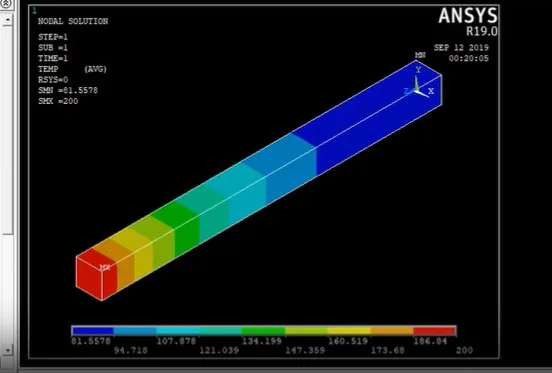
  • Solution of Nodal temperature

  • Heat flux

  • Path Operations

  • Plot Results

  • Temperature Distribution and thermal flux

  • Thermal Flux

  • Calculating the heat flux

Course content

The course is readily available, allowing learners to start and complete it at their own pace.

9 lectures55 min
  1. What is Fin And their Needs ?
    8 min
  2. Fin Efficiency and their Results
    5 min
  3. Steps Involved in FEA Analysis
    2 min
  4. Heat flux
    8 min
  5. Nodal Solution and path operations
    7 min
  6. Mesh Volume
    3 min
  7. Modeling the problem
    10 min
  8. Convection
    5 min
  9. Theoritical calculations
    7 min

Opportunities that await you!

Skills & tools you'll gain

ANSYS

Career opportunities

₹199

Access anytime

Questions and Answers

A: Higher h pulls more heat out, and it does it hardest near the base where conduction feeds it. That's why gradients sharpen there. Option B feels right if you've lived in lumped-parameter land, but fins aren't lumped and mesh sensitivity gets worse, not better. Option C mixes up directionality; stronger convection never raises tip temperature. Option D ignores the Biot logic — conduction limits don't mean immunity to boundary condition changes.

A: Aluminum's appeal is boring and that's why it survives reviews — known k(T), stable properties, and mountains of data. Copper tempts people with high conductivity, but mass, cost, and oxidation penalties catch up fast. Stainless solves a different problem and quietly kills heat transfer. The composite option looks modern, yet the missing temperature-dependent data will get you stopped cold by the authority.

A: Standards bodies care about validation, not brand names. Analytical fin solutions exist for a reason — they're the yardstick. Vendor certificates feel comforting but don't prove your setup is right. Residuals only say the math settled, not that it's right. Blanket safety factors without physical basis get stripped out fast during review.

A: The tip still carries gradient, just smaller. Coarsening it invites numerical wobble. Iterations don't fix spatial error, so B misses the root cause. Changing geometry to hide mesh error is a classic self-own. Ignoring it works until someone plots temperature contours and asks why they're jagged.