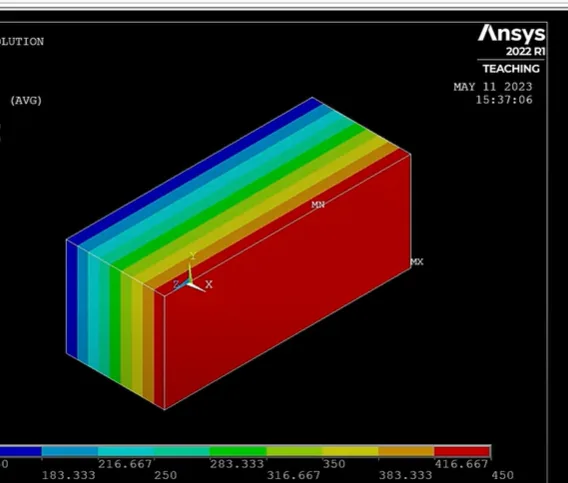
Thermal Analysis of wall in Ansys APDL
Thermal Analysis of wall in Ansys APDL

- Lifetime access
- Certificate of completion
- Foundational Learning
- Access to Study Materials
Why enroll
What enrolled engineers say
Initially, I wasn’t sure what to expect from this course, especially since most of my recent work has been more hands-on than simulation-heavy. The focus on thermal analysis of single and composite walls in ANSYS APDL ended up filling a real gap in my understanding, particularly around how conduction through layered materials is actually implemented in the solver. From an energy utilities perspective, the treatment of steady-state heat transfer and wall insulation performance was directly applicable to a district heating project I’m supporting. The course also tied in well with aerospace-style composite wall behavior, similar to what’s seen in equipment enclosures and secondary aircraft structures where thermal gradients matter. One challenge was getting comfortable with APDL commands for defining material properties and boundary conditions; a small syntax error can quietly throw off results. A practical takeaway was learning how to correctly extract heat flux and temperature profiles across wall thickness, which I’ve already reused to sanity-check a real model. The explanations around contact and layer definition helped clear up confusion from past trial-and-error work. It definitely strengthened my technical clarity.
Coming into this course, I had some prior exposure to the subject, mostly from steady-state heat transfer work in energy utilities. What was missing was a clean way to model multilayer walls in ANSYS APDL without relying on canned GUI workflows. The sections on composite wall conduction and applying convection boundary conditions were directly useful. A similar setup was later reused on a turbine enclosure insulation study, and the same logic also maps well to aerospace problems like fuselage panel thermal gradients during ground soak. One challenge was getting the boundary conditions right in APDL, especially separating heat flux inputs from film coefficients without over-constraining the model. Debugging element orientation and temperature-dependent material properties took more time than expected, but that mirrors real project work. The course didn’t hide those rough edges, which was helpful. A practical takeaway was learning how to script parametric wall thickness and material swaps, then post-process temperature drops and heat flow consistently. That filled a knowledge gap left by GUI-heavy tutorials. Overall, the content felt aligned with practical engineering demands.
At first glance, the topics looked familiar, but the depth surprised me. Coming from an energy utilities background, wall heat transfer is something dealt with often around boiler enclosures and insulated piping, but this course forced a more rigorous setup in ANSYS APDL. The sections on steady‑state vs transient conduction and how boundary conditions drive results were especially relevant. One area that filled a real gap was handling composite walls with multiple materials and contact interfaces. That’s something that also shows up in aerospace thermal protection panels, and seeing how to model layered conduction properly helped connect theory to practice. A challenge was getting the APDL scripting right for mesh control and thermal loads; small mistakes led to unrealistic temperature gradients, which took some trial and error to catch. The most practical takeaway was learning how to sanity‑check results using hand calculations before trusting the solver. That’s already been applied on a current plant retrofit study where wall heat losses needed quick validation. Overall, it felt grounded in real engineering practice.
Your instructor
Team EveryEng
Engineer
Mechanical Engineering
Is this course for you?
You should take this if
- You work in Manufacturing & Industrial
- You're a Mechanical Engineering / CAD & Analysis professional
- You prefer self-paced learning you can revisit
You should skip if
- You need a different specialisation outside Mechanical Engineering
- You need live interaction with an instructor
Course details
Course suitable for
Key topics covered
Course content
The course is readily available, allowing learners to start and complete it at their own pace.
- Single Wall Analysis5 min
- Composite Wall Analysis5 min
Opportunities that await you!
Skills & tools you'll gain
Career opportunities
Why people choose EveryEng
Industry-aligned courses, expert training, hands-on learning, recognized certifications, and job opportunities-all in a flexible and supportive environment.


 Aug 29, 2026