<link href="https://fonts.googleapis.com/css2?family=Caveat:wght@500;700&family=JetBrains+Mono:wght@400;500;600&display=swap" rel="stylesheet" /> Skip to main contentEngineering Courses, Mentoring & Jobs | EveryEng
Tire Design in CATIA V5 banner

Tire Design in CATIA V5

Tire Design in CATIA V5 banner
Self-paced Beginner

Tire Design in CATIA V5

4(1581)
14 enrolled
1482 views
FREE
17 min
Anytime
English
1482 views
Team EveryEng
Team EveryEngMechanical Engineering
  • Lifetime access
  • Certificate of completion
  • Foundational Learning
  • Access to Study Materials
Volume pricing for groups of 5+

Why enroll

Using CATIA V5's surfacing and solid modeling tools, students will explore methods for designing tire profiles, tread patterns, and sidewall contours to meet specific performance and aesthetic requirements. They will learn how to optimize tire designs for factors such as rolling resistance, noise reduction, and wet grip, balancing competing design objectives.

What enrolled engineers say

9 verified reviews
  • Feb 25, 2026

    This course turned out to be more technical than I anticipated. Coming from an automotive background, the focus on building a tire from the bead up in CATIA V5 filled a gap that usually gets glossed over in vehicle packaging work. The walkthrough of sidewall profiles, tread pattern features, and how they tie into load ratings and the contact patch was especially useful. There were also parallels to aerospace work I’ve done, particularly around tolerance stack‑ups and thinking about ply orientation in a way that’s not far off from composite laminate design. One real challenge was managing CATIA’s parametric relationships. A small change to a sketch dimension could break downstream surfaces, and it took a bit to understand how to structure the model so updates didn’t ripple out of control. That learning curve was frustrating but realistic. A practical takeaway was building a reusable tire template that can be quickly adjusted for different rim diameters and section widths. That’s already helped on an early-stage automotive concept where quick iteration mattered more than detailed FEA. The content felt aligned with practical engineering demands.

    Piyush P. Verified
  • Feb 25, 2026

    Initially, I wasn’t sure what to expect from this course. Coming from production automotive programs, beginner-level CAD content can feel abstract. That said, the walkthrough of tire architecture in CATIA V5 was grounded enough to be useful. Breaking the model down into tread, sidewall, and bead regions mirrors how we actually think about load paths and durability in vehicle programs. One challenge was managing parametric robustness. Small changes to section profiles caused downstream failures in the design tree, especially around the sidewall surfaces. That’s a real CATIA V5 pain point, and it would’ve helped to spend a bit more time on constraint strategy and edge cases, like extreme camber or low-pressure deformation scenarios. The discussion around ply angles and how they influence stiffness tied nicely into broader automotive topics like NVH and rolling resistance. There were also parallels to aerospace practices—fatigue life thinking and conservative geometry control felt familiar, even if the certification context is different. A practical takeaway was building a reusable parametric template for tire sections, which is closer to how industry teams work under time pressure. Overall, the course connects component-level design to system-level vehicle implications. I can see this being useful in long-term project work.

    Barış G. Verified
  • Feb 25, 2026

    Coming into this course, I had some prior exposure to the subject from automotive wheel-end projects, but not specifically tire modeling in CATIA V5. The walkthrough of tire cross‑section layout, bead geometry, and basic surfacing tools was useful, especially seeing how parametric constraints can be set up early to control section changes. That approach lines up with how we manage design intent in production automotive CAD, even if the examples stayed on the simpler side. One challenge was dealing with CATIA V5’s tree structure and sketch constraints—small mistakes there cascade quickly, and the course didn’t always call out those edge cases. Translating theoretical tire construction (ply angles, belt layers) into clean, editable geometry took more trial and error than expected. In industry, this is usually paired with downstream FEA and fatigue checks, similar to aerospace load‑envelope validation, which were only briefly mentioned. A practical takeaway was building a reusable parametric template for the tire section that can be adapted for different load ratings and rim sizes. From a system-level view, it helped reinforce how tire geometry affects suspension kinematics, contact patch behavior, and even certification margins. The content felt aligned with practical engineering demands.

    Karthik 1. Verified

Is this course for you?

You should take this if

  • You work in Automotive
  • You're a CAD & Analysis / Automobile Engineering professional
  • You prefer self-paced learning you can revisit

You should skip if

  • You need a different specialisation outside CAD & Analysis
  • You need live interaction with an instructor

Course details

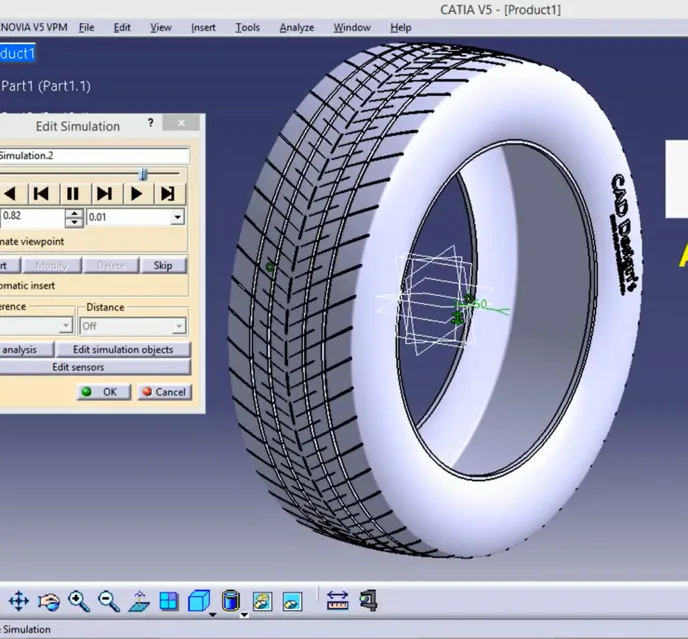
This course provides an in-depth study of tire design using CATIA V5, one of the most widely used computer-aided design (CAD) software in the automotive industry. Participants will learn the fundamental concepts of tire structure, including tread patterns, sidewall design, and bead configuration, and how these affect vehicle performance, safety, and ride comfort. The course covers advanced CATIA V5 tools and techniques for modeling tire geometry, creating parametric designs, and simulating tire behavior under different conditions. Students will gain practical skills in 3D modeling, surface design, and assembly integration of tires with vehicles. The training also emphasizes the importance of materials selection, durability, and compliance with automotive standards. Real-world case studies and hands-on exercises help learners bridge theoretical knowledge with practical applications. By the end of the course, participants will be able to design, analyze, and optimize tires efficiently using CATIA V5. This course is ideal for automotive engineers, designers, and CAD professionals seeking specialized expertise in tire design and development. Participants will also develop the ability to innovate and improve tire performance for modern vehicles, preparing them for challenging roles in the automotive sector.

Course suitable for

Key topics covered

  • Design a tire

  • Design a tire

Course content

The course is readily available, allowing learners to start and complete it at their own pace.

2 lectures17 min
  1. Design a tire
    8 min
  2. Design a tire
    9 min

Opportunities that await you!

Skills & tools you'll gain

CATIA

Career opportunities

FREE

Access anytime

Questions and Answers

A: Non-tangent guide curves crossing section planes create local surface kinks that look fine in CAD but blow up meshing; the red herring is blaming the offset thickness, which is usually robust if the base surface is clean.

A: Formulas tied to a pitch table survive pitch changes; the red herring is suppressed features, which juniors use but forget to revalidate, leading to mismatched pitch counts.

A: If draft is checked against the wrong pull direction, visuals lie and steel locks up; the red herring is the color scale, which gets blamed but isn't the root cause.

A: A master axis breaks update loops; the red herring is fixing the rim, which hides the issue until someone changes the spec and the model explodes.