Skip to main contentEngineering Courses, Mentoring & Jobs | EveryEng
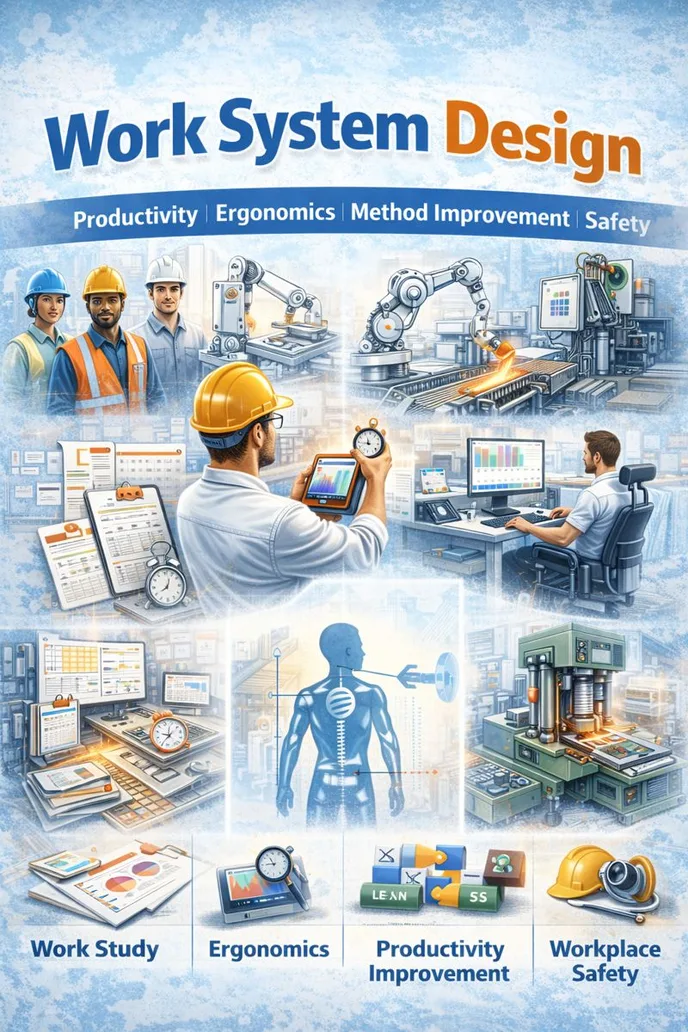
Work system design banner
Preview this course

Work system design

Work system design banner
Preview this course
Self-paced Advanced

Work system design

3(115)
322 views
FREE
930 min
Anytime
English
322 views

Engineering Academy
Engineering AcademyLearn Without Limits: Free Engineering Courses
  • Lifetime access
  • Certificate of completion
  • Anytime Learning
  • Learn from Industry Expert

Why enroll

Participants join this course to learn how to design and improve work systems that balance productivity, efficiency, safety, and human well-being. The course equips learners with practical and analytical tools to study work methods, measure performance, and develop optimized workflows that reduce waste, fatigue, and operational inefficiencies.

The program is especially valuable for students and professionals interested in industrial engineering, production management, ergonomics, and operations. Participants gain the ability to analyze real-world work environments, apply ergonomic principles, and design jobs and workplaces that enhance both employee comfort and organizational performance.

By joining this course, learners strengthen their problem-solving and decision-making skills and gain industry-relevant knowledge applicable to manufacturing and service sectors. The course also provides a strong foundation for advanced studies and professional roles in productivity improvement, lean systems, and human-centered system design.

Is this course for you?

You should take this if

  • You work in Mechanics & Turbomachinery
  • You're a Mechanical Engineering / Production Engineering professional
  • You have 3+ years of hands-on experience in this field
  • You prefer self-paced learning you can revisit

You should skip if

  • You're new to this field with no prior experience
  • You need a different specialisation outside Mechanical Engineering
  • You need live interaction with an instructor

Course details

Work System Design is a fundamental course in industrial and production engineering that focuses on the systematic design, analysis, and improvement of work systems to achieve high productivity, efficiency, safety, and worker well-being. The course integrates principles of ergonomics, work study, human factors, and operations management to develop optimized methods for performing tasks in manufacturing and service environments.

The course begins with an introduction to work systems and their components, including workers, machines, materials, methods, and the working environment. It emphasizes the importance of understanding human capabilities and limitations in designing effective work systems. Concepts such as anthropometry, biomechanics, physiological factors, and workplace ergonomics are covered to ensure safe, comfortable, and efficient job design.

Key topics include method study, work measurement, time study, standard time determination, and productivity analysis. Students learn to analyze existing work methods, eliminate unnecessary motions, and develop improved processes using tools such as process charts, motion study, and principles of motion economy. The course also addresses job design, work layout planning, and material handling systems to enhance workflow and reduce fatigue and delays.

In addition, Work System Design covers workplace safety, environmental factors, and quality of work life, highlighting their impact on employee performance and organizational effectiveness. Modern approaches such as lean manufacturing, work system optimization, and the use of digital tools for work analysis are introduced to align the course with current industrial practices.

By the end of the course, learners gain the skills required to design and evaluate efficient, safe, and human-centered work systems. The knowledge acquired is highly relevant for careers in manufacturing, operations management, ergonomics, industrial engineering, and productivity improvement initiatives.

source : NPTEL [youtube]

Course suitable for

Key topics covered

  • introduction to work system design

  • flow process charts

  • operation process charts

  • human aspects of work study

  • case study on productivity

  • productivity measures

Course content

The course is readily available, allowing learners to start and complete it at their own pace.

29 lectures15 hr 30 min
  1. Work System Design
    5 min
  2. Work System Design: Introduction
    30 min
  3. Work Study: Basic Concept
    31 min
  4. Techniques of Work Study
    38 min
  5. Flow Process Charts
    36 min
  6. Flow Process Charts: Examples
    32 min
  7. Two-Handed-Process Charts
    36 min
  8. Multiple Activity Charts
    34 min
  9. Operation Process Charts: Examples
    34 min
  10. Operation Process Charts
    35 min
  11. Method Study: Recording Techniques
    39 min
  12. Method Study: Steps
    33 min
  13. Method Study: Basic Concept
    38 min
  14. Human Aspects of Work Study
    36 min
  15. Concept of Work Content
    34 min
  16. Steps Involved in Work Study
    34 min
  17. Case Study on Productivity
    35 min
  18. Numerical Problems on Productivity
    28 min
  19. Productivity Improvement Technique
    35 min
  20. Causes of Low Productivity
    31 min
  21. Factors Influencing Productivity
    25 min
  22. Productivity Measurement Models
    28 min
  23. Productivity Measures
    26 min
  24. Measurement of Productivity
    35 min
  25. Introduction and Concept of Productivity
    33 min
  26. Development and Selection of New Method
    31 min
  27. Critical Examination Techniques
    38 min
  28. Installation and Maintenance of Improved Methods
    30 min
  29. Memo-Motion Study
    30 min

Opportunities that await you!

Career opportunities

Why people choose EveryEng

Industry-aligned courses, expert training, hands-on learning, recognized certifications, and job opportunities-all in a flexible and supportive environment.

FREE

Access anytime

Questions and Answers

A: The boundary definition is the tripwire here. B31.3 allows pressure testing by system, not by intent, and anything outside the documented test boundary is untreated risk. Visual condition or assumed shop tests don't close that gap. From a Lean startup view, restarting a test is wasteful, but running with an unverified boundary invites rework or worse.

A: Plan 32 lives or dies on flush quality and pressure margin. That's the threshold. Assuming Plan 11 or editing drawings doesn't change what's physically installed. Verifying the external flush conditions is fast, reduces startup churn, and aligns with first-pass yield thinking.

A: Wet H2S at low temperature pushes you into cracking risk, not wall loss. The hardness and stress threshold is what matters. Uniform corrosion and sulfidation sit in different operating windows, and chasing them burns inspection effort without payoff.

A: That 10°C bump shifts the map. Reduced density cuts developed head, pulling you closer to surge. Opening recycle feels counterproductive to throughput, but it's the move that protects the machine and avoids a longer outage.