
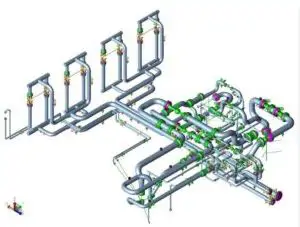
Advanced Pipe Stress Analysis Training with Caesar II | For Beginners & Engineering Professionals
Advanced Pipe Stress Analysis Training with Caesar II | For Beginners & Engineering Professionals

- 7-day money-back guarantee
- Lifetime access
- Certificate of completion
Why enroll
What enrolled engineers say
.
Coming into this course, I had some prior exposure to the subject, mostly from oil & gas brownfield work where pipe stress was handled by a separate team. That gap showed up whenever nozzle loads or thermal expansion questions came back during reviews. This training helped connect the theory with what actually happens inside Caesar II, especially around ASME B31 checks, support modeling, and static vs dynamic load cases. The sections on nozzle load qualification and dynamic analysis were directly relevant to a chemical/pharmaceutical utility project I’m currently on, where vibration and occasional relief valve loads are a concern. One challenge was the pace and length of the course—it’s long, and keeping focus through the advanced dynamic modules took effort. Still, working through full models instead of just slides made it stick. A practical takeaway was learning how small changes in restraint stiffness or support type can swing stresses and equipment loads. That insight was applied immediately on an energy utilities header reroute, avoiding an unnecessary expansion loop. The content felt aligned with practical engineering demands.
Initially, I wasn’t sure what to expect from this course, especially since Caesar II training often stays too theoretical. Coming from oil & gas and energy utilities projects, the gap was always translating ASME B31 basics into a clean, defensible model. This course spent time on that, particularly static load cases, restraint modeling, and nozzle load qualification, which showed up directly on a refinery revamp I’m currently supporting. The dynamic analysis section was tougher to get through. Modal concepts and response spectrum setup took a couple of replays, and balancing that with a live chemical/pharmaceutical plant support job was a challenge. Still, the explanations around when dynamic checks are actually required versus when they’re overkill were useful. One practical takeaway was a repeatable checklist for Caesar II model setup—supports, operating cases, and code stress checks—which is now being reused on a utility steam header analysis. The doubt-clearing session helped resolve a real question around expansion loop behavior rather than textbook examples. Overall, this filled gaps that day-to-day project pressure usually leaves untouched. The content felt aligned with practical engineering demands.
Your instructor
Anup Kumar Dey
Senior Piping Engineer
Owner of https://whatispiping.com/
Is this course for you?
You should take this if
- You work in Oil & Gas Downstream or Energy & Utilities
- You're a Piping & Layout Engineering / Mechanical Engineering professional
- You have 3+ years of hands-on experience in this field
- You prefer self-paced learning you can revisit
You should skip if
- You're new to this field with no prior experience
- You need a different specialisation outside Piping & Layout Engineering
- You need live interaction with an instructor
Course details
Course suitable for
Key topics covered
Course content
The course is readily available, allowing learners to start and complete it at their own pace.
- Introduction to Comprehensive Pipe Stress Analysis using Caesar II Software10 min
- What is Pipe Stress Analysis57 min
- Deciding Stress Critical Lines and Preparing Critical Line List30 min
- Inputs for Pipe Stress Analysis12 min
- Introduction-Basics of ASME B31.3 for a Piping Stress Engineer18 min
- Scopes and Exclusions8 min
- Why stress is generated in a piping system17 min
- Types of Stresses-Sustained, Occasional, Expansion10 min
- Pipe Thickness Calculation13 min
- Reinforcement Requirements5 min
- Code Equations and Allowables31 min
- 12.0 Introduction to Pipe Supports5 min
- 13.0 Role of Pipe Supports in Piping Design16 min
- 14.0 Types of Pipe Supports15 min
- 15.0 List of Pipe Supports29 min
- 16. What is the meaning of Pipe Support Spacing or Span?11 min
- 17. How to Support a Pipe16 min
- 18.0 Pipe Support Optimization Rules7 min
- 19.0 What do you mean by Pipe Support Standard8 min
- 20.0 Support Engineering Considerations16 min
Opportunities that await you!
Skills & tools you'll gain
Career opportunities
Why people choose EveryEng
Industry-aligned courses, expert training, hands-on learning, recognized certifications, and job opportunities-all in a flexible and supportive environment.
What learners say about this course

Came in needing a clearer mental model of the PSV discharge stack and how Caesar II treats it across cases. The section on setting up the relieving load case and checking nozzle loads on the example vertical stack stuck, especially the moment where the expansion loop flipped the governing stress; that’s a decision point I’ve seen argued in reviews. It's mostly beginner‑paced, which is fine for onboarding, though I wasn't sold on the brief coverage of thermal transients. Now I can explain the why behind calls I used to hand‑wave in infra discussions.

The section headers pulled me in, and the content mostly delivered without fluff. As a bootcamp grad filling gaps, seeing the UG-28 external pressure chart walked step-by-step with numbers for OD, t, and L stuck. The vacuum example where they flip from internal pressure intuition to buckling checks made it click, especially the note about corrosion allowance being ignored for collapse. I liked the quick asides that map this to prod checks or a PR review, even if it's not code. wasn't sold on the handwave around material selection; wished there was a bit more on how oilgas specs treat allowable stress under vacuum. Still, it cleaned up questions I've been half-ignoring for a year, and now I can sanity-check calcs before they hit a repo or CI.

This course turned out to be more technical than I anticipated. Coming from oil & gas and energy utilities projects, HDPE lines were often treated as “low risk,” especially for utility water and chemical transfer, so the deeper dive into viscoelastic behavior and long-term creep was overdue. The sections on thermal expansion, support spacing, and anchoring were especially relevant to a district cooling network job where HDPE headers were seeing unexpected movement. One real challenge was adjusting my thinking away from metallic piping assumptions. Load cases that work fine for carbon steel don’t translate cleanly to HDPE, and the time-dependent material behavior took some effort to model correctly in the software. There’s a bit of a learning curve there, particularly when combining pressure, temperature, and installation effects. A practical takeaway was a clearer method for checking allowable stresses over time and setting anchor locations to control growth without over-restraining the line. That’s already been applied on a small revamp at a utilities plant. The course filled a gap that normal pipe stress training doesn’t cover well, and I can see this being useful in long-term project work.

This course turned out to be more technical than I anticipated. Coming from oil & gas gathering systems and water utility networks, HDPE is often treated as a “flexible, low-risk” option, and that assumption gets challenged pretty quickly here. The sections on viscoelastic behavior, creep rupture, and thermal expansion were especially relevant when compared against how we normally handle carbon steel under ASME codes. One challenge was shifting away from metallic piping instincts. Boundary conditions and anchoring philosophy for HDPE behave very differently, and a few early exercises exposed how easy it is to over‑constrain the model and inflate stresses. The discussion on edge cases—like long above‑ground runs with temperature cycling or buried lines transitioning to pump stations—matched issues seen in energy utilities more than textbook examples. What stood out was the system-level implication of support spacing and restraint strategy. A practical takeaway was a clearer method for setting anchor locations and allowing controlled movement, instead of relying on rules of thumb used in industry. The software walkthroughs weren’t flashy, but they mirrored real project constraints and imperfect data. I can see this being useful in long-term project work, especially where HDPE is replacing steel without fully updating the design mindset.


 Aug 29, 2026

